Published 2026-08-31 · updated 2026-08-31
Learn to Learn — ඉගෙන ගන්න හැටි ඉගෙන ගන්න
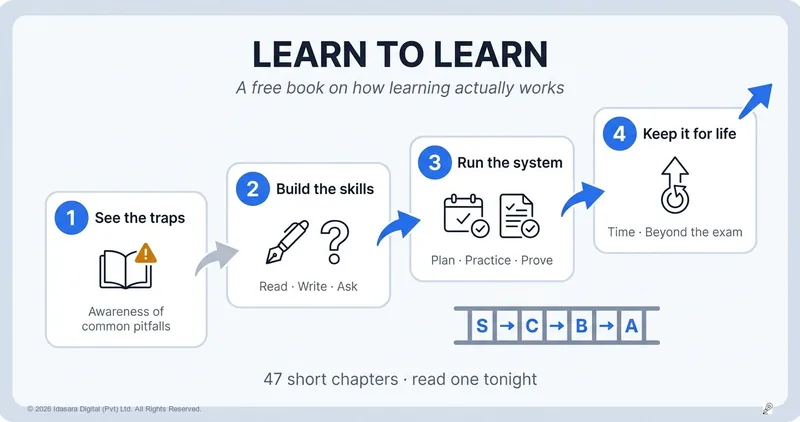
A free book of short chapters on how learning actually works — written for Sri Lankan students facing O/L and A/L, and for the parents and teachers beside them. Every chapter solves one real studying problem, tonight, with a pen, paper, and your textbook. Read it in order like a book, or jump straight to the chapter that names your problem.
Nobody teaches you how to learn.
School teaches you subjects — nine of them at O/L, three deep ones at A/L. Tuition teaches you the subjects again. But the skill underneath all of it — how to read so it stays, how to take a note that teaches you, how to know whether you're actually ready, how to climb from an S to an A — that skill is left to luck. And so thousands of hard-working students study late into the night with methods that quietly don't work, and conclude something false and cruel: "maybe I'm just not clever enough."
This book exists to end that conclusion. Its claim, defended chapter by chapter with a century of learning science: grades are made by method, not talent — and method can be learned. The students you call "naturally bright" are, almost always, students running better methods. This book hands you those methods, one short chapter at a time.
The journey runs in four movements. First, why learning feels hard — the traps built into every brain (familiar isn't known; most of today is forgotten by tomorrow) and the honest way out. Then the core skills of the daily loop: read properly, write notes that actually teach you, and ask — teachers, friends, and AI — in the way that gets real answers. Then the system around the skills: plan the syllabus so nothing is left uncovered, and prove it on paper — exercises, past papers, honest marking, and the mistake-hunting that manufactures an A. Finally, time and beyond: the schedule that survives a whole year, and why everything you build here — deep reading, clear writing, sharp asking — is exactly the skill the AI-age working world pays for, long after the exams end.
Every chapter stands alone, ends with a "do this tonight," works without any app, and links to the full Idasara Method for deeper reading. New chapters land regularly — save this page.
Where to start
- New to the book? Start with the first three chapters of Part 1, in order — then run Your First 7 Days, the one-week starter that assembles the whole method.
- Exam in a few months? Go straight to The Grade Progression Ladder, then past-paper volume, the Mistake Bank, what "exam ready" means, and the exam day playbook — with exam nerves and cramming vs consistency before you plan a single all-nighter.
- A parent? Start with How to Help Without Hovering and "I Never See You Studying", then what "exam ready" actually means, no app can learn for your child, and — when you're weighing the spend — what it costs and the phone question.
- A teacher? Start with What a Prepared Class Makes Possible and flipped learning.
- Met a term you don't know? The Glossary defines every tool this book names — Me Time, the Mistake Bank, the figure walk, and the rest — in one paragraph each.
Download the book — free
The whole book in four volumes — free PDFs, no signup needed.
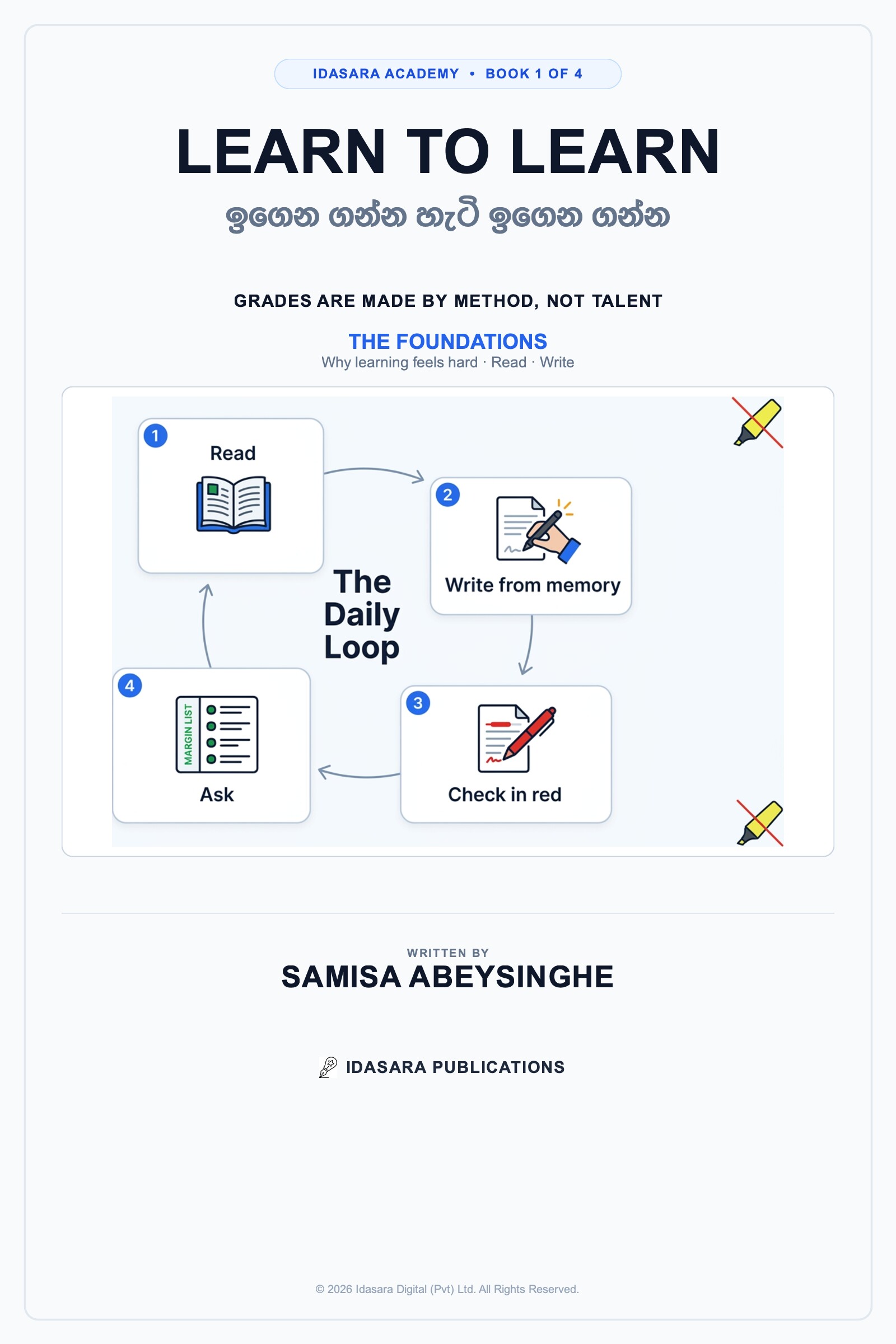
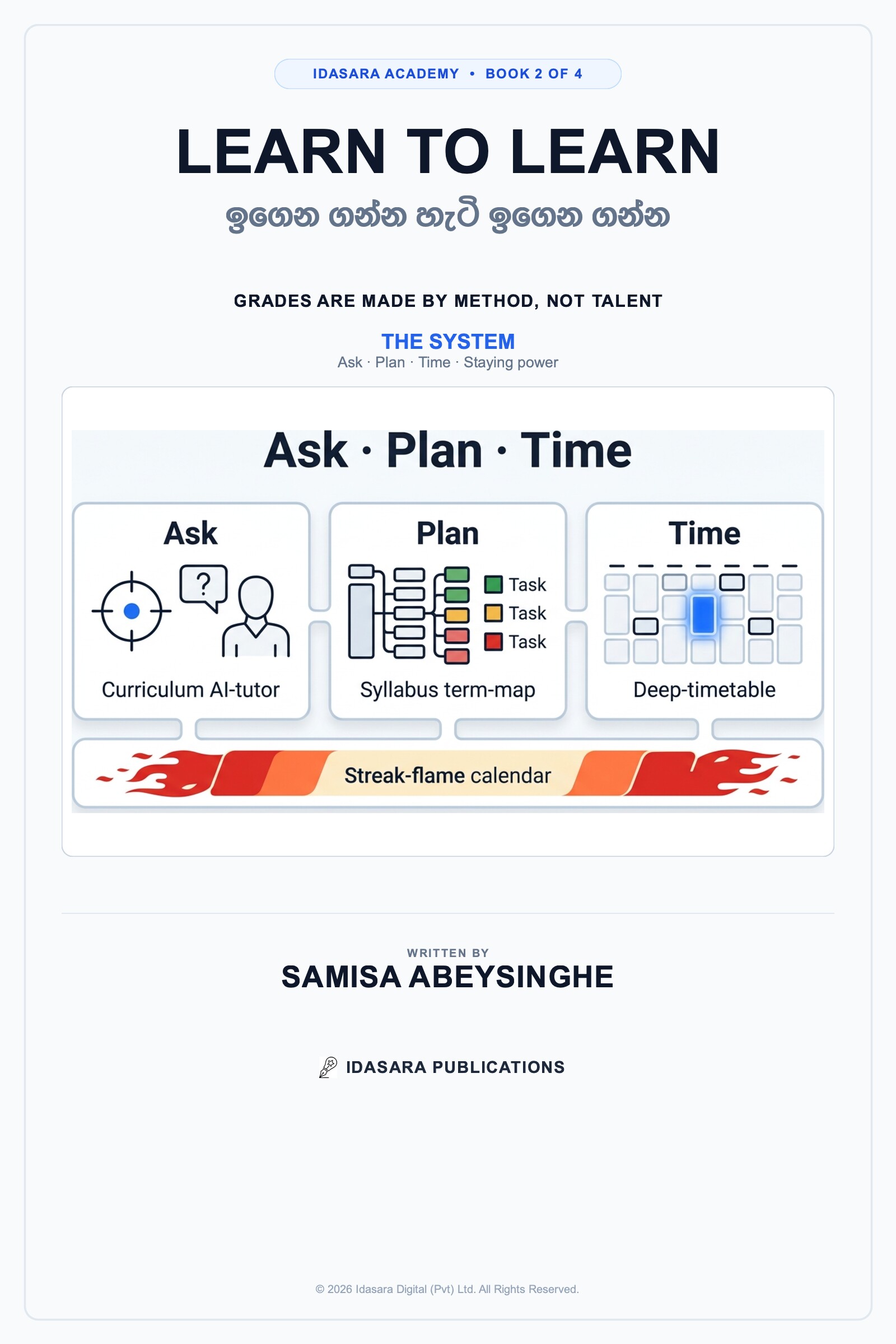
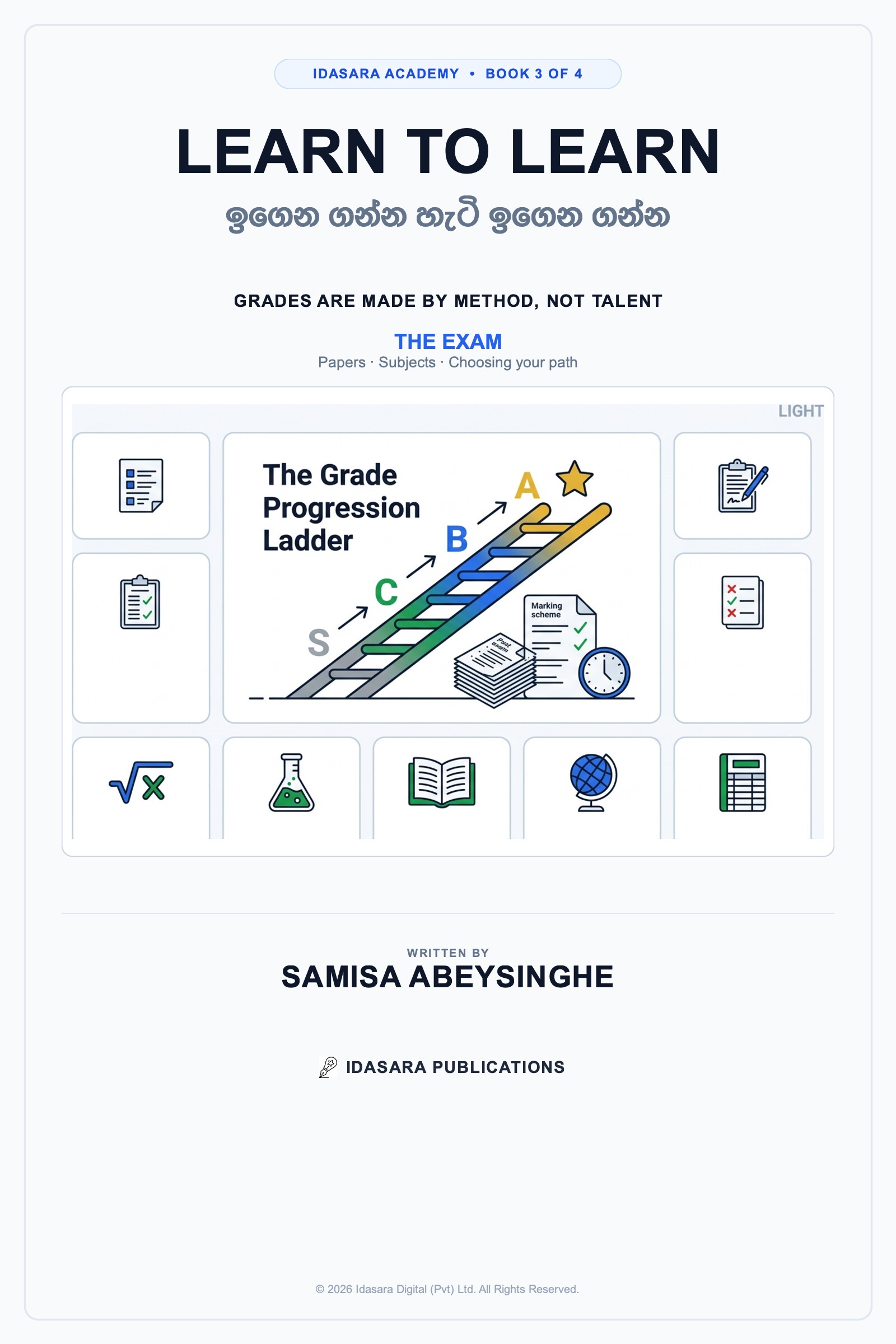
Part 1 — Why Learning Feels Hard
The traps every brain ships with — and why your effort was never the problem.
- Working Hard Isn't Working — and It's Not Your Fault — Why do I study all night and still panic in the exam?
- Me Time: The Hours That Decide Everything — Why do the hours alone with a subject matter more than any class?
- Clear While Reading, Blank While Writing: The Illusion of Competence — Why does the chapter feel clear but the blank page feel impossible?
- Why Highlighting Doesn't Work — Why doesn't my rainbow-coloured textbook turn into marks?
- You Lose Most of Today's Studying by Tomorrow — Why can't I remember what I studied three weeks ago?
- Grades Are a Ladder, Not a Lottery — Is an A pass talent, or a method anyone can run?
- No App Can Learn For You (Including Ours) — Will downloading an app fix my grades?
- Your First 7 Days — How do I actually start — without trying to change everything on one Monday?
- Motivation That Survives Monday — Why is motivation an output, not a fuel — and what's the machine?
- Study Groups That Actually Work — Why do groups fail at learning and shine at testing?
- "Everyone Is Better Than Me" — What do ranks actually measure — and which race are you really in?
- Subjects You Hate — Why is boredom usually difficulty in disguise — and how is interest built?
Part 2 — Read
Where the marks actually come from, and how to read so it stays.
- Why You Must Read the Textbook — Where do exam questions actually come from?
- Read, Then Read Fast — Why does reading speed decide marks — and why is "speed reading" the wrong answer?
- Read Even If You Don't Understand — Should I stop when a paragraph makes no sense?
- The Question Log — What do I do with "I just don't get it"?
- Read the Verb Before You Write a Word — Why did I lose marks on a question I knew?
- Studying in a Language You Don't Think In — How do I learn hard subjects in a language that isn't mine yet?
Part 3 — Write
Notes that teach you, and the hand that sits the exam.
- Why You Must Take Your Own Short Notes — Why can't I just study from my friend's notes?
- How to Take a Good Short Note — What does a note that actually works look like?
- How Mind Maps Make Your Short Notes Better — When does a map beat a list?
- Study in Pictures — Why does one drawn diagram outlast a page of sentences?
- The Figure Walk — How do I refresh a whole chapter in fifteen minutes?
- Why Clear Handwriting Matters — Does handwriting really change my marks?
- Write Fast, Yet Clear — How do I finish a three-hour paper without my hand giving up?
- Pen Beats Keyboard: What Brain Science Says — Why handwrite when I can type?
- The Red-Ink Audit — How do I know my notes aren't confidently wrong?
- How to Memorise Dates, Formulas and Vocabulary — Why won't the fact-lists stay in, and what actually works?
Part 4 — Ask
Getting real answers — from teachers, friends, and AI — without renting your knowledge.
- How to Ask a Good Question — Why do vague questions get useless answers, from teachers and AI alike?
- AI Is a Tutor, Not an Answer Machine — Is using AI to study cheating?
- The Exam Hall Has No Wi-Fi — Why does AI help vanish in a paper-based exam?
- Before You Trust Any AI With Your Exam — Why not just use free ChatGPT?
- One Hour, Two Skills: Prompt Packs — Can exam revision teach a career skill at the same time?
- The Skill Employers Will Pay For — What does tonight's studying have to do with my future job?
Part 5 — Plan
The syllabus as a contract — so no gap survives to the exam unseen.
- The Syllabus Is a Contract — How do I know I'll finish the syllabus in time?
- Term 1 Debt Is the Most Expensive Debt — Why do this term's lessons feel impossible? (Hint: it's an old gap talking.)
- What Is Time Management, Really? — Is it about studying more hours?
- Flipped Learning: Hear the Lesson Second — Why do toppers already know the lesson before class?
- The Night Before Class: Read, Question, Ask — What 20-minute ritual makes tomorrow's lesson worth double?
- Your School May Be Behind. The Paper Doesn't Care. — What if my class never reaches a section?
Part 6 — Practice & Prove
Where coverage becomes a grade: exercises, papers, honest marking, and mistake-hunting.
- End-of-Chapter Exercises, First, On Paper — What's the minimum practice that secures a pass?
- An Answer Is Worth Nothing Until Something Marks It Honestly — How do I know what an examiner would give me?
- The Grade Progression Ladder: C to B to A — What exactly do I do to move up one grade? (The book's operational heart.)
- Why 10 (or 20) Past Papers Is the Real Number — How many past papers are "enough"?
- Your Mistakes Are Your Syllabus — What should I revise tonight, specifically?
- Method Marks vs Accuracy Marks — Why did a correct answer get 2 out of 5?
- What "Exam Ready" Actually Means — How do I stop feeling ready and start knowing?
- Exam Nerves: What They Are, and What Actually Calms Them — Why does my mind go blank — and what genuinely helps?
- The Exam Day Playbook — From the night before to the final ten minutes: how do I run the day itself?
- The Bad Term Test: The 48-Hour Bounce — How does a bad mark become the year's best data purchase?
- Building Your Past-Paper Library — Where do papers and schemes actually come from — and how does a pile become a system?
- The Exam-Year Map — Every month has one job: the whole book, on one calendar. (The capstone.)
Part 7 — Time
The schedule that survives a whole year — and the weakest-subject arithmetic nobody warned you about.
- The Pomodoro Technique — Why do 25 focused minutes beat 4 distracted hours?
- Pair a Hard Subject With an Easy One — Why does one hard subject wreck my whole evening?
- Your Hardest Subject Deserves Your Best Hour — When should I study what?
- Nine Subjects Without Panic — How does an O/L student keep everything moving at once?
- Deep Work for A/L: The 90-Minute Block — Why can't I finish the long questions?
- The Z-Score: Your Weakest Subject Decides Your Seat — Why can't I just be brilliant at my best subject?
- Cramming vs Consistency — Can the last month save the year?
- Beating the Phone — You're not weak — you're out-engineered. Here's the counter-design.
- Sleep: The Unfair Advantage — Why is sleep when studying gets kept — and what's the teen number?
Part 8 — Beyond the Exam
What all of this was really building — for students, parents, and teachers.
- The Repeat Year: How to Do It Right — and How to Know If You Should — The results sheet disappointed. Now what?
- Learning to Learn: The Skill That Outlasts Every Exam — What survives after O/L and A/L are over?
- For Parents: How to Help Without Hovering — How do I support my child without adding pressure?
- "I Never See You Studying" — The blame cycle that breaks students — and the visibility that ends it. (Students: send this one home.)
- For Parents: What It Costs, What It Replaces, and the Phone Question — The payer's three questions, answered plainly.
- The O/L-Year Parent Playbook — The year has seasons; your job changes with them.
- Parenting an A/L Student — The job inverts: logistics and load-bearing, not supervision.
- Parenting From Abroad — The exam year across an ocean — on instruments, not guilt.
- Results Day at Home — The 24 hours families are quoted on for decades: rehearse them.
- The Family Education Budget — Rupees follow diagnosis — plus the predator checklist.
- Money Skills for Students — The study engine, pointed at rupees.
- Find Your Mentor — One consenting adult changes a study year — and the ask that gets a yes.
- For Teachers: What a Prepared Class Makes Possible — What changes when students arrive already knowing the basics?
- Reading and Writing in the AI Age — Will these "old" skills still matter in my child's career?
Part 9 — Subject Playbooks
How to study each subject family — the method per subject, never the content.
- How to Study O/L Maths (and stop fearing it) — Why doesn't watching solutions work — and which doors does maths guard?
- How to Study Science — Where do Science marks actually hide?
- How to Study O/L English — Why can't grammar books fill the essay box?
- How to Study History, Civics & Essay Subjects — Why do both the memoriser and the storyteller score C?
- How to Study the A/L Science Stream — What weekly architecture keeps three deep subjects alive?
- How to Study A/L Commerce & Arts — What kind of subject are you actually holding?
Part 10 — Choosing Your Path
The decisions after each results sheet — made by evidence, not by neighbours.
- After O/L: Choosing Your Stream — Which stream — decided by evidence, gates, and destination, in that order?
- Choosing Your A/L Combination — Which doors does your keyring silently lock?
- Choosing Your O/L Electives — The Friday form that's really a three-year fork.
- After A/L: The University Question, Honestly — What are the five doors — and what are the waiting months for?
- Pick the Career, Then Walk Backwards — Why does destination-first beat prestige-forward?
- The NVQ Road: A Real Path, Fully Mapped — Seven levels to a state degree — why does nobody tell families this?
- Scholarships and Funding — Why does the money go to systematic applicants?
- Earn While You Learn — How does working inside a path beat working instead of one?
Part 11 — Hard Mode
For access-constrained homes and comeback students — studying with less, starting from behind. The book's heart.
Access - Studying on Little Data and Weak Signal — Why is the method offline-first, and how does the weekly supply-run work? - No Quiet Room: Studying in a Full House — How is quiet manufactured from time, place, and negotiation? - No Tuition in My Area: The Self-Study Year — How are tuition's three services rebuilt from reachable parts? - The Free Education Stack — What does the zero-rupee student actually have? (Everything that matters.) - Studying While Working or Caring — The broken-day method: fragments, anchors, and the negotiated floor. - One Phone, Whole Family — How does a timetable end the nightly fight over the shared device?
The Comeback - Starting From S and F: The Comeback Protocol — Why do comebacks start below the syllabus — and how fast is the road back? - Maths From Zero — For the student who was "never a maths person" (no such gene exists). - If Reading Itself Is Slow — The on-ramp for the skill hiding inside every other struggle. - The First 30 Days of a Turnaround — Why the midnight vow fails, and how momentum is actually engineered. - Six Months Left: The Honest Rescue — The triage order that buys marks by price.
About this book
Learn to Learn is published free by Idasara Academy, in English, Sinhala, and Tamil. It is the student-facing companion to the Idasara Method — the full scientific framework behind these chapters: Part 1 — The Human Foundation · Part 2 — The Plan · Part 3 — The Papers · Part 4 — Time.
Every claim in these chapters is grounded in published learning science — sources are cited at the end of each chapter. Every method works with a pen, paper, and the official textbooks. The Idasara Academy app exists to make the method a daily habit; the method itself is yours, free, starting tonight.
FAQ
Do I need to read the chapters in order? No — every chapter stands alone and tells you where it connects. In-order reading gives the full arc (traps → skills → system → time → life); problem-first reading works just as well. Most readers do both: one pass by problem, one by order.
Is this only for O/L and A/L students? The examples are Sri Lankan national exams, because that's who we serve first — but the methods (retrieval, spacing, honest feedback, error elimination) are universal learning science. Grade 6 to university, the engine is the same.
Is the book really free? What's the catch? The book: free, all of it, in all three languages — because the method working is the best introduction to what we build. The app: free to start, a paid plan from Rs 3,000 a month covering all subjects together rather than one, and the full engine — handwritten answers marked, the readiness picture — from Rs 4,500 (Rs 9,000 at A/L). Every new account opens with 42 days of that full engine, free, so you can judge it before paying for it. It works fully in Sinhala, Tamil and English, at academy.idasara.org. Each chapter ends with one optional step in it; no chapter ever depends on it.
How often do new chapters appear? The book grows in waves — follow Idasara Academy's channels or check this shelf. The full map is above; chapters go live wave by wave, so a title without a link is simply still coming.