Choosing Your A/L Combination: Check Every Door Before You Turn the Key
The short answer: List ten to fifteen courses and paths you might actually want, look up each one's required subjects in the current official admissions handbook (the UGC's annual publication, via your school), and choose the combination — third subject included — that opens the most doors you value. Requirements are written in named subjects, and eligibility is checked before any ranking, so a missing subject closes a door quietly.
A chapter of the free book Learn to Learn
Published 2026-08-31 · updated 2026-08-31
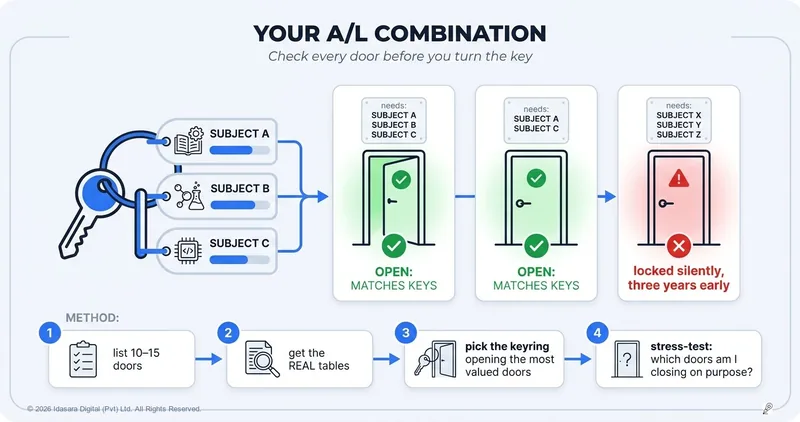
Inside each stream hides a second decision families treat as an afterthought: the exact three-subject combination — and combinations lock doors silently, years before you knock on them. This chapter of Learn to Learn gives the combination method: list the doors first, check each door's required key, and only then pick the third subject everyone else picks by rumour.
Here is a small tragedy that repeats every year, in every district.
A student finishes A/L with a genuinely good result — and discovers, at the university application stage, that the course they'd quietly dreamed of requires a subject they didn't take. Nobody lied to them. Nobody warned them either. The door was locked three years earlier, in a fifteen-minute conversation about "which third subject is easiest," and the lock made no sound.
The stream chapter picked your river; this one is about the exact boat. Combinations matter because admission requirements are written in subjects, not streams: courses ask for these named subjects, sometimes at named grades. The combination you register is a keyring — and the whole method is to inventory the doors before cutting the keys.
How do you choose a combination? Doors first, keys second
Step 1 — List your plausible doors, generously. Not just the dream course: the realistic alternatives, the adjacent fields, the "maybe" paths — ten to fifteen doors is a healthy list, drawn from the careers-backwards chapter's walk. At sixteen you cannot know your one destination; that's exactly why the combination should keep clusters of doors open, not bet everything on one.
Step 2 — For each door, find the required key — from the source. Course entry requirements live in the official admissions handbook (the UGC's annual publication — get the current one through your school; the private and professional institutions publish their own). This is the step families skip and rumours replace: "Bio opens medicine" is a rumour's version of a requirements table. Write the actual subject requirements next to each door. Twenty minutes with the real tables beats three years of assumption.
Step 3 — Choose the combination that opens the most doors you actually value. Usually the first two subjects choose themselves within a stream; the battle is the third subject — and here the method earns its keep, because the popular heuristics are all wrong:
- "Take the easiest third" — easiest for whom? Subject difficulty is personal (your evidence profile again), and "easy" subjects with huge cohorts can be brutal Z-competition.
- "Take what my friends take" — the class group is a real comfort, and a terrible reason to lock doors.
- "It doesn't matter, only the Z matters" — the Z gets you ranked; the subjects get you eligible. Both gates must open.
The right third subject is the one that (a) appears in the requirement tables of doors you value, (b) your evidence says you can perform in, and (c) you can survive Tuesday-nights with for two years. In that order.
Step 4 — Stress-test before you sign. Two questions to the finished combination: "Which of my listed doors does this keyring NOT open?" — name them consciously; closing doors is allowed, but only on purpose. And "if my number-one door doesn't open (the Z falls short), what does this combination reach instead?" — a good combination degrades gracefully into its neighbouring doors; a fragile one leaves a strong result with nowhere to go.
Special cases worth naming
The Technology stream's third subject is a genuine strategic choice (English, ICT, Economics and others pair with the two technology cores) — the door-tables differ meaningfully between them; run the method, don't take the default. Aspiring professionals (law, accountancy, banking): many professional paths care about results and English more than specific subjects — check the professional bodies' actual entry rules before assuming a stream owns them. And the maths-in-Commerce question: combinations with stronger quantitative subjects open management and finance doors that softer triples don't — check before choosing comfort.
One honest boundary, as always with rules that change: requirement tables are living documents — courses adjust them. The method's answer isn't to memorise this year's tables but to decide from the current ones and re-verify at application time. What never changes is the direction of the error: students err by checking too late, never by checking too early.
Do this week
- Build the door list (10–15, generous) with the careers-backwards walk.
- Get the current requirements tables through your school; write each door's key beside it.
- Draft your combination; run the two stress-tests; name the doors you're consciously closing.
- Only then, the family conversation — with the door-table on the table.
At a glance
- Combinations lock doors silently: admission requirements are written in named subjects — the keyring is cut years before the knock.
- Method: doors first (10–15, generous) → keys from the source (current official tables via your school, never rumours) → combination that opens the most valued doors → stress-test (which doors am I closing? how does it degrade if the Z falls short?).
- The third subject is the battle: not the easiest, not the friends', not "doesn't matter" — the one in your valued doors' tables that your evidence supports.
- Closing doors is allowed — only on purpose.
- Re-verify tables at application time; they're living documents.
One step further with Idasara Academy
This method is built into the tools, free to start: the A/L combination planner walks the doors-and-keys check before you lock anything, and the Degree Explorer runs Step 1's generous door-listing from the career side. Fifteen rumour-driven minutes replaced by an evening with real tables — the cheapest insurance in your A/L years.
Start Free — Create Your Account →
FAQ
I've already registered a combination and this chapter worries me. Too late? Run the method now anyway: most students discover their combination opens more than they knew (relief), and early-discovery of a genuine mismatch is exactly when schools can still process changes. The repeat of the stream chapter's rule: switch early and deliberately, or settle in informed.
My school offers a limited set of combinations. What then? Run the method over the available keyrings — it still ranks them by doors-opened, and it tells you honestly what each closes. Where the gap to a valued door is severe, that's a family conversation about schools, held now rather than at application time.
Do universities really reject strong Z-scores over a missing subject? Eligibility is checked before ranking — the requirements table is a gate, not a preference. That's precisely why this chapter exists: the system tells you its keys in advance, in writing, every year. Read them.
How much should the third subject's "scoring reputation" (easy A) matter? Less than the rumour-market thinks: scoring runs through the Z's relative machinery (each subject standardised against everyone who sat it), cohort strength shifts year to year, and your own evidence-fit swamps subject reputation. Doors and evidence first; reputation as a tiebreaker at most.
Further reading
The door-listing walk: Pick the Career, Then Walk Backwards. What the Z does and doesn't decide: The Z-Score. The stream context: After O/L: Choosing Your Stream.
Sources
- Trinity College Kandy — A/L stream & subject guidance (combination structures; verify current circulars)
- StudentLanka — Guide to NVQ in Sri Lanka (the doors beyond university tables)
- The Idasara Method: Part 3 — The Grade Progression Ladder & Paper Marking (evidence profiles)