Pick the Career, Then Walk Backwards
The short answer: No degree "leads to" a job on its own — the walk goes the other way. Name the career you actually want, find the credential that reaches it, then let that choose your stream and subjects; one page of backwards walking plus a conversation with someone doing the work beats every brochure.
A chapter of the free book Learn to Learn
Published 2026-08-31 · updated 2026-08-31
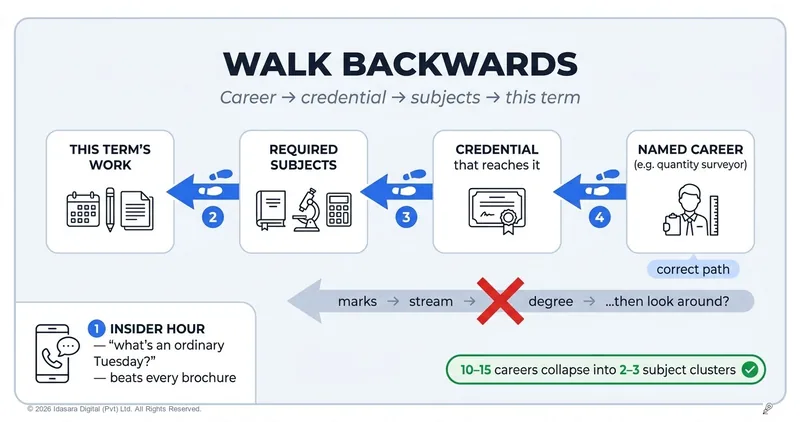
Sri Lankan students navigate forwards — good marks → good stream → good degree → then look around for what jobs exist — and discover at twenty-four what they could have known at fifteen. This chapter of Learn to Learn teaches the reverse walk: start from real work you'd want, walk backwards through the credentials that reach it, and let the walk choose your subjects — plus the one research tool that beats every brochure: a conversation with someone already there.
Ask a Grade-10 student why they're aiming for the science stream and listen to the answer: "to get a good degree." Ask which degree: "engineering, maybe medicine." Ask what an engineer actually does all Tuesday: silence.
That silence is the forward-navigation problem. Forward navigation optimises each step by prestige — best available stream, best available degree — and defers the only question that matters (what work will I actually do and want?) until after every fork has been taken. It produces the country's quiet epidemic: graduates holding hard-won credentials that lead somewhere they never chose.
The fix is mechanical, and younger is better: navigate backwards. Destination → credential → subjects → this term's work. Four steps, one page.
Step 1 — Collect destinations, widely and concretely
Not "a good job" — named work: quantity surveyor, software engineer, physiotherapist, accountant, teacher, agri-entrepreneur, naval officer, UX designer. Collect ten to fifteen candidates, deliberately wider than your family's default three (doctor-engineer-accountant is a menu, not the market). Sources for collecting: what adults around you actually do (asked properly — see Step 3), fields attached to subjects you enjoy, and the career-exploration tools that list work you've never heard named. At fifteen, breadth is rigour — you cannot want what you've never seen.
Step 2 — Walk each one backwards on paper
For each candidate, three questions fill one line each:
- What credential reaches it? Degree (which, from where)? Professional qualification? NVQ track? Several routes? (Most careers have more routes than the prestige lens shows — the five-door chapter's point, applied per career.)
- What does that credential require? The named A/L subjects and grades (the combination chapter's tables), or the entry rules of the professional body or vocational track.
- So what does it ask of me now? Which stream, which subjects, what evidence level — this term's version of the destination.
Fifteen careers walked backwards collapse, reliably, into two or three subject clusters — and suddenly the stream and combination decisions stop being identity crises and become table lookups: choose the cluster that covers the most destinations you'd actually want. That's the whole trick: backwards walking converts "who am I?" into "which bridge covers my map?" — a question a teenager can actually answer.
Step 3 — The insider conversation: one hour that beats every brochure
Every destination on your shortlist deserves the research no website provides: one conversation with someone doing the work. An aunt's colleague, a past pupil of your school, a neighbour, a parent's contact — Sri Lankan networks reach almost every profession within a few introductions if you ask out loud.
Ask the questions brochures never answer: What's an ordinary Tuesday, hour by hour? What did you only learn after entering? What kind of person thrives here — and who gets miserable? Would you choose it again? What's the honest money path, early years included? One such hour routinely deletes a fantasy destination or elevates an ignored one — the highest-value research a student can do, and it costs a phone call and some courage. (Do it with the asking chapter's craft: precise questions, gratitude, notes written up the same evening.)
Step 4 — Hold it all loosely, re-walk yearly
The honest caveat that keeps this method from becoming a new prison: you are not choosing a life at fifteen — you are aiming one. Destinations will change as you grow and as the market moves (the AI-age chapters are clear on how much); the walk's output isn't a vow, it's a bearing — and clusters, not single careers, are what you steer by, because clusters survive changes of heart. Re-run the one-page walk each year: twenty minutes to check the bearing against the person you're becoming. The students in trouble were never the ones who changed destination; they're the ones who never had one.
Do this month
- Collect the fifteen destinations — family survey, subject-adjacent fields, an explorer tool. Names, not categories.
- Walk each backwards: credential → requirements → what-it-asks-now. One page.
- Find the clusters; hold them against your evidence profile (the stream chapter's Question 1).
- Book two insider conversations. Actually book them — this step is where the method becomes real.
At a glance
- Forward navigation (marks → stream → degree → then look around) defers the only real question until every fork is taken. Walk backwards: destination → credential → subjects → this term.
- Collect 10–15 named careers — breadth is rigour; you can't want what you've never seen.
- The walk collapses careers into subject clusters — turning "who am I?" into "which bridge covers my map?"
- One insider conversation beats every brochure: the ordinary-Tuesday question, the would-you-again question.
- Hold it loosely; re-walk yearly. A bearing, not a vow — clusters survive changes of heart.
One step further with Idasara Academy
The backwards walk is literally what the free Degree Explorer does — start from careers and trace back through degrees to requirements — with path comparison cards putting the routes side by side, evidence-cited. Step 2's paperwork, automated; your part is Step 3's phone call, which no app will ever replace.
Start Free — Create Your Account →
FAQ
My parents have already chosen my destination. What does the walk do for me? Run it anyway — twice. Walk their destination backwards honestly (sometimes it's a better case than the conflict suggests), and walk yours. The two one-pagers turn a loyalty fight into a comparison of maps — the winnable version of the conversation, especially with an insider hour behind each.
What about careers that barely exist yet — AI-era work? Exactly why you steer by clusters and keep the engine: new careers attach to existing clusters (quantitative, expressive, technical, care) far more than they invent new ones, and the lifelong-learning chapter's machinery is your hedge against the genuinely unforeseeable. Bearing plus engine beats prophecy.
Nobody in my family's network does the work I'm curious about. (rural readers especially) Widen the definition of network: past pupils of your school (teachers know them), the professional's institution itself (a polite letter gets more replies than students expect), and structured mentor programmes. The mentor chapter makes this a full method — the first insider is the hardest; they know the second.
Doesn't this pressure children into careerism too young? The opposite, done right: the walk removes pressure by replacing a vague, unarguable "your whole future!" with a small, revisable page. Children are already carrying the forward-navigation pressure — this just gives them a steering wheel to hold instead.
Further reading
Where the walk's output lands: Choosing Your Stream · Choosing Your A/L Combination · The NVQ Road. The conversation craft: How to Ask a Good Question.
Sources
- StudentLanka — Guide to NVQ in Sri Lanka (routes beyond degrees, per career)
- UNESCO — AI and education (why clusters + the learning engine beat single-career prophecy)
- The Idasara Method: Part 2 — The Plan