Part 2: The Plan — Syllabus Coverage & Flipped Learning
Layer 2 of The Idasara Method: the 3-term syllabus roadmap, your syllabus contract and term tracker, and the flipped classroom that puts you ahead of school and tuition.
Layer 2: The Plan (Syllabus Coverage & Flipped Learning)
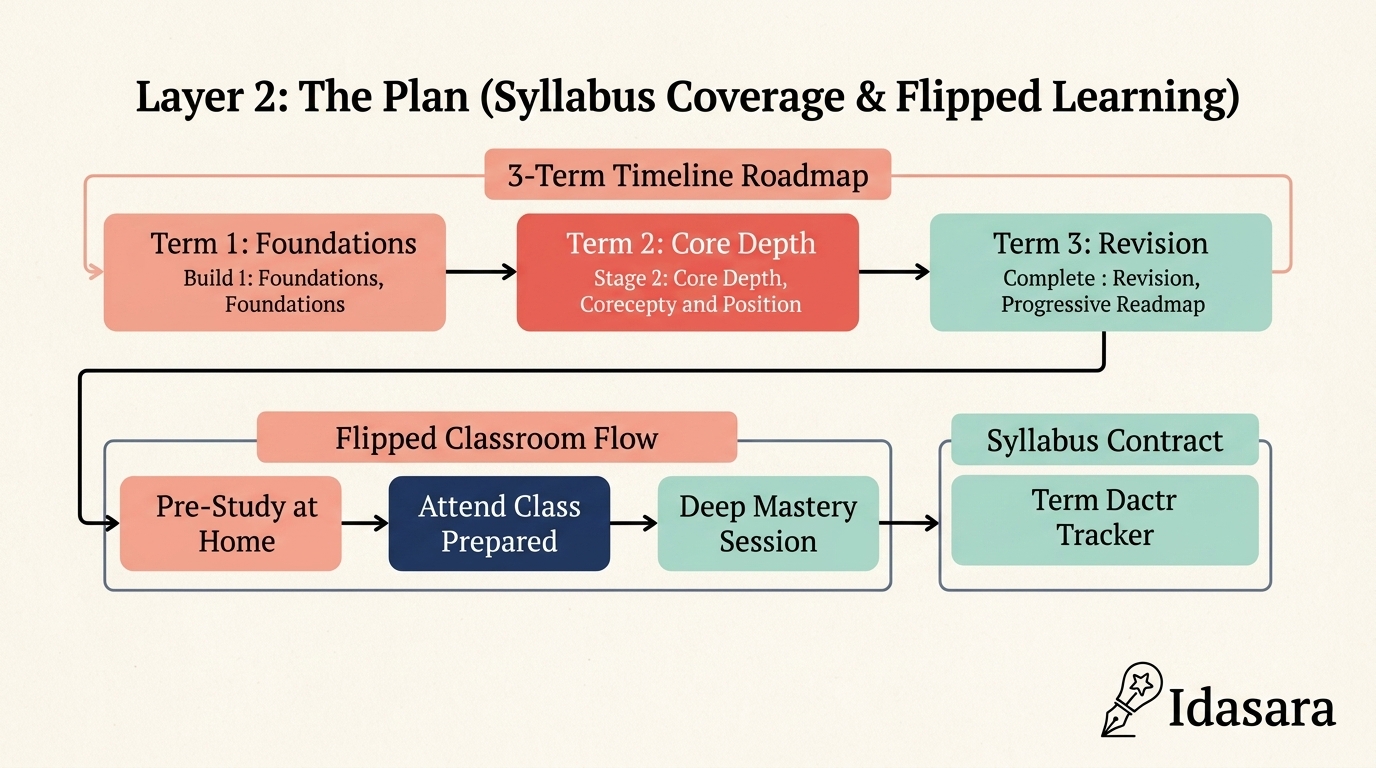
1. Step 10: Know the Map — Control Your Syllabus Coverage Timelines
A primary cause of pre-examination anxiety is the creeping realization that time is running out while major sections of the syllabus remain unstudied. Students frequently ask: "How can I be sure I am covering enough material to pass with distinction?"
In national examinations (both GCE Ordinary Level and GCE Advanced Level), examination boards construct papers that test the entire national syllabus. Questions are mathematically distributed across all three academic terms.
If you enter an examination hall having covered only 70% of your syllabus topics, your maximum achievable mark is capped at 70%—even if your performance on those covered topics is flawless. This makes an A pass statistically unlikely and leaves you highly vulnerable to difficult questions.

Visualizing Syllabus Velocity
In Idasara Academy, every subject's lesson outline in the Short Notes tool explicitly structures the syllabus across Term 1, Term 2, and Term 3:
- O/L Subjects (Grades 10–11): All 9 subjects are mapped term-by-term, giving you a clear visual indicator of completed versus remaining topics across your entire subject portfolio.
- A/L Streams: Your 3 stream subjects (e.g., Combined Mathematics, Physics, Chemistry) are structured across the full two-year academic timeline.
By monitoring these term markers, you maintain total control over your syllabus velocity. You no longer have to guess whether you are on schedule. If you notice a Term 2 topic unstudied while your school reaches Term 3, you can use the app's daily plan to bridge the gap immediately.
2. The Syllabus Contract & Term Tracker
Knowing the map is not the same as holding yourself to it. The plan only works if it is written down, dated, and checked.
Your Syllabus Contract
Open the lesson outline for your grade in Short Notes. It lists every topic your national syllabus expects, already grouped into Term 1, Term 2 and Term 3. That list is not a suggestion — it is the examinable universe, and the paper will be built from it.
Treat it as a contract you sign with yourself at the start of the year:
- Term 1 — Foundations. The topics that everything later depends on. Falling behind here is the most expensive debt in the whole year, because every Term 2 topic assumes you have them.
- Term 2 — Core Depth. The heaviest marks in most subjects. This is where a student who is on schedule pulls decisively ahead of one who is catching up.
- Term 3 — Advanced & Revision. The last new material, then consolidation. A student still learning Term 1 content in Term 3 has already lost the A.
Your Term Tracker
The contract is only enforceable if you can see where you actually are against where you should be.
- Check coverage weekly, not monthly. Open the term list and mark what is genuinely finished — finished meaning you have completed the full 7-move loop on it, not that you have heard of it.
- Compare against the calendar, not against your class. Your school may itself be behind. The syllabus does not care.
- Act on a gap in the week you find it. A single unstudied Term 2 topic discovered in March is one evening's work. The same gap discovered in Term 3 competes with revision, past papers and every other subject at once.
You want to find out about a gap in March, not in the examination hall. That is the entire purpose of Layer 2: the loop from Layer 1 is useless if you finish it in November.
3. Step 11: Run Ahead of Class — The Flipped Classroom

The most successful students do not treat school or private tuition classes as the place where they hear about a topic for the very first time.
If you sit in a classroom with zero prior knowledge of the lesson being taught, your brain spends all its cognitive energy attempting to grasp basic definitions, terms, and initial formulas. You leave the class with incomplete notes and unresolved doubts, forcing you to re-learn the entire topic from scratch at home.

How to Execute Ahead-of-Class Mastery
- Self-Paced Pre-Study at Home: Use your national textbooks, handwritten short note routine, and Idasara's Short Notes and Ask AI tools to study upcoming syllabus lessons before your school teacher or tuition tutor covers them in class.
- Clear the Basics Early: Use Ask AI to resolve foundational definitions, simple worked examples, and basic diagrams at home.
- Attend Class Prepared: When your teacher begins the lesson in school or tuition class, you are not struggling to keep up. You are validating what you already know, following advanced problem-solving steps effortlessly, and identifying edge-case questions.
- Leverage Teacher Expertise: Use your teacher's live presence for what they do best: explaining complex, high-level nuances, sharing exam technique tips, and answering the deep questions logged in your physical notebook.
By flipping your learning cycle, you transform classroom attendance from passive note-taking into a high-leverage mastery session.
4. Actionable Student Checklist for Part 2
- ☐ Surgical Queries Drafted: Am I feeding specific questions from my Question Log into
Ask AIrather than asking broad, generic questions? - ☐ Paper-First Exercise Habit: Have I attempted every textbook end-of-chapter exercise in my notebook before checking logic with AI?
- ☐ Prompt Packs Used: Have I worked through topic-aligned Prompt Packs on paper to develop prompt engineering skills?
- ☐ Closed-Loop Annotations Done: Have I written the key AI takeaways into my physical notebook beside my original Question Log entry?
- ☐ Curriculum Guarded AI Chosen: Am I using Idasara
Ask AIto ensure telemetry feeds into my Mistake Bank and Readiness Score?
The reads of The Idasara Method
- Start here: The 12-Step Master Journey — The whole method in order, from first textbook page to exam day.
- Layer 1 · The Loop — Textbook reading, handwritten notes, Question Logs, and Ask AI.
- Layer 2 · The Plan — The 3-term syllabus roadmap, your syllabus contract and term tracker, and the flipped classroom. (you are here)
- Layer 3 · The Papers — C to A pass ladder, Vision OCR marking, and Mistake Bank.
- Layer 4 · Time — Pomodoro focus rhythm, hard-and-easy subject pairing, stage-based pacing and Z-score protection.
- The Book · Learn to Learn — The complete method as a free 100-chapter book, in English, Sinhala and Tamil.
Put The Idasara Method into Practice Today
Get your personal AI Study Coach, NIE-aligned short notes, and Vision OCR paper marking. Free to start.
Start Free — Create Your Account →