Parenting an A/L Student: The Job Inverts
The short answer: Swap supervision for support: clear the household around your child's study blocks, guard sleep and rest, review progress monthly with the weakest subject's trend as the headline, and absorb the Z-score pressure from relatives instead of passing it indoors. Daily checking suffocates exactly the self-management the A/L years demand.
A chapter of the free book Learn to Learn
Published 2026-08-31 · updated 2026-08-31
The O/L year taught parents a supervision playbook — and then the A/L years quietly change the game: an almost-adult, a two-year marathon, stakes the whole family feels, and a Z-score nobody at home can influence directly. This chapter of Learn to Learn is the inversion: why the A/L parent's job is logistics and load-bearing rather than supervision, how the two-year arc differs from the O/L sprint, and what to do with the fear the Z-score breeds at dinner tables.
The A/L parent's instinct is to run the O/L playbook harder — more watching, more asking, more pressure — because the stakes rose. And it backfires almost mechanically, for a reason worth naming plainly: the O/L year was about building a studying child; the A/L years are about supporting a studying almost-adult. Supervision that guided a fifteen-year-old suffocates a seventeen-year-old — and the A/L's actual demands (deep-work autonomy, self-managed weeks, the stream's brutal self-discipline) are exactly the capacities suffocation prevents. The child who most needs to own their learning is the one the fear tempts you to own it for.
So the job inverts. Here is its A/L shape.
What should an A/L parent actually do?
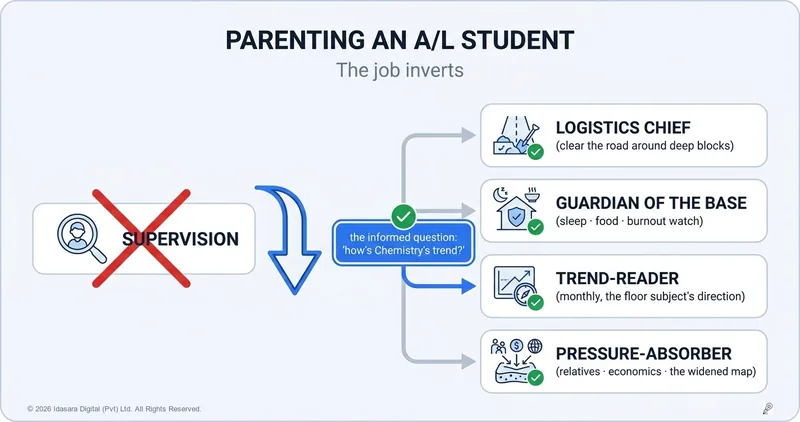
Role 1 — Chief of logistics. The A/L student's scarcest resource is uninterrupted deep-block time (the stream chapters showed why fragments can't build six-idea chains). The parent's highest-value contribution is unglamorous: the household engineered around the blocks — meals that don't ambush the 90 minutes, errands routed off the peak hours, transport to classes solved, the season's paperwork carried. Less watching over the shoulder; more clearing the road. Many strong A/L results are two years of a parent silently owning everything that isn't studying.
Role 2 — Guardian of the base. The two-year arc runs on the boring fundamentals at adult intensity: sleep held to the timetable (the deep-work brain is the most sleep-expensive machine in the house), food as fuel through the long horizon, the burnout watch — because the A/L's signature failure isn't laziness but mid-course collapse (the marathon run as a two-year sprint). The parent sees the early signals before the student does: the abandoned exam-free channel, the vanished friends, the joyless grind. Guarding the base sometimes means enforcing rest — the strangest and most valuable pressure an A/L home can apply.
Role 3 — Watch the month, not the day. The instruments-conversation survives the inversion but changes rhythm: monthly direction, not daily checking — coverage against the two-year map, the marked papers' line over time, and the weakest subject's direction (the Z chapter's arithmetic is the one piece of A/L strategy a parent should genuinely understand: the weakest subject rules the result, so "how is Chemistry moving this month?" is the informed question, where "how many hours today?" is the amateur one). Daily checking of an almost-adult reads as distrust; reading the month together reads as partnership.
Role 4 — The pressure-absorber. The A/L household sits inside a pressure system — relatives' rankings, the neighbour's medicine-entrant, the family's economic hopes sometimes riding openly on the result — and the parent's role is absorbing that weather, not conducting it indoors. The armor lines, upgraded for A/L stakes; the economic hopes spoken once, carefully, never nightly; and the widened-map conversation (Part 10's five doors) held early and calmly — a student who knows the family sees multiple honourable roads studies with courage; one who believes a single cutoff decides their worth studies with dread, and dread's exam-day price is documented in this book.
The seasons, A/L edition
The arc has its own calendar, briefly: Year one is habits-and-coverage at depth (the inversion's launch season — autonomy granted visibly, the logistics machine built, the combination decision's aftermath settled without reopening it); the middle is the drift-watch at two-year scale (trend reviews; the floor subject's allocation honestly revisited each term); the final six months are the O/L sharp season's rules at higher intensity — routine sacred, valves open, support-crew fortnights — plus the A/L's own addition: the selection-season companionship (the handbook read together, preferences discussed as the adult decision it is, and the waiting months — the after-A/L chapter's territory — planned as a family before results day makes everything feel like verdicts).
Do this month
- Audit your current mode honestly: supervision or logistics? Count last week's questions to your child — how many were daily checking ("did you study?") vs trend-and-logistics ("what should I clear from your Saturdays?")? Invert the ratio.
- Book the monthly trend-review — twenty minutes, instruments open, the floor subject's direction the headline.
- Hold the widened-map conversation this month, not in results season: the five doors on the table, the family's real constraints spoken once, the courage installed early.
At a glance
- The A/L job inverts: from supervising a child to supporting an almost-adult — supervision now suffocates the exact autonomy the stream demands.
- Four roles: logistics chief (engineer the household around deep blocks) · guardian of the base (sleep, food, the burnout watch — sometimes enforcing rest) · month-watcher (monthly direction of the weakest subject — never the daily check) · pressure-absorber (relatives, economics, the widened map held early).
- The Z's one parental lesson: the weakest subject rules — "how's the floor's trend?" is the informed question.
- The arc: year-one autonomy launch → middle drift-watch → final-months support crew + selection-season companionship.
- The constant survives from the O/L chapter, doubled: love visibly un-indexed to the cutoff.
One step further with Idasara Academy
The inversion has a matching instrument: the parent dashboard's trend view — free to start — is built for monthly-altitude reading (coverage against the two-year map, per-subject trajectories, the floor flagged) rather than daily surveillance, which is precisely the distinction this chapter turns on. The A/L parent's dashboard glance is a month's worth of "did you study?" questions, retired.
Start Free — Create Your Account →
FAQ
My child says "leave it to me" and shows me nothing. Trust or worry? The inversion doesn't mean information-darkness — it means the trend deal: full daily autonomy in exchange for the monthly instruments-review. Offer exactly that trade in those words; almost-adults accept trend-accountability far more readily than surveillance. Refusal of even trends, persisting, is worth gentle outside help (the mentor route) — darkness plus high stakes is where quiet collapses hide.
We're funding classes across two towns and the money is straining. How do we decide what to cut? The stream chapters' conversion test, run together: which classes can the student demonstrably reproduce cold afterwards? Cut from the bottom of that list, never from the top of the fear list — and read the family-budget chapter before the next fee cycle. An A/L student consulted on the economics studies the funded hours differently.
The Z-score talk at every gathering is crushing my child. What do I actually say to relatives? One sentence, cheerful and closed: "Preparation's on track — we'll know in December, and there are good roads either way." Then change the subject, visibly. You're modelling the widened map in public — which your child hears louder than any private reassurance.
What if I see the burnout signals — the joyless grind — mid-year? Act early and structurally, not motivationally: enforce a genuine rest week-end (the base-guardian's authority), re-open the exam-free channel personally (you attend too), and re-run the load honestly together — sometimes a class must go, sometimes a target must be re-set by the triage rules. Burnout caught at the signals costs a fortnight; burnout ignored costs the second year.
Further reading
The machinery at this altitude: The Z-Score (the one strategy chapter to read as a parent) · After A/L (the widened map) · Deep Work (what you're clearing the road for). The predecessor playbook: The O/L-Year Parent Playbook.
Sources
- NHS — teens, pressure and when to act
- Trinity College Kandy — A/L structure (what the two years demand)
- The Idasara Method: Part 4 — Time Management & Flipped Learning (the deep-block life the household serves)