The O/L-Year Parent Playbook: Your Job Changes Every Term
The short answer: Match the support to the season: early on, protect the study habit and settle electives and tuition calmly; mid-year, watch the coverage drift, not the child; in the final terms, guard sleep and routine and keep the pressure outside. The one job that never changes is love that visibly doesn't move with the marks.
A chapter of the free book Learn to Learn
Published 2026-08-31 · updated 2026-08-31
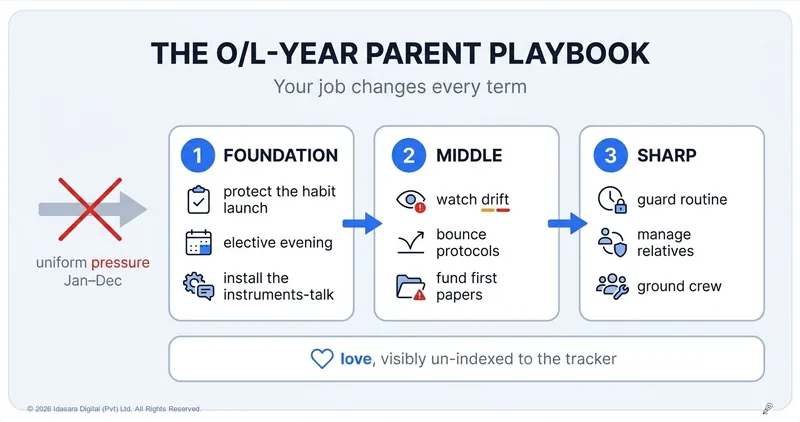
The O/L year arrives and parents do the only thing the culture shows them: apply constant, uniform pressure for twelve months — the same worried pressure from January to December. But the year has seasons, and the parent's useful job changes with them. This chapter of Learn to Learn is the calendar: what your child actually needs from you in each phase — and the one job that never changes.
Here is the O/L-year parent's most common mistake, made from pure love: treating the whole year as one long exam-eve. December's intensity applied in February exhausts everyone by June — the child burned out before the race's real hills, the household's pressure spent before it might have mattered, the relationship worn thin exactly when the hard season needs it.
The fix is a farmer's insight: the year has seasons, and each rewards different work. Here is the parent's calendar — built on everything the earlier parents' chapters installed (the instruments, the process praise — praising effort, not outcomes — the retired gauges; if you haven't read Help Without Hovering and the visibility chapter, start there — this chapter assumes their machinery).
Terms 1–2 of Grade 10: the foundation season
The year's real outcome is being decided here — not in December's cramming but in whether the habits and coverage get built early (the whole book's thesis, at family scale). The parent's seasonal jobs:
- Fund the system's launch: the child starting this book's machinery (the first-7-days chapter; the tracker — the syllabus coverage chart — on the wall) needs the launch protected — the anchor time held sacred, the twenty-minute sessions never interrupted for errands, the process praise on schedule. A habit protected in February is worth ten lectures in November.
- Run the elective decision properly (the elective chapter's evening — this is its season), and the tuition audit calmly: classes added by diagnosis, not by neighbourhood panic. The Grade-10 tuition stack is where family money burns brightest for least return; the audit chapters exist for this conversation.
- Set the household's information rhythm: the weekly instruments-conversation installed now, while stakes are low and the habit can form gently. Homes that start evidence-talk in February have it working by the season it matters.
Grade 10's end → Grade 11's start: the middle season
Coverage is compounding (or drifting) — the term tracker tells which, and this season's parent watches drift, not marks: the school-behind chapter's calendar-check is a parent skill too ("is the class where the syllabus says?" is a question you can ask the tracker without asking the child). Seasonal jobs: term-test bounces run properly (the 48-hour protocol at home — day one safety, day two mining; your response to the year's first bad paper teaches the child whether papers come home unfolded forever after), the first full-paper experiences funded (papers, schemes, quiet sitting time — the ladder's Rung 2 arriving), and the exam-year logistics settled early: registration papers, the school's requirements, so December's admin never lands on study weeks.
Grade 11's final terms: the sharp season
Now — and only now — the household enters exam mode, and the parent's job shrinks to guarding: the routine held sacred (sleep and meals as the timetable's fixed stars — the cramming and sleep chapters are your warrant; the all-nighter you're tempted to permit is the one to refuse), the pressure valves opened (the exam-free channel kept alive when it feels most dispensable — it's most needed now; relatives and their commentary managed at the door with the armor lines), the rescue supported without panic if the tracker says the year drifted (the six-months chapter run with the child — triage decided together beats triage imposed), and the exam-day fortnights run like the support crew — you handle everything around the race so the runner only runs: the playbook chapter's logistics (documents, routes, breakfasts, the quiet after each paper — no post-mortems at the gate) are largely parent-deliverable.
And the job that never changes, all twelve months: being the one adult whose love is visibly not indexed to the tracker. The child who knows the home survives any December outcome studies better, not worse — fear is a terrible fuel (every chapter about it agrees), and the results-day chapter ahead is this principle's final exam. Say it out loud at least once a term, in your own words: the exam measures preparation, never worth — and this house knows the difference.
Do this — at the year's start (or today, wherever the year finds you)
- Print the seasons: mark the family calendar with the three phases and each one's headline job. Pressure has a season; it isn't "always."
- Install what the earlier chapters specified, if not yet running: the wall instruments, the weekly evidence-conversation, the process-praise habit.
- Book the two family evenings the year needs in advance: the elective/tuition-audit evening (early) and the pre-exam logistics evening (late). Decisions made in calm season beat decisions made in December's weather.
At a glance
- The O/L year has seasons; uniform year-long pressure burns the child by June and the relationship by November.
- Foundation season (early): protect the habit-launch · run the elective + tuition-audit evenings · install the weekly instruments-conversation while stakes are low.
- Middle season: watch drift (the tracker, not the child) · run term-test bounces properly · fund the first full papers · settle logistics early.
- Sharp season: the job shrinks to guarding — routine sacred, valves open, relatives managed, rescue (if needed) decided together, exam fortnights run as the support crew.
- The constant: love visibly un-indexed to the tracker — said out loud, once a term.
One step further with Idasara Academy
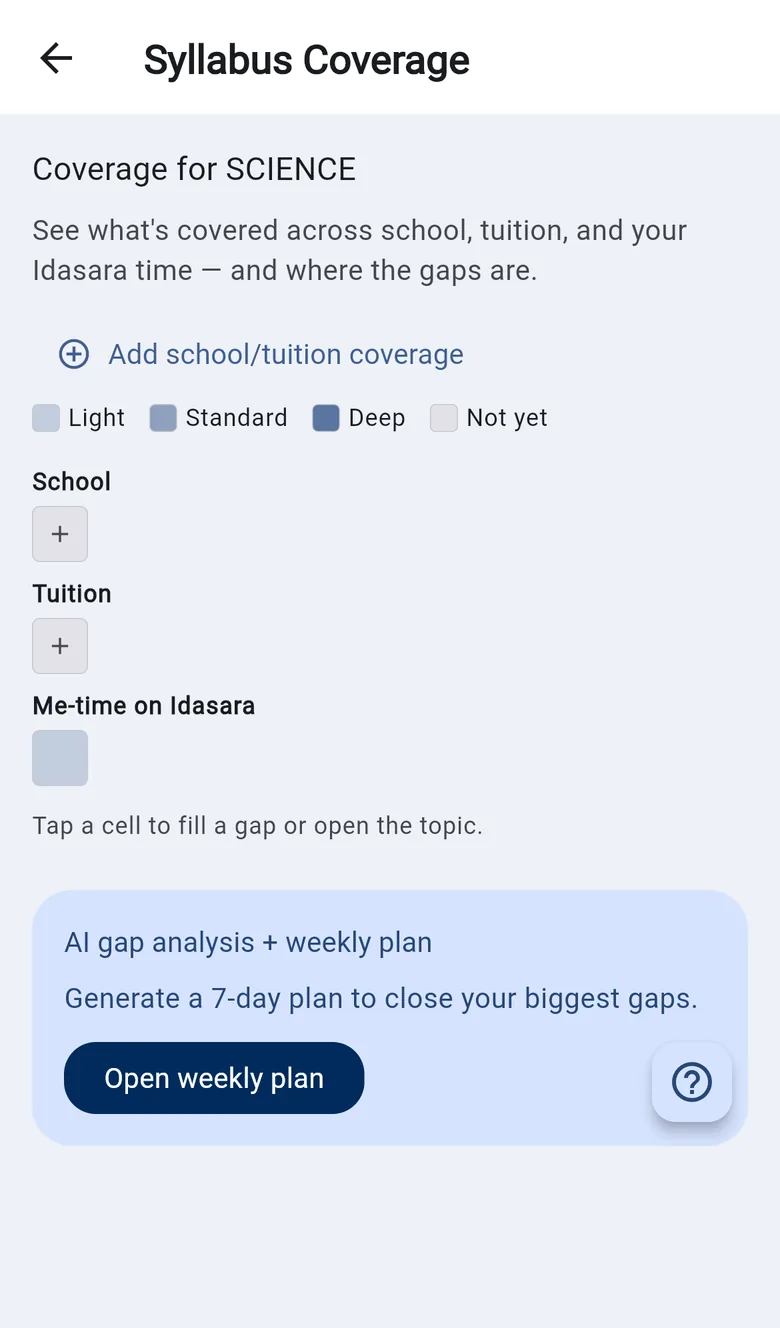
The calendar's watching-jobs fit on the parent dashboard — free to open, with coverage-vs-term for the drift check, and the exam plan's traffic light for the season's health. One screen the family reads together — the difference between a supported candidate and a surveilled one.
Start Free — Create Your Account →
FAQ
This is my first child's O/L year and I don't know what "normal" looks like. That's most O/L parents, and it's why the instruments matter more than instincts: the tracker and the term tests are "how it's going," readable without experience. For the culture's folklore (the panic-buying of classes, the December heroics), this book's audit chapters are the second opinion your neighbours won't give.
My child refuses the whole system — no tracker, no conversations. Start smaller than the system: the blame-cycle chapter's trade (visibility for the end of nagging) is the usual door in, and the first-fortnight rule from the parents' chapter applies — instruments before questions. Where refusal persists, one outside adult (the mentor chapter) often carries what a parent can't. What never works: installing the system by force — it becomes surveillance, and you've read what that builds.
Both parents disagree about pressure — one of us is the 'strict one.' The child pays for two different pressure levels at one dinner table, so agree on the smallest sharable thing: the calendar's seasons and the constant. Even the strictest instinct usually accepts "pressure has a season" faster than "pressure is wrong" — and the instruments give the worried parent something to do with the worry besides pressing.
What does a realistic 'good O/L year' outcome look like? By the instruments, not the neighbours: coverage genuinely finished, habits that survived the year, papers whose marks climbed across attempts, and a child still speaking to you in December. Grades follow that cluster more reliably than they follow anything else a parent can watch — and everything in that cluster, unlike grades, is buildable directly.
Further reading
The machinery this calendar schedules: Help Without Hovering · "I Never See You Studying" · The Bad Term Test · Six Months Left. The next year's version: Parenting an A/L Student.
Sources
- NHS — supporting a child through exams
- What Parents Ask — the fear-of-failure root
- The Idasara Method: Part 2 — The Plan (the term structure the seasons follow)