The Bad Term Test: The 48-Hour Bounce Protocol
The short answer: Take 48 hours: day one, feel the disappointment — no conclusions, no big decisions; day two, go through the marked paper and sort every lost mark into knowledge, method, precision, or format. Then aim the next few weeks at what the sorting found, and re-sit the same paper cold in two or three weeks — the climbed re-mark is the real answer to the bad number.
A chapter of the free book Learn to Learn
Published 2026-08-31 · updated 2026-08-31
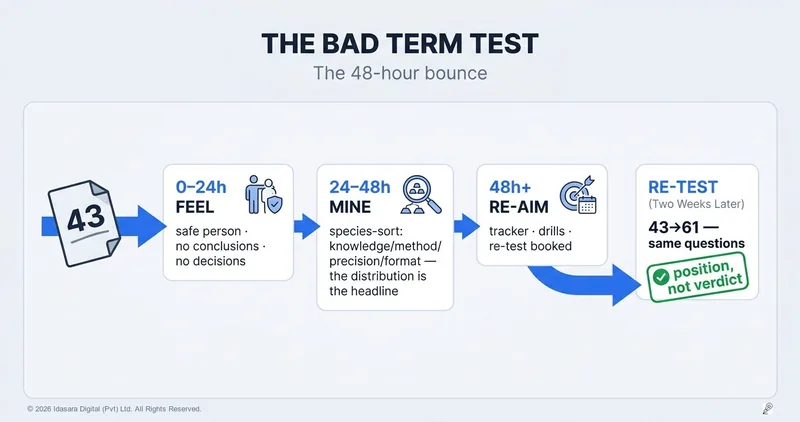
Somewhere mid-year, a marked paper comes back wearing a number that stings — and what a student does in the next 48 hours matters more than the number does. Most spiral or shrug; both waste the most valuable object the school year produces. This chapter of Learn to Learn is the bounce protocol: the day of feeling, the day of mining, and the re-aim that turns a bad Tuesday into December's favour.
The paper lands on the desk, folded to hide the corner. 43. Or 27. Or the 61 that was supposed to be an 80.
Two default responses now compete, and both lose the year's best purchase. The spiral treats the number as a verdict — the fixed-gap conclusion from last chapter, freshly stamped — and studies less thereafter (why feed a lost cause?). The shrug files the paper and vows vaguely ("I'll work harder"), touching nothing specific — the wince-and-file pathway the mistake-bank chapter named, at test scale. What both miss: a marked term test is bought data — hours of your performance, professionally examined, against real questions, months before it counts. You paid for this diagnosis with a bad afternoon. The protocol collects what you paid for.
Hour 0–24: feel it, contained
First, the honest part this book keeps insisting on: disappointment is not a malfunction. A bad mark on real effort should sting — the sting is proof you care, and pretending otherwise just buries it where it ferments. So the protocol's first day is deliberately unproductive: feel it, say it to someone safe, take the evening off on purpose (a planned rest is not a spiral — the difference is the plan). Two containment rules only: no conclusions on day one (the sting writes terrible analysis — "I'm hopeless at chemistry" is pain talking, not data), and no big decisions (subjects don't get dropped, streams don't get questioned, on the day the paper came back). The repeat-year chapter's grief rule, at term scale: feel first, decide later.
Hour 24–48: the mine
Day two, the sting settled, the paper opens — as evidence, with the tools you own:
- Mark the marking: walk the paper question by question with the shopping chapter's eye. Where exactly did marks leave? Sort every loss by species — the bank's taxonomy: knowledge (never studied / never stuck), method (wrong procedure), precision (the careless species — usually shockingly large), format (the verb unanswered, the time that ran out, the steps done invisibly).
- Find the distribution's message. The species-count is the test's real headline, and it's routinely the opposite of the number's story: a 43 that's half precision-and-format errors is a student two habits away from a 60 — not a chemistry crisis. A 61 that's all knowledge-gaps in two topics is a coverage message, topic-named. The number said how much; the mine says what kind — and what kind is the only actionable half.
- Bank everything — every lost mark into the mistake bank — your running ledger of errors — per its rules, so the test joins the permanent machinery instead of the folder of shame.
Twenty to forty minutes. It's the same post-mortem the paper-volume chapter runs on practice papers — the term test is just a practice paper the school paid to mark for you.
Hour 48+: the re-aim
The mine's output rewrites the next month, specifically: the named coverage gaps enter the tracker's repair queue (oldest first, beside current work — the debt chapter's structure), the method-and-precision species get their drills and checklists (three fresh problems; the ten-second sweep), the format losses get their chapter-a-week (the verb habit, the time budget), and — the piece most students skip — the re-test: in two or three weeks, re-sit the same paper cold. The re-mark is the protocol's payoff and the spiral's antidote: a visibly climbed number on the same questions is evidence-grade proof that the first number was a position, not a verdict. Show it to the household while you're at it — the parents' chapters explained what evidence does to worried families that vows never did.
And that's the whole reframe, said once plainly: December's exam is the test you can't mine. The term test is the one you can. A bad term test caught, mined, and re-aimed in month five is one of the luckiest things that can happen to a candidate — the same leaks, undetected, were headed for the paper that counts. Every A-student's history contains these bad Tuesdays; what their histories share is the 48 hours that followed.
What should parents do in the same 48 hours?
The child's protocol needs a parallel one at home. Day one: no interrogation, no comparison, no consequences-on-arrival — the sting is doing its work; your job is the safe person it gets said to (and the household's other adults held off — the armor line exists for results of every size). Day two onward: ask for the mine, not the number — "what did the paper teach us?" — and fund the re-test's evidence with process praise — praise for the work, not the child — when it lands. A home that runs this twice becomes a home where papers come out of school bags unfolded — and that, more than any single mark, is the year's win.
Do this — when the paper comes back
- Day one: feel it, say it, rest deliberately. No conclusions, no decisions.
- Day two: the mine — species-sort every lost mark, read the distribution's real headline, bank it all.
- This week: the re-aim into tracker and drills; the re-test booked in the diary. Then let the climbed re-mark say what vows never could.
At a glance
- A bad term test is bought data — hours of performance, professionally marked, months before it counts. The spiral and the shrug both waste the purchase.
- 0–24h: feel it, contained — planned rest, safe person, no conclusions or decisions on day one.
- 24–48h: the mine — species-sort every lost mark (knowledge / method / precision / format); the distribution, not the number, is the headline — and it's routinely better news than the number.
- 48h+: the re-aim — gaps to the tracker, species to their drills, and the cold re-test in 2–3 weeks: the climbed re-mark is proof the number was a position, not a verdict.
- Parents: day one is for safety, day two for "what did it teach us?" — homes that run this get unfolded papers forever after.
One step further with Idasara Academy
The protocol's mining day is tool-assisted end to end: photograph the returned paper and Exam Paper Marking (paid tiers) itemises the losses in the scheme's currency, every error lands species-sorted in the Mistake Bank, and Today's Plan absorbs the re-aim automatically — with the re-test's climb showing up on the exam plan's readiness trend, where the whole family can watch the verdict die. The 48 hours, with the bookkeeping carried.
Start Free — Create Your Account →
FAQ
The bad mark was in my best subject — that's what's shaking me. Best-subject stumbles are almost always format-and-precision stories (confidence breeds skipped steps and unread verbs — the mine will show you), and they're the fastest repairs in the book. What actually needs guarding is the story: one bad Tuesday in a strong subject is noise; treat it as data like any other paper, and don't let it touch the identity the streak built.
My school doesn't return marked papers, just the number. How do I mine? Ask — politely, specifically, with the teacher-conversation craft ("I'd like to learn from my errors — could I see where marks were lost?"); most teachers grant what's asked as method. Where the paper truly stays hidden: reconstruct from memory the questions that hurt, re-attempt them cold, and mark against the textbook — a rougher mine, still worth digging.
What if the mine shows it really is a broad knowledge collapse? Then you've caught a coverage debt mid-year instead of in December — which is the rescue and comeback chapters' territory, entered with a precise map instead of panic. A broad collapse found in month five is the good version of that news; the protocol did exactly its job.
Should term-test marks change my stream/subject plans? One test, never — day-one's no-big-decisions rule extends here. A pattern across mined tests is real evidence, and it feeds the decision chapters' machinery (evidence → gates → destination) calmly, at term boundaries — not in the week a folded paper came home.
Further reading
The machinery the mine feeds: Your Mistakes Are Your Syllabus · Method Marks vs Accuracy Marks. The bigger-stakes version: The Repeat Year. The identity protection: Starting From S and F.
Sources
- The Learning Scientists — Retrieval Practice (the re-test as the completing move)
- What Parents Ask — responding to disappointing results (day one at home)
- The Idasara Method: Part 3 — The Grade Progression Ladder & Paper Marking (the post-mortem machinery)