Starting From S and F: The Comeback Protocol
The short answer: You improve failed subjects by starting below the syllabus, not from today's lessons: walk backwards until you find work you can do cold, then rebuild from that line — one subject, twenty to thirty minutes daily, moving up only when problems work from a blank page. The gaps close faster than the fear predicts, and the daily evidence rewrites the story the results slip told.
A chapter of the free book Learn to Learn
Published 2026-08-31 · updated 2026-08-31
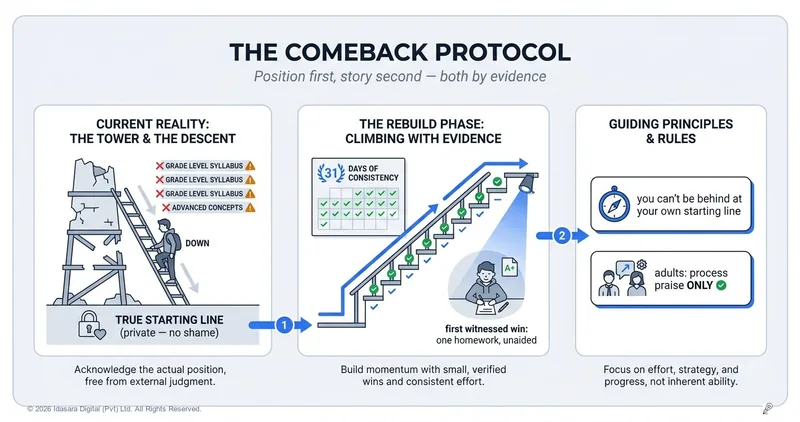
Somewhere behind every weak results slip is a student who has quietly agreed with the world's verdict — and stopped. This chapter of Learn to Learn is the comeback protocol: why "study harder from here" is the wrong instruction, how to find your true starting line (it's below the syllabus, and that's fine), and the engineered small wins that rebuild a student the verdict said was finished.
The weak student's real problem is almost never this term's syllabus. It's two other things stacked underneath it.
The first is position: an S or F today usually means the gaps started years ago and compounded (the debt chapter's tower, several floors deep). Today's lessons assume beams that were never laid — so attending harder, copying more, even honest effort with this book's methods aimed at today's chapter, pours work onto floors with nothing under them.
The second is the story: years of red marks write a sentence into a student — "I'm not the studying kind" — and the sentence does more damage than the gaps, because it stops the trying. Every teacher knows this student: not lazy — a student who has stopped believing trying works.
The comeback protocol attacks both, in the only order that works: position first, honestly; story second, by evidence. Never by speeches.
Step 1 — Where is the true starting line? (It's lower, and that's fine)
The one move that separates comebacks from another failed "this term I'll work hard": stop starting from today's syllabus. Instead, run placement — subject by subject, walk backwards through past years' material until you hit ground that holds: work you can actually do, cold, on paper. For maths it might be two or three grades back; for a language, the basics of sentences; for science, the earlier concepts today's chapter silently assumes.
This feels like humiliation. It is the opposite — it is the first honest measurement in years, and everything real gets built on it. The rule to hold onto: you cannot be behind at your own starting line. A Grade-11 student rebuilding from Grade-8 maths is not "doing Grade-8 work" — they are doing the only work that makes Grade-11 possible, in the only order that was ever going to work. (The maths-from-zero and slow-reading chapters run this placement for the two most common deep gaps.)
Step 2 — Build from the line, small and daily
From the true line, the machinery is this book's usual engine set deliberately small: one subject prioritised (not all nine — the comeback fights on one front first, usually the gate subjects: maths and the language of instruction), twenty to thirty minutes daily of real work at the placement level (the loop miniaturised: read small, produce small, check honestly), and climbing only on cold proof — the next level unlocks when this level's problems work from a blank page, not when boredom suggests moving on. The tower rebuilds startlingly fast this way — years of gaps are mostly thin gaps, and an adult-strength Grade-11 mind eats Grade-8 material in weeks, not years. That speed is the protocol's secret weapon; nobody tells weak students how fast the road back actually runs once it starts from solid ground.
Step 3 — Engineer the wins the story needs
The identity — "not the studying kind" — does not yield to encouragement. It yields to evidence the student cannot argue with, so the protocol manufactures evidence on a schedule:
- The visible ladder: placement levels ticked off on a wall chart — each tick a fact, not a feeling.
- The streak: the daily twenty minutes, tracked, unbroken — because "I have studied every day for 31 days" is a sentence that quietly kills "I'm not the studying kind" in a way no adult's speech ever will.
- The first real-world win, aimed deliberately: within the first month, one moment where the rebuilt foundation touches school — a homework done unaided, one question right on a class test, one answer volunteered. Small, public, undeniable. The story starts rewriting itself at the first witnessed win; the protocol's job is to make that win inevitable rather than hoped-for.
And a warning for the adults in this student's life, because you can wreck Step 3 in one sentence: the comeback's early wins are small by design — meet a first-in-years homework-done with "see, you were just lazy before" and the whole rebuild dies of the old verdict. The only correct response is the process praise the parents' chapters taught: name what they did. Nothing else.
What does a comeback semester actually look like?
Month one: placement + the daily twenty on one subject + the first engineered win. Month two: the rebuilt subject starts touching the current syllabus (homework becomes possible; class starts making sense — students describe it as the fog lifting forward); a second subject enters at twenty minutes. Month three onward: the ordinary machinery of this book takes over, subject by subject, because the student now has ground to stand on — and, more decisive, a different sentence in their head. The slip that started this chapter said S and F. Slips measure positions, not people; positions move. That's the whole protocol.
Do this tonight
- Choose the one subject the comeback starts with (gate subjects first: maths or language).
- Run the first placement walk: back through past-year materials until problems work cold. Write the honest line: "my ground floor is ___." No one else needs to see it.
- Set the daily twenty and the wall chart. Tick day one tonight — the streak starts with this evening, not with next term.
At a glance
- Weak results are two stacked problems: position (gaps that started years back) and story ("not the studying kind"). Attack them in that order — position by placement, story by evidence.
- Placement: walk backwards to ground that holds. You cannot be behind at your own starting line.
- Build small: one subject, 20–30 daily minutes at the true level, climbing only on cold proof — and the road back runs fast from solid ground.
- Engineer the wins: wall-chart ladder, the unbroken streak, one deliberate real-world win in month one. Evidence rewrites the story; speeches don't.
- Adults: process praise only. One "you were just lazy before" can kill the whole rebuild.
One step further with Idasara Academy
Micro-quiz ladders run the placement walk with no audience for the honest answer, and the streak makes Step 3's evidence visible on its own. Nobody at school needs to know where your ground floor was.
Start Free — Create Your Account →
FAQ
I'm in the exam year. Is there time for a comeback that starts grades below? The protocol compresses honestly: gate subjects only, placement immediately, and the rescue chapter's triage decides what the remaining months buy — often a pass where an F was certain, which changes every door in Part 10. And if the calendar truly wins this round: the repeat-year and earn-and-learn chapters are comebacks on longer clocks. The protocol doesn't expire.
My school has already streamed me with the "weak class." Doesn't that decide it? Streaming measures your old position with the school's limited tools. The protocol runs quietly underneath — placement, daily twenties, cold proof — and a changed position forces a re-measurement sooner or later. A changed position has made more than one school quietly change its mind.
What if I run placement and the ground floor is really, really low? Then you've found the truth that years of pretending hid — and the truth is buildable, which pretence never was. Low ground floors mostly mean the basics were never taught properly, not that they can't be learned; the two deep-gap chapters (maths-from-zero, slow reading) exist for exactly this floor. The measurement can't hurt you. Only the not-measuring ever did.
Honestly: is it worth it? Maybe I'm just not academic. Maybe exams will never be your arena — Part 10 mapped honourable roads that don't run through them. But that conclusion deserves to be drawn from evidence after a real attempt with correct method, not from years of wrong-method failure. Run the protocol for one term. Then decide from data, like everything else in this book. Most students who do are surprised by who they turn out to be.
Further reading
The deep-gap on-ramps: Maths From Zero and If Reading Itself Is Slow. The mechanism behind the gaps: Term 1 Debt. The momentum design: The First 30 Days.
Sources
- UCLA Bjork Lab — research overview (prior knowledge scaffolds new learning)
- What Parents Ask — the fear behind not-studying (the story problem, from the family side)
- The Idasara Method: Part 3 — The Grade Progression Ladder & Paper Marking (the ladder the comeback rejoins)