Maths From Zero: For the Student Who Was "Never a Maths Person"
The short answer: There is no maths gene — "weak from the beginning" means the order broke years ago and the gaps stacked. The fix is to walk back privately to the last level you can do cold, then climb one skill at a time, twenty minutes a day; back-year maths is thinner than the dread suggests, and the road up is shorter than it looks from the bottom.
A chapter of the free book Learn to Learn
Published 2026-08-31 · updated 2026-08-31
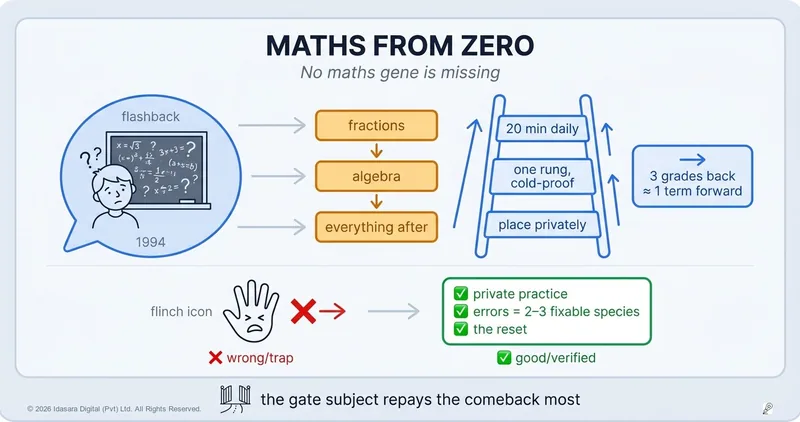
No subject manufactures despair like mathematics — because no subject stacks so mercilessly, punishes gaps so publicly, or gets turned into an identity so young. This chapter of Learn to Learn is the from-zero rebuild: why maths phobia is conditioning rather than truth, the ladder back from whatever floor you're really on, and why this one subject repays the comeback more than any other on the timetable.
Ask an adult who "can't do maths" when it started, and you'll almost always get a scene, not a date: a class left behind somewhere around fractions or algebra, a board that stopped making sense, perhaps a teacher's sarcasm or a parent's sigh — and then years of sitting in maths classrooms physically present and mathematically absent, each year's material stacking on the missing one, each test confirming the verdict a child wrote too early: not a maths person.
Read that scene with this book's eyes and the diagnosis is almost boring: maths phobia is the debt chapter plus the fear chapter, fused. The tower stacked (maths stacks harder than anything — the maths playbook said it), the gaps compounded, and the repeated public failure conditioned a flinch that now fires before the thinking starts — which is why "just try harder at today's maths" has failed this student every year: today's maths was never the problem, and the flinch made even the possible feel impossible.
The rebuild answers both. And it starts with the sentence this student most needs: there is no maths gene you're missing. National-curriculum mathematics — all of it, through A/L — is learnable by ordinary minds in the right order. The order is everything. Yours was broken years ago; we're going to repair it.
The from-zero ladder
Start where the ground truly holds — however far back. The comeback protocol's placement walk, run on maths specifically: go back through past years' books until you find problems that work, cold, on paper. Number work? Fractions? Basic algebra? Wherever it is, that's the floor — private information, requiring no announcement — and from it the ladder climbs one skill at a time: master cold → three clean problems from a blank page → next skill. Never two rungs at once; maths punishes skipped rungs like nothing else, which is exactly how you got here.
Small daily, forever-feeling, isn't. Twenty minutes daily on the ladder — the comeback's standard dose — moves through back-year maths far faster than fear predicts: the material is thin (each year's genuinely new maths is weeks, not months, of content for an older student), and every repaired rung makes the next one easier, because maths is the one subject where the tower metaphor is literally the curriculum's design. A student starting three grades back can reach their own year's work far sooner than the dread predicts — the road is shorter than it looks from the bottom.
Retrain the flinch alongside the skills. The phobia half needs its own handling: work alone or with a patient checker at first (the flinch was conditioned by audiences; the rebuild deserves privacy — a micro-quiz cannot smirk), treat every error as the mistake-bank data it is (species-sorted: most "hopeless at maths" errors turn out to be two or three repeated method slips — fixable, countable, finite), and use the exam-nerves reset when the freeze fires mid-problem: pen down, exhale, easiest step first. The flinch fades the way it was built — by repetition, now of a different experience: problems working.
And know why it's worth it — the honest stakes. Maths is the timetable's gate subject: the O/L grade that decides which A/L streams open (and whose failure forces the re-sit anyway — you cannot actually escape this subject, only postpone it), the entry line in job after job, the confidence that bleeds into science and accounting. No comeback pays better. That's not pressure; that's the reason this chapter exists at all.
What can the parent of the "not-maths" child do?
Two contributions, both restraints. First: stop the inheritance — "I was never good at maths either" is meant as comfort and lands as permission-to-quit, wrapped in genetics that don't exist; replace it with the true sentence: "nobody taught me in the right order — we're doing it differently." Second: protect the privacy of the floor. The rebuild works partly because nobody's watching the Grade-8 work; a parent who announces it to relatives converts the repair back into shame. What you're allowed to see is the streak and the ladder ticks — and what you're asked to say is the process praise — naming the work, not the child — on schedule.
Do this tonight
- Run the maths placement walk — past-year books, backwards, until problems work cold. Write the floor down, privately.
- Do twenty minutes at that level: read one small section's example (covered, per the playbook), attempt, check. Tick the streak.
- Say the replacement sentence out loud, because it's true and the other one wasn't: "I was never taught in the right order. Starting tonight, I am."
At a glance
- "Not a maths person" = stacked debt + conditioned flinch — a scene from years ago, compounding ever since. Not a gene; genes like that don't exist.
- The rebuild: placement walk to the true floor (private, unannounced) → one rung at a time, cold-proof to climb → twenty minutes daily.
- The road is shorter than the dread: back-year maths is thin for an older mind — three grades back can touch the present inside a term.
- Retrain the flinch with privacy, species-sorted errors (usually two or three repeated slips, not hopelessness), and the mid-problem reset.
- The stakes are the gates: streams, re-sits, jobs. No comeback on the timetable pays better.
One step further with Idasara Academy
If the flinch needs a patient checker, the AI Study Coach (free for 5 messages a day; uncapped on the paid tiers) guides the stuck step at 9 p.m. without a sigh, in your language, as many times as it takes. The one subject that most needs a judgement-free room now has one.
Start Free — Create Your Account →
FAQ
How do I sit in this year's maths class while secretly rebuilding from Grade 8? Change the class's job: it's your preview of the destination, not your workload — attend lightly, collect what lands, refuse the despair (you know why it doesn't land yet). Homework gets honest triage: attempt what touches your rebuilt rungs; for the rest, the teacher conversation from the school-behind chapter ("I'm rebuilding foundations — here's my plan") wins more allies than students expect.
Is a tuition class the answer for maths-from-zero? Usually not at first — classes run at the class's level, which is the broken order all over again. The rebuild needs your level. A patient individual helper (a capable relative, a senior student, the AI coach) checking your ladder work beats any class until you're within reach of the cohort — then a good class becomes useful again.
I freeze in maths tests even on problems I can do at home. That's the flinch outliving the gaps — normal, and it fades last. Bridge it with the nerves chapter's machinery at maths-scale: retrieval-built skills (your cold-proof rungs are exactly that), timed low-stakes practice to make the pressure familiar, the reset for the freeze. The test-you catches up with the home-you; give it a few honest cycles.
Realistically — from an F, what can the exam-year version of me get? Placement decides the honest answer — no book can promise a grade. What the mechanism says: the gate skills (number work, algebra basics, the standard problem types that anchor Paper I) are where a floor-up rebuild buys its first marks, and the jump from F to a pass is the single highest-value grade movement on the whole slip. Aim there first; let overshoot surprise you.
Further reading
The general protocol this specialises: Starting From S and F. The subject's full method once you're rebuilt: How to Study O/L Maths. The debt mechanics: Term 1 Debt.
Sources
- UCLA Bjork Lab — research overview (ordered prerequisite learning)
- Smith, A. et al. (2016) — retrieval under stress (why cold-proof rungs survive test pressure)
- Trinity College Kandy — A/L gates (what the maths grade decides)
- The Idasara Method: Part 3 — The Grade Progression Ladder & Paper Marking