How to Study O/L Maths — and Stop Being Afraid of It
The short answer: You pass O/L maths by doing it daily, not reading it — attempt problems with your own pen, re-do worked examples from a blank page, write every step, and log every error by type until it's fixed. Twenty minutes of real attempts a day, checked the same day, builds more marks than hours of watching solutions.
A chapter of the free book Learn to Learn
Published 2026-08-31 · updated 2026-08-31
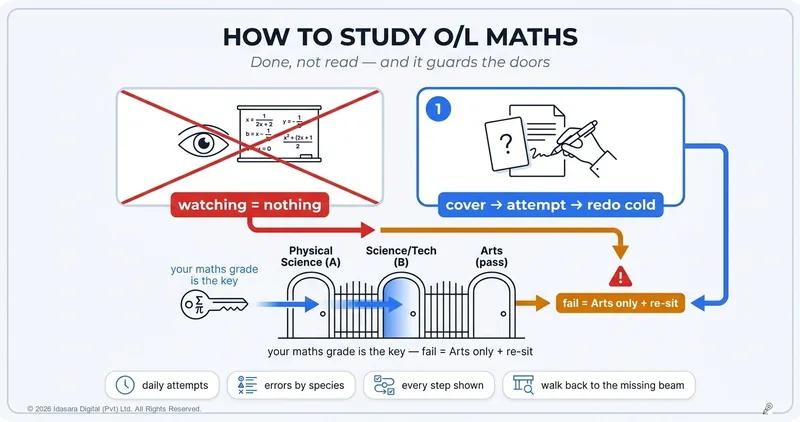
Maths is the most feared O/L subject and the most misunderstood: students study it like a reading subject, and maths refuses to be read. This chapter of Learn to Learn is the maths playbook — why watching solutions teaches almost nothing, the daily method that actually builds marks, and the door-fact every family should know: your maths grade quietly decides which A/L streams will even let you in.
Ask a student who fears maths how they study it, and you'll hear the problem hiding in plain sight:
"I read the chapter. I go through the worked examples. I watch the tuition sir solve the problems. I understand everything when I see it… but in the paper, I can't do it myself."
Every sentence describes watching. And maths is the one subject that gives you absolutely nothing for watching — because maths is not a body of information to remember. It is a skill you perform, like swimming or bowling. Nobody learns swimming by understanding swimming. You already know this book's oldest law — knowledge must flow out of you — and maths is that law at maximum strength: reading maths feels clear (the illusion-of-competence chapter told you why), and produces almost nothing the exam can pay.
So the whole playbook comes down to one sentence: maths is done, not read — and everything below is just that sentence, organised.
Why does your maths grade matter so much? (read this even if you hate maths)
Before method, the stakes — because maths is not just one subject among nine. It is a gate.
School guidance on A/L admission spells it out: Physical Science streams typically demand a top maths grade at O/L, Science and Technology streams a strong one — and a student who fails maths can typically enter only the Arts stream, and must re-sit O/L maths during their A/L first year anyway. (Exact thresholds are set by circulars and your school — verify the current rules — but the shape is stable: every stream you might want walks through your maths result.) The subject you're tempted to avoid is the one deciding which futures stay open. That's not pressure. That's the map — and the good news is that maths, of all subjects, responds most predictably to correct method.
How do you actually study maths? The five rules
Rule 1 — The worked example is a workout, not a story. Never read a worked example. Cover the solution, attempt the problem yourself, then uncover line by line only when stuck — and afterwards, re-do it from a blank page. An example you can't reproduce cold is an example you've only watched. This one habit converts every textbook chapter and every tuition class from entertainment into training.
Rule 2 — Volume of attempts, on paper, daily. Maths marks track one number: problems genuinely attempted with your own pen. The exercises chapter's paper-first rule runs at full power here — every end-of-chapter exercise, full working, before any help. Twenty minutes of real attempts daily beats a three-hour Sunday of watching; skill-building is a daily-dose business (you know the spacing science).
Rule 3 — Mine every error by species. Maths errors sort cleanly into the mistake bank — your logbook of every error — by species: concept (didn't understand — re-learn), method (wrong procedure — re-derive, then three fresh problems of the same type), precision (sign slips, misread digits — install your ten-second check). Most "weak at maths" students discover their leak is heavily method-and-precision — curable in weeks — not concept at all.
Rule 4 — Show every step, always, even in practice. The marking chapter taught you why: maths schemes pay method marks, line by line, and steps done in your head are steps done for free. Practising with full working also slows you down exactly where errors breed. Train as the scheme pays.
Rule 5 — When a problem defeats you, walk backwards. Maths is the most tower-like subject in the syllabus — today's topic stands on last year's. A Grade-11 problem that feels impossible is usually a Grade-9 beam that's missing (the debt chapter's whole argument). Don't grind the impossible problem; find the earlier skill it assumes, repair that, and watch today's topic unlock. "I'm bad at maths" is almost always "I have old maths debt" — a different, fixable sentence. (If your debt goes deep, the Maths-from-Zero chapter in Hard Mode — the book's catch-up chapters — is your on-ramp.)
What does a good maths week look like?
- Daily (20–40 min): one focus block of attempts — today's exercises paper-first, plus two or three old problems re-done cold (spaced retrieval, maths edition).
- At the stuck moment: log the exact step, get guided not given (the tutor rules), finish with your own pen, diary a cold re-attempt.
- Weekly: one timed mixed set — problems from different chapters shuffled together, because the paper never announces which chapter a question comes from, and mixed practice is what builds the recognising which tool to use skill that single-chapter drilling never touches.
- Every attempt checked the same day; errors banked by species. In season: past papers on the ladder's schedule — the staged past-paper climb — like every subject.
Do this tonight
- Take one worked example you "understood" this week. Blank page, solution covered: do it. The result — either way — is tonight's most useful information.
- Attempt four exercises paper-first, full working. Bank the errors by species.
- If even the basics feel impossible: stop grinding forward. Find the last chapter where problems do work out, and restart from there — that's not going backwards; that's finding the beam.
At a glance
- Maths is done, not read — a performed skill; watching solutions builds recognition, and the paper pays only production.
- The gate: A/L streams demand strong O/L maths (top grades for science streams; fail → Arts-only + compulsory resit — verify current circulars). Avoiding maths closes doors silently.
- Five rules: cover-and-attempt worked examples · daily paper attempts · errors mined by species · every step shown · impossible problems → walk back to the missing beam.
- Weekly timed mixed sets teach the skill single-chapter drilling can't: recognising which tool the question wants.
- "Bad at maths" usually means "old maths debt" — a fixable sentence.
One step further with Idasara Academy
The maths method needs two things at volume: graded problems and honest checking. Micro-quizzes — free to start — give you the daily attempt-dose per topic, walk-backwards ladders included, with every slip banked by topic in the Mistake Bank automatically. On the paid tiers, Exam Paper Marking reads your handwritten working and pays it the way the examiner will — method marks, line by line — so Rule 4 gets audited all year, not discovered in December.
Start Free — Create Your Account →
FAQ
I understand in class but can't do it alone at home. Why? That is the watching trap — class understanding is recognition riding the teacher's momentum. The fix is mechanical: same-day cover-and-redo of what class solved. If you can reproduce it cold within 24 hours, you own it; if not, you've found tonight's work.
How many problems a day is enough? Fewer than you fear: four to six genuine attempts (full working, checked, banked) on school days, more on weekends. It's the daily and the checked that build the skill — a hundred unexamined problems teach less than ten mined ones.
Is tuition useless for maths, then? No — a good teacher is excellent at explaining method and marking your attempts. Tuition fails only when it becomes pure watching. Apply the conversion test from the Me Time chapter: after class, can you re-do today's problems cold? If yes, the class is earning its evening.
I panic and blank in maths papers specifically. Maths anxiety? Maths panic is usually stacked debt meeting time pressure — the exam-nerves chapter's tools apply (retrieval-built skill holds under stress), but the deeper cure is the walk-backwards repair, because confidence in maths is just competence with a small delay. Start below where it hurts.
Further reading
The engine under this playbook — paper-first practice, error species, the ladder — is the whole method: Part 3 — The Grade Progression Ladder & Paper Marking.
Sources
- Trinity College Kandy — Guidance on selecting A/L subject streams (stream maths thresholds; fail-maths → Arts + resit; verify current circulars)
- Dunlosky, J. et al. (2013) — overview at the Association for Psychological Science (practice testing; distributed and interleaved practice)
- UCLA Bjork Lab — research overview (interleaving: mixed sets beat blocked drilling)
- The Idasara Method: Part 3 — The Grade Progression Ladder & Paper Marking