Part 3: The Papers — Grade Ladder, Script Marking & the Writing Skill
Layer 3 of The Idasara Method: the C to A grade ladder, Vision OCR script marking, Mistake Bank telemetry, and why deep reading and writing decide both your grade and your career in the AI age.
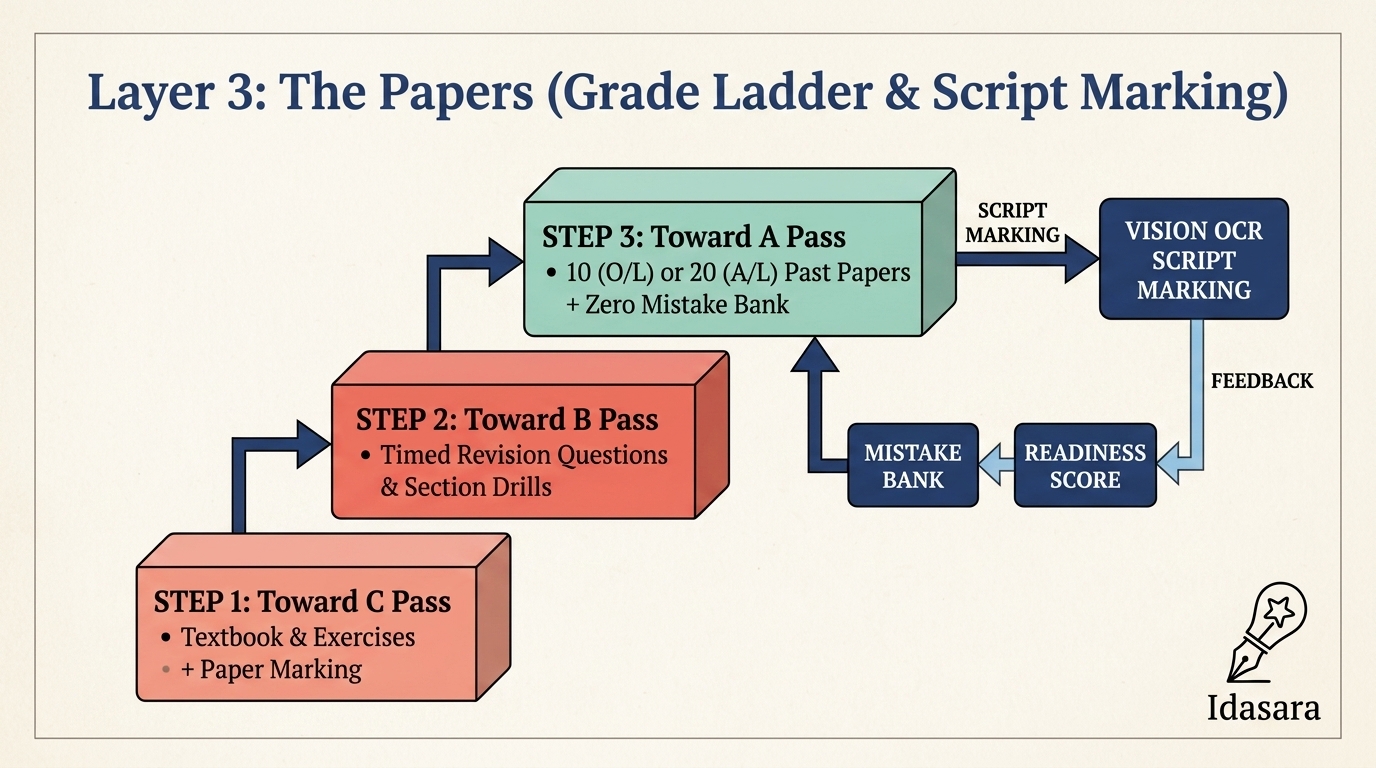
1. The Grade Progression Ladder: Toward C, B, then A
Academic achievement is not a mystery, nor is it reserved for students with "natural talent." It is a predictable progression up a clear, objective performance ladder.
By executing a specific sequence of study actions, you can steer, step by step, the grade you achieve on examination day.

Level 1: Securing the C Pass (The Foundational Baseline)
Three steps that examiners consistently reward, in any national subject:
- Read your official government textbooks or NIE Resource Books thoroughly.
- Complete every single end-of-chapter exercise in your physical notebook.
- Upload your handwritten exercise solutions to the Exam Paper Marking Tool for rubric-based evaluation.
Result: you have made a full first pass of the syllabus, worked the baseline textbook problems, and checked your answers against national marking standards. That is the foundation a Credit is built on.
Level 2: Accelerating to B and A Passes (The Mastery Phase)
To elevate your performance from a C Pass to a Very Good (B Pass) or Distinction (A Pass), you must shift from concept intake to diagnostic exam performance:
The B Pass Acceleration
- Solve App Revision Questions: Work through the topic-specific revision questions in Idasara Academy under timed conditions.
- Execute Sectional Past Paper Drills: Attempt specific past paper sections (e.g., Part I Multiple Choice or Part II Essay questions) for recently completed terms.
The A Pass Mastery Threshold
-
Execute Full Past Paper Sweeps:
- O/L Candidates: Idasara suggests at least 10 full papers under strict exam conditions.
- A/L Candidates: Idasara suggests at least 20 full papers under strict exam conditions.
Those counts are Idasara's guidance, not an official threshold. Real past papers are published by the Department of Examinations at doenets.lk/pastpapers; Idasara's own practice papers are exam-style, written to the syllabus, and are labelled as such.
-
Upload All Scripts to Exam Paper Marking: Submit photos of your complete handwritten answer scripts to the Exam Paper Marking Tool.
- Zero Out Your Mistake Bank: Open your Mistake Bank dashboard. Use Ask AI in Socratic mode to resolve every red and amber topic until your active error count drops to zero.
- Maximize Your Exam Readiness Score: Track your composite readiness score on the Time Management Tab until it reaches peak levels.
This empirical diagnostic loop is what separates students who merely "know the content" from top national scorers who earn A passes and university placements.
2. Vision OCR Script Marking & the Feedback Loop

Reading notes and attempting quizzes is necessary, but it leaves your study loop open. You cannot know how an official national examiner will evaluate your handwritten working until you submit your scripts for formal rubric marking.
The Exam Paper Marking Tool closes the learning loop.

How Paper Marking Works Under the Hood
When you snap a photo of your handwritten notebook page and submit it:
- Multi-Modal Vision OCR: The system extracts your handwritten text, mathematical equations, and diagram labels.
- Official Scheme Grounding: The engine cross-checks your working against official Department of Examinations marking rubrics.
-
Mark-by-Mark Breakdown:
- Method Marks (M): Partial credit awarded for correct mathematical procedures or logical derivation steps.
- Accuracy Marks (A): Marks awarded for correct final values and precise units.
- Keyword Rubrics: Verifies that mandatory syllabus terms are present in essay and structured answers.
Step 7: In-Context Clarification on Marking Feedback
If you receive your marked script and notice a 3-mark deduction on Question 4(b), do not ignore it.
Tap Ask AI directly from your marking result screen and ask:
"I lost 3 marks on Question 4(b) for missing intermediate steps. Can you show me the exact working lines required by the official marking scheme to get full marks?"
The AI will guide you through the exact structural layout required by national examiners, allowing you to fix presentation defects permanently.
3. Readiness Score & Mistake Bank Telemetry
To understand how the study engine guides your daily activity, it helps to see how the diagnostic engines operate behind the scenes:
                                  READINESS ENGINE
                                (Composite 0-100 Score)
                                          │
       ┌──────────────────┬───────────────┴───────────────┬──────────────────┐
       │                  │                               │                  │
       v                  v                               v                  v
┌──────────────┐   ┌──────────────┐               ┌──────────────┐   ┌──────────────┐
│ Past Paper   │   │ Mistake Bank │               │ Syllabus     │   │ Z-Score &    │
│ Accuracy     │   │ Health (%)   │               │ Velocity     │   │ Rank Model   │
└──────────────┘   └──────────────┘               └──────────────┘   └──────────────┘
1. The Mistake Bank Telemetry Engine
The Mistake Bank does not simply store a list of incorrect answers. It acts as an active knowledge health monitor:
- Every Mistake Is Caught: Every incorrect response—whether from a quick micro-quiz, revision question, or paper marking upload—is automatically categorized and mapped to a unique topic key (e.g.,
chemistry-organic-nucleophilic-substitution). - Topic Health Index (0–100%): Active, uncorrected errors depress that topic's health index toward 0%, turning the topic card RED on your dashboard.
- Socratic Remediation: Correcting the error through targeted practice or resolving doubts via Ask AI restores the topic health back to 100% (GREEN).
2. The Exam Readiness Score Engine
Your Exam Readiness Score is a real-time composite metric (0–100) calculated by aggregating four dynamic inputs:
- Past Paper Accuracy: Your historical score on official marking schemes.
- Mistake Bank Health: The percentage of resolved versus active errors across all your enrolled subjects.
- Syllabus Coverage Velocity: Your progress relative to the 3-term timeline.
- Z-Score & Rank Models (A/L): Statistical predictions of your relative standing within the national cohort.
When your Exam Readiness Score reaches high levels, you no longer have to rely on hope or luck. You possess empirical, data-driven proof that you are ready for examination day.
4. Steps 8 & 9: Deep Reading & Writing — The Exam Skill That Is Also a Life Skill
Every mark you will ever be awarded is given for something you wrote. The examiner cannot see what you understand — only what you managed to put on the page.
That makes deep reading and clear writing the two skills that convert everything in Layers 1 to 3 into an actual grade. They are not a separate subject; they are the delivery mechanism for all of them.
You practise these in Layer 1, and you are graded on them here. Step 2 (writing your own short notes by hand) and Step 3 (keeping a question log in your own words) are where the skill is built, quietly, one lesson at a time. A student who has spent a year compressing textbook chapters into their own sentences walks into the exam hall already fluent. A student who only ever highlighted does not.
There is a second reason this matters, and it outlasts the exam. In the age of generative AI, the scarce human skill is no longer retrieving information — the machine does that instantly. It is articulating precisely what you want, judging whether the answer is any good, and expressing the result clearly to another person. Every one of those is reading and writing. A student who can frame a sharp question and critique a weak answer gets leverage out of AI; a student who cannot gets fluent-sounding nonsense and no way to tell. The same skill that earns the A also decides who is employable a decade after the A stops mattering.
We live in an increasingly digital world, yet national examinations remain strictly paper-based. This creates an apparent paradox for modern students. However, there is a profound synergy between traditional examination skills and 21st-century AI mastery.
                   THE DUAL-BENEFIT SKILL ARCHITECTURE

   National Examination Requirements:     21st-Century AI Literacy Demands:
  ┌─────────────────────────────────┐    ┌─────────────────────────────────┐
  │ • Independent Reading           │    │ • Precise & Clear Prompting     │
  │ • Deep Comprehension            │ =  │ • Critical Answer Evaluation    │
  │ • Structured Written Composition│    │ • Synthesizing AI Outputs       │
  └─────────────────────────────────┘    └─────────────────────────────────┘
The Examination Requirement
When you step into an examination hall:
- You must read dense, complex question papers independently without external guidance.
- You must comprehend subtle instructions, distinguishing between directional verbs like Describe, Explain, Derive, Compare, and Evaluate.
- You must compose structured, logical answers in writing under strict time limits.
The AI Age Requirement
In the modern workplace, working effectively with AI tools requires the exact same human capabilities:
- Prompting is Writing: To extract high-value work from an AI system, you must write clear, precise, well-structured prompts. Vague writing produces useless AI responses.
- Evaluating is Reading: To use AI safely, you must read the AI's output critically, spot subtle errors, comprehend complex data, and synthesize the results into actionable solutions.
By committing to reading your textbooks, taking handwritten notes, answering prompt packs on paper, and using Ask AI for targeted clarification, you are not just preparing for an exam. You are mastering the two most vital human skills of the 21st century: deep reading and precise writing.
5. Actionable Student Checklist for Part 3
- ☐ Term Timelines Audited: Have I checked my 3-term syllabus progress in Short Notes to ensure 100% coverage before exams?
- ☐ Grade Goal Set: Am I executing the specific steps required for my target grade on the Grade Progression Ladder?
- ☐ Scripts Uploaded for Marking: Am I uploading photos of my handwritten past paper attempts to the Exam Paper Marking Tool?
- ☐ Marking Deductions Clarified: Have I used
Ask AIto understand why marks were deducted on marked scripts? - ☐ Mistake Bank Reviewed: Am I actively clearing red and amber topic indicators on my dashboard?
The reads of The Idasara Method
- Start here: The 12-Step Master Journey — The whole method in order, from first textbook page to exam day.
- Layer 1 · The Loop — Textbook reading, handwritten notes, Question Logs, and Ask AI.
- Layer 2 · The Plan — The 3-term syllabus roadmap, your syllabus contract and term tracker, and the flipped classroom.
- Layer 3 · The Papers — C to A pass ladder, Vision OCR marking, and Mistake Bank. (you are here)
- Layer 4 · Time — Pomodoro focus rhythm, hard-and-easy subject pairing, stage-based pacing and Z-score protection.
- The Book · Learn to Learn — The complete method as a free 100-chapter book, in English, Sinhala and Tamil.
Put The Idasara Method into Practice Today
Get your personal AI Study Coach, NIE-aligned short notes, and Vision OCR paper marking. Free to start.
Start Free — Create Your Account →