Part 1: The Human Foundation & The 7-Move Learning Loop
The seven moves you run on every single lesson: official textbooks, handwritten short notes, a question log, targeted Ask AI clarification, textbook exercises, paper marking, and Prompt Pack stretch.
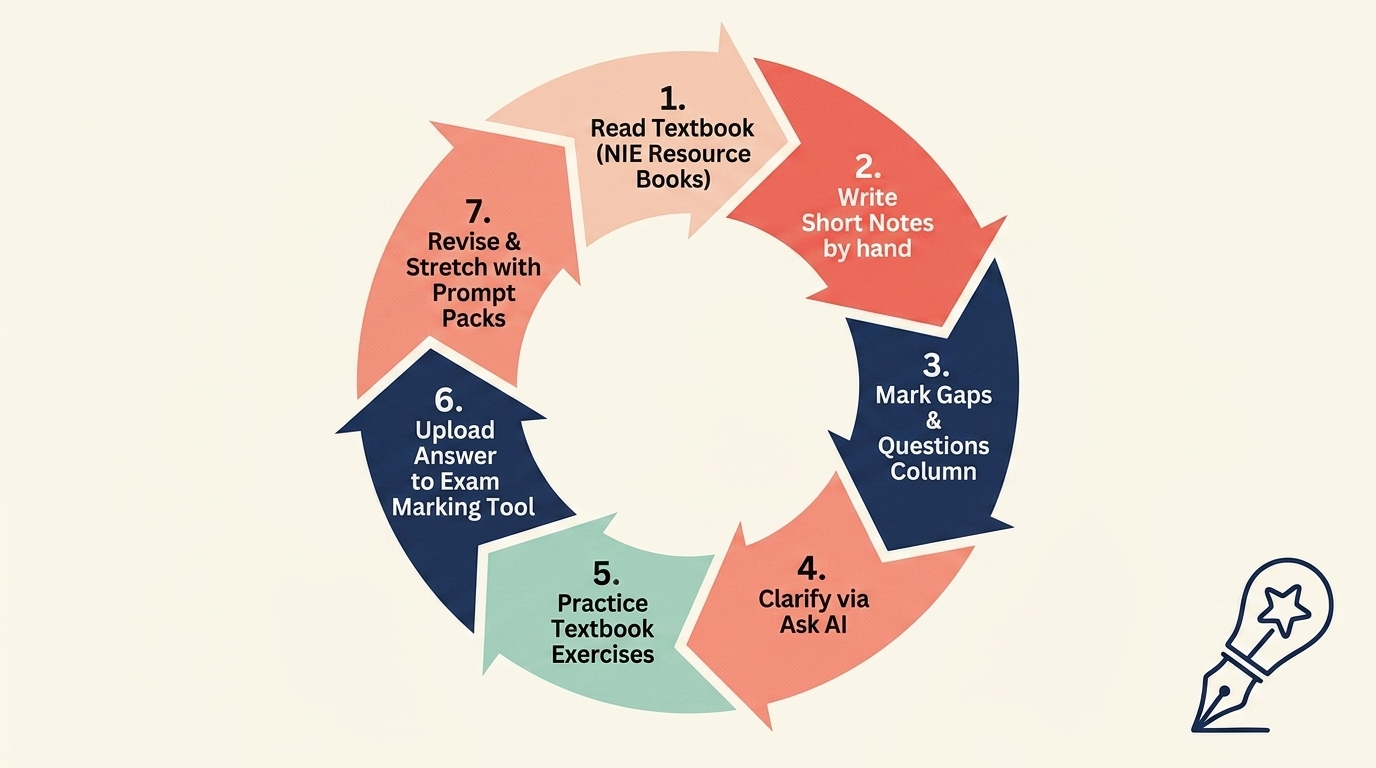
Layer 1: The 7-Move Learning Loop

1. The Illusion of Competence: Working Hard vs. Working Scientifically
Ask almost any student preparing for high-stakes national examinations what it takes to succeed, and you will hear the exact same response: "I just need to work harder."
So we lock ourselves in our rooms. We spend late nights at our study desks, re-reading textbook chapters three or four times, highlighting line after line in fluorescent neon markers, and watching hours of online video lectures. We feel exhausted at the end of the day, which gives us a comforting sense of productivity.
Yet, despite all this effort, thousands of students experience a crushing wave of panic when they sit for a real examination paper and encounter an unfamiliar question:
- "Why does a chapter feel so crystal clear when I read it in my room, but completely blank when I try to write an answer on a blank page?"
- "Why do I keep making mistakes on the exact same types of calculation problems?"
- "Why can't I remember the specific definitions and steps I highlighted just three weeks ago?"
The uncomfortable truth of education is that hard work alone is not enough. The secret to academic distinction lies in working scientifically.

The Neurological Trap of Recognition
Most traditional study habits—re-reading notes, highlighting passages, or passively watching video explainers—trigger what cognitive psychologists call recognition memory.
Because your eyes are looking at printed text that you have seen before, your brain's temporal lobe recognizes the visual pattern. It signals: "I know this." This creates a dangerous illusion of competence. You feel as though you have mastered the topic.
However, a national examination does not test recognition; it tests active recall and synthesis.
When you sit in an examination hall, you are handed a blank answer script. There are no highlighted lines to prompt your memory. If you have only trained your brain to recognize text while looking at it, your prefrontal cortex will freeze when asked to retrieve and reconstruct that knowledge from memory.
The Science of Cognitive Effort
Real, enduring learning only happens when your brain is forced to exert cognitive effort. According to the Ebbinghaus Forgetting Curve, up to 70% of newly read information is lost within 24 hours unless active neural retrieval takes place.
Every time you force your brain to recall a formula, draw a diagram from memory, or summarize a complex law in your own handwriting, you strengthen the physical neural pathways (synaptic connections) associated with that concept. The harder your brain works to retrieve information, the more permanent that memory becomes.
Idasara Academy was engineered around this fundamental neurological reality. Technology is not a magic shortcut designed to replace your personal cognitive effort. Instead, it acts as a precision framework—a digital mentor designed to structure, guide, and amplify your human effort.
2. Move 1 · Step 1: Ground Your Study in Official Textbooks First
Before you launch any digital application, open a study software, or attempt complex exam papers, your primary learning source must always remain your official national textbooks.
       PRIMARY RESOURCE HIERARCHY FOR SRI LANKAN CURRICULA

  O/L Students (Grades 6–11):
  ┌─────────────────────────────────────────────────────────┐
  │ Official Educational Publications Department Textbooks   │
  └─────────────────────────────────────────────────────────┘

  A/L Students (All Streams):
  ┌─────────────────────────────────────────────────────────┐
  │ Official NIE (National Institute of Education)          │
  │ Resource Books & Educational Publications Dept Texts    │
  └─────────────────────────────────────────────────────────┘
Why Primary Sources Are Non-Negotiable
National examination boards—whether drafting papers for GCE Ordinary Level (O/L) or GCE Advanced Level (A/L)—do not invent questions from private tuition class handouts, informal internet summaries, or third-party revision guides. They construct examination questions directly from the official national syllabus specifications and approved government resource books.
- For O/L Students (Grades 6–11): Every definition, scientific law, historical timeline, and mathematical technique across your 9 subjects must be anchored in your official government textbooks published by the Educational Publications Department.
- For A/L Students: Whether you are studying Physical Science (Combined Mathematics, Physics, Chemistry), Biological Science, Commerce, Arts, or Technology, your single master reference is the official NIE Resource Books published by the National Institute of Education.
The Risk of Third-Party Shortcuts
When you rely exclusively on tuition class hand-outs or condensed internet sheets during your first read of a topic, you take a major risk:
- Third-party summaries often simplify complex concepts, skipping the foundational steps required for full-mark essay answers.
- Terminology and phrasing in informal guides frequently diverge from the precise keywords required by official marking schemes.
- Diagrams in secondary summaries often omit mandatory labels that national examiners check for.
Always begin your learning cycle by reading the primary government textbook or NIE resource book. This ensures your foundational knowledge matches the exact standard by which your national examination papers will be marked.
3. Move 2 · Step 2: The Neural Power of Pen and Paper
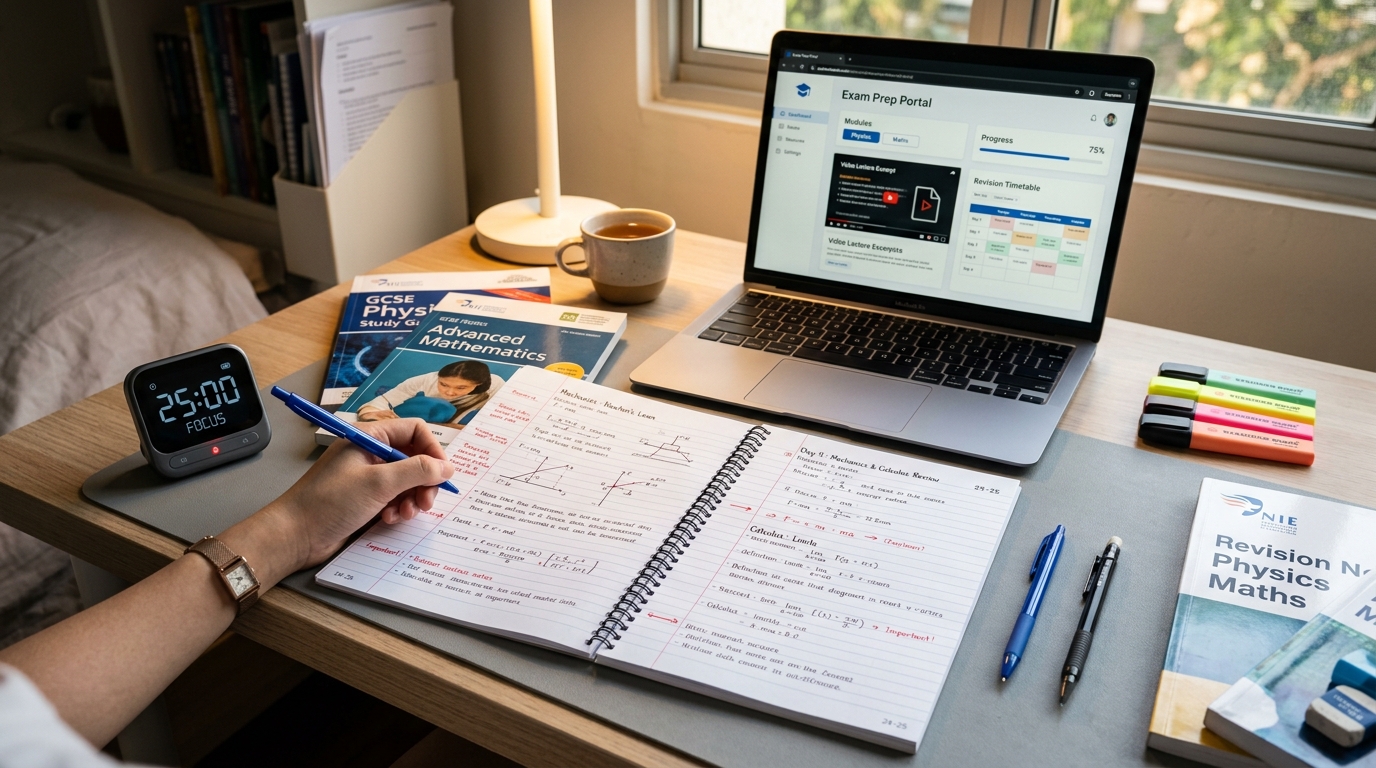
Once you open your official textbook to a new chapter, put all digital devices aside. Your single most powerful tool for long-term memory formation is a physical notebook and a pen.
                                  THE HANDWRITTEN RECALL CYCLE

  ┌───────────────────┐        ┌───────────────────┐        ┌───────────────────┐
  │ 1. Read Chapter   │ ───►   │ 2. Write Notes    │ ───►   │ 3. Digital Audit  │
  │    NIE / Govt Text│        │    Handwritten    │        │    Idasara FE     │
  └───────────────────┘        └───────────────────┘        └───────────────────┘
Why Handwriting Outperforms Digital Typing
Brain imaging studies comparing handwriting to keyboard typing reveal a dramatic difference in neural engagement. Typing is a mechanical, repetitive movement where every key feels identical. Handwriting, however, involves complex motor-sensory coordination:
- Distinct Tactile Traces: The physical stroke of forming a mathematical integral (∫), a chemical structure, or a biological diagram creates a unique sensory memory trace in the brain.
- Forced Synthesis: Because handwriting is slower than typing, you cannot write down every single word from the textbook. Your brain is forced to actively process the text, extract key ideas, and synthesize them in your own words.
- Physical Examination Stamina: National examinations require three hours of continuous, legible handwriting per paper. Writing your study notes by hand builds the necessary hand muscles and writing speed, ensuring physical fatigue never sabotages your performance during a final exam.
The 3-Pass Handwritten Short Note Method
As you study a textbook section, create your own handwritten short notes using a structured 3-pass approach:
Pass 1: Read and Digest
Read a complete sub-section (2 to 3 pages) without holding a pen. Focus purely on understanding the logical flow and core ideas.
Pass 2: Extract from Memory (Active Recall)
Close the textbook. In your physical notebook, write down the core laws, main definitions, formulas, and rough diagrams from memory. Only open the textbook to check a formula if you are completely blocked.
Pass 3: Keep It Dense and Concise
A 20-page textbook chapter should distill down to 2 or 3 pages of dense, clear handwritten notes. Use bullet points, clear headings, boxed formulas, and annotated diagrams.
The Self-Comparison Protocol
Once you have completed your handwritten notes for a topic, open the Short Notes tool in Idasara Academy.
Place your physical handwritten notebook right next to your screen and execute the Self-Comparison Protocol:
┌─────────────────────────────────────────────────────────────────────────────────┐
|                          THE SELF-COMPARISON PROTOCOL                           |
├─────────────────────────────────────────────────────────────────────────────────┤
| 1. Open Idasara Short Notes for the matching grade, subject, and topic.         |
| 2. Compare your handwritten notes item-by-item against the digital summary.     |
| 3. Use RED INK in your physical notebook to make annotations:                   |
|    • Add any missing SI units or mathematical conditions.                      |
|    • Correct definitions to match official marking scheme keywords.             |
|    • Add missing diagram labels or boundary conditions.                         |
└─────────────────────────────────────────────────────────────────────────────────┘
Why Red Ink Annotations Matter
Annotating your handwritten notes in red ink during the digital comparison step creates a stark visual signal for your brain. When you revise your notes weeks later, your eyes will instantly lock onto the red ink sections—the exact areas where your initial memory missed a detail.
This protocol transforms note-taking from a passive transcription exercise into a sharp self-audit.
4. Move 3 · Step 3: The Reading Discipline & Question Log
One of the most destructive habits students develop is abandoning a textbook reading session the moment they hit a difficult concept or unfamiliar sentence.
When an O/L student encounters a complex physics law or an A/L student meets a dense organic reaction mechanism, the natural emotional reaction is frustration and anxiety. The student thinks, "I don't understand this," closes the book, and switches to an easier subject or picks up their phone.
This breaks study momentum, reinforces negative self-talk, and leaves knowledge gaps unaddressed until exam week.
┌─────────────────────────────────────────────────────────────────────────────────┐
|                          THE QUESTION LOG DISCIPLINE                            |
├─────────────────────────────────────────────────────────────────────────────────┤
| 1. NEVER STOP READING: Continue to the end of the section without freezing.     |
| 2. MARGIN QUESTION LOG: Convert vague confusion into a written, specific question.|
| 3. TARGETED RESOLUTION: Use Idasara Ask AI to resolve the exact logged query.   |
└─────────────────────────────────────────────────────────────────────────────────┘
Rule 1: Never Stop Reading When Stuck
When you encounter a paragraph you do not fully grasp, do not freeze and do not close the book. Keep reading to the end of the section.
In well-structured textbooks, subsequent paragraphs, worked numerical examples, or summary diagrams frequently provide the missing context that clarifies the earlier confusion. Reading to the end gives your brain the complete picture.
Rule 2: Maintain a Parallel Question Log Notebook
In your physical notebook—right beside your short notes—reserve a margin column titled "Question Log".

Whenever a concept remains unclear after finishing the section, convert your vague feeling of frustration into a precise, written question.
Transforming Vague Frustration into Actionable Questions
| Vague Emotion (Avoid) | Actionable Question Log Entry (Correct) |
|---|---|
| "I don't get electricity." | "Why does adding a resistor in parallel decrease total circuit resistance?" |
| "Chemistry is impossible." | "What is the structural difference between an SN1 and an SN2 reaction mechanism?" |
| "I can't do Combined Maths." | "Why do we apply the integration by parts formula to ∫ x cos(x) dx instead of substitution?" |
| "History dates are confusing." | "What were the three specific terms of the Colebrooke-Cameron Commission of 1833?" |
Why Logging Questions Works
Logging your questions in writing accomplishes two critical cognitive goals:
- Emotional De-escalation: It shifts your brain out of an emotional "panic mode" into an analytical "problem-solving mode." You no longer feel helpless; you have defined a clear query.
- Surgical AI Input: It prepares sharp, high-value queries to feed into Idasara Ask AI in the next phase of your study engine, ensuring you get direct, accurate answers without wasting time.
5. Move 4 · Step 4: Targeted AI Clarification with Ask AI
Once you have established your human foundation—reading your official national textbooks, drafting your handwritten short notes, and compiling specific doubts in your physical Question Log—it is time to bring artificial intelligence into your learning workflow.
AI should never be used as a lazy shortcut to avoid reading or thinking. When used correctly, AI functions as a 24/7 personal tutor, providing immediate, targeted clarification at the exact moment you encounter a learning roadblock.
┌─────────────────────────────────────────────────────────────────────────────────┐
|                          THE TARGETED AI CLARIFICATION WORKFLOW                 |
├─────────────────────────────────────────────────────────────────────────────────┤
| 1. Open your physical notebook to your "Question Log".                         |
| 2. Input your specific, written query into Idasara Ask AI.                      |
| 3. Read the AI's curriculum-grounded response carefully.                        |
| 4. Annotate your handwritten short notes with the key takeaway.                 |
└─────────────────────────────────────────────────────────────────────────────────┘
The Anatomy of a Surgical Query
Instead of asking broad, vague questions that yield generic internet answers, feed the exact, concrete queries you logged during your textbook reading session directly into Idasara Ask AI:
Ineffective vs. Surgical Prompting
| Approach | Prompt Example | Why It Fails / Succeeds |
|---|---|---|
| Ineffective (Vague) | "Explain Physics electricity." | Yields generic textbook definitions that do not target your specific point of confusion. |
| Ineffective (Solution-Seeking) | "Give me the answer to Question 3." | Prevents cognitive effort and robs you of the learning experience. |
| Surgical Query (Correct) | "I understand that total current splits across parallel resistors, but why does the potential difference across each branch remain equal to the source voltage?" | Pinpoints your exact conceptual gap, allowing the AI to deliver a surgical, high-impact explanation. |
The Closed-Loop Note Annotation Protocol
Once Ask AI provides an explanation, your work is not finished. Reading an AI response on a digital screen still risks falling into the "illusion of competence" trap.
To lock the explanation into long-term memory:
- Read the AI's response on your screen.
- Pick up your pen and write the core takeaway directly into your physical notebook beside your original Question Log entry.
- Box the takeaway or highlight it in red ink.
This closes the active learning loop, converting a digital AI response into permanent handwritten notes.
6. Move 5 · Step 5: Master Textbook End-of-Chapter Exercises First
Learning is incomplete until theoretical concepts are applied to solve concrete problems.
                   THE PROBLEM-SOLVING PIPELINE

  ┌───────────────────────────┐      ┌───────────────────────────┐
  │ 1. Textbook Exercises     │ ───► │ 2. Interactive Prompt     │
  │    Solve on paper first   │      │    Packs for Deep Work    │
  └───────────────────────────┘      └───────────────────────────┘
Every official government textbook (O/L) and NIE Resource Book (A/L) contains curated exercises at the end of each lesson. These problems represent the baseline standard expected by national examination boards.
- The Paper-First Rule: Work through every textbook problem in your physical notebook without looking at solutions or asking for help.
- Log Blocked Calculation Steps: If you get stuck on Question 4(b), do not abandon the problem. Write down your partial working and log the exact step where your logic diverged.
- Use
Ask AIto Guide Resolution: Input your partial working into Ask AI and ask: "Here is my calculation for Question 4(b). Where did my mathematical step diverge from the marking scheme?" This forces the AI to act as a Socratic guide rather than an answer generator.
7. Move 6 · Step 6: Upload Your Answer to the Exam Paper Marking Tool
Your written answer is worth nothing until something marks it honestly.
At this point in the loop you photograph the answer you have just written and upload it to the Exam Paper Marking tool. Idasara's Vision OCR reads your handwriting, marks against the NIE scheme, and returns per-question feedback — the same engine described in detail in Part 3: The Papers.
The distinction between the two layers is scale, and it matters. Here in Layer 1 you are marking one answer from one lesson, immediately, so a misconception dies the day it is born. In Layer 3 you will run the same engine across whole past papers to convert syllabus coverage into a grade. Same tool, different unit of work.
8. Move 7 · Step 7: Revise & Stretch with Revision Questions & Prompt Packs
Once the lesson's own exercises are marked, stretch further. Answer the Revision Questions for that topic on paper, mark them with the Exam Paper Marking tool, and close whatever gaps they expose — then move to the Prompt Packs below.
Prompt Packs: Building 21st-Century AI Literacy While You Revise
In addition to textbook exercises, Idasara Academy provides structured Prompt Packs on the Learn Tab under the Ask tile.
Prompt packs are curated, pre-structured prompt frameworks designed for specific subjects (e.g., "Break down the 4 stages of mitosis with diagram labels", "Generate a past-paper style calculation on projectile motion with step-by-step guidance", or "Analyze the economic causes of the 1930s Great Depression").
┌─────────────────────────────────────────────────────────────────────────────────┐
|                       THE PROMPT PACK LEARNING WORKFLOW                         |
├─────────────────────────────────────────────────────────────────────────────────┤
| 1. Select a topic-aligned Prompt Pack from the Learn Tab.                        |
| 2. Attempt to draft your response on paper BEFORE launching the AI interaction. |
| 3. Trigger the Prompt Pack to interact with Ask AI.                             |
| 4. Compare your written attempt against the AI's structured response.           |
└─────────────────────────────────────────────────────────────────────────────────┘
Why Prompt Packs Build Essential AI Literacy
Working with Prompt Packs accomplishes something far greater than passing an examination: it builds AI Literacy—the ability to effectively communicate with, guide, evaluate, and direct artificial intelligence systems.
In higher education and modern careers, prompting is not a study trick; it is a fundamental professional capability. By using pre-structured prompt packs, you learn:
- How to structure multi-part requests clearly.
- How to ask an AI system for step-by-step verification rather than raw output.
- How to critically evaluate AI responses for accuracy and syllabus compliance.
9. Why Ask AI Beats "Bare Naked ChatGPT"
Students frequently ask a logical question: "Why should I use Idasara's Ask AI tool when I can just use free, generic AI tools like standard ChatGPT?"
While generic consumer AI models are impressive, relying on "bare naked" ChatGPT for national examination preparation carries severe hidden risks and structural disadvantages.
┌─────────────────────────────────────────────────────────────────────────────────────────┐
|                          IDASARA ASK AI vs. BARE NAKED CHATGPT                          |
├──────────────────────────────────────┬──────────────────────────┬───────────────────────┤
| METRIC / CAPABILITY                  | BARE NAKED CHATGPT       | IDASARA ASK AI        |
├──────────────────────────────────────┼──────────────────────────┼───────────────────────┤
| National Curriculum Alignment        | ✗ Generic web data       | ✓ 100% NIE Grounded   |
| Syllabus Terminology Precision       | ✗ Foreign terms (US/UK)  | ✓ National Rubric Terms|
| Protection Against Hallucinations    | ✗ High risk of error     | ✓ Guarded Engine      |
| Prompt Engineering Effort Required   | ✗ High (Manual setup)    | ✓ Zero (Built-in)     |
| Automated Error Telemetry Ingestion  | ✗ None (Isolated chats)  | ✓ Ingests to Mistake  |
| Real-Time Exam Readiness Analytics   | ✗ None                   | ✓ Recalculates Score  |
| National Rank & Z-Score Impact       | ✗ None                   | ✓ Dynamic Alignment   |
└──────────────────────────────────────┴──────────────────────────┴───────────────────────┘
1. The Prompt Engineering Tax
When using standard ChatGPT, you must act as an expert prompt engineer. To receive an answer relevant to Sri Lankan GCE O/L or A/L, you must manually type long context setups (e.g., "Act as a Sri Lankan GCE A/L Physics teacher following the NIE 2026 syllabus...").
If you forget to provide this context, generic AI will answer using foreign syllabi (such as US High School AP Physics or UK A-Levels), which often use different mathematical conventions, unit notation, and definition structures.
2. Hallucinations and Syllabus Drift
Generic AI models are designed to generate plausible-sounding language, not to adhere strictly to national exam syllabi. They frequently "hallucinate"—generating formulas or step-by-step methods that sound convincing but are marked as incorrect by national examination boards. One piece of inaccurate advice from an ungrounded AI can cost you critical marks.
Idasara's Ask AI operates inside strict curriculum guardrails. Responses are cross-checked against national textbooks and official marking schemes, eliminating hallucination risks and ensuring every explanation matches what national examiners demand.
3. Automated Telemetry: The Mistake Bank Integration
This is the single most critical distinction: generic AI tools have no memory of who you are, what you know, or where you fail.
When you ask a question or make a mistake inside generic ChatGPT, that interaction vanishes into a disorganised chat log. It does not update your study schedule, track your weak topics, or calculate your exam readiness.
When you interact with Idasara Ask AI:
- Every point of confusion or incorrect attempt is automatically logged into your personal Mistake Bank.
- Your Subject Health Meter updates in real time.
- Your Exam Readiness Score and Z-Score Projection recalculate automatically.
- Your Today's Plan schedule dynamically re-adjusts to give you practice on that exact weak spot.
Idasara's AI is not an isolated chatbot; it is a sensor connected to your master learning engine.
10. Actionable Student Checklist for Part 1
Before moving on to digital tools or practice papers, verify that you have executed these four foundational habits for your current syllabus topic:
- ☐ Primary Resource Checked: Am I studying from the official Educational Publications Department textbook (O/L) or NIE Resource Book (A/L)?
- ☐ Handwritten Notes Drafted: Have I written my short notes, core formulas, and diagrams by hand in a physical notebook without looking at the text?
- ☐ Self-Comparison Completed: Have I compared my handwritten notes against Idasara Short Notes and marked missing keywords/units in red ink?
- ☐ Question Log Compiled: Have I listed my specific, unresolved questions in my notebook margin, ready for targeted AI clarification?
Summary of Part 1 Principles
- Reject the Illusion of Competence: Passive re-reading and highlighting build visual familiarity, not exam recall. Active retrieval builds permanent neural connections.
- Ground in Primary Government Sources: National examination papers are constructed directly from official textbooks and NIE resource books.
- Handwrite Your Short Notes: Pen-and-paper drafting engages motor-sensory memory networks and builds the physical writing stamina required for 3-hour exam papers.
- Execute the Self-Comparison Protocol: Audit your handwritten notes against digital summaries to catch missed details using red-ink annotations.
- Maintain a Written Question Log: Never close your book when confused. Keep reading to the end of the section and record precise questions in your notebook margin.
The reads of The Idasara Method
- Start here: The 12-Step Master Journey — The whole method in order, from first textbook page to exam day.
- Layer 1 · The Loop — Textbook reading, handwritten notes, Question Logs, and Ask AI. (you are here)
- Layer 2 · The Plan — The 3-term syllabus roadmap, your syllabus contract and term tracker, and the flipped classroom.
- Layer 3 · The Papers — C to A pass ladder, Vision OCR marking, and Mistake Bank.
- Layer 4 · Time — Pomodoro focus rhythm, hard-and-easy subject pairing, stage-based pacing and Z-score protection.
- The Book · Learn to Learn — The complete method as a free 100-chapter book, in English, Sinhala and Tamil.
Put The Idasara Method into Practice Today
Get your personal AI Study Coach, NIE-aligned short notes, and Vision OCR paper marking. Free to start.
Start Free — Create Your Account →