Part 4: Time — The Master Schedule Engine
Layer 4 of The Idasara Method: Pomodoro focus rhythm, hard-and-easy subject pairing, stage-based pacing for O/L 9 subjects and A/L Z-Score protection, and the 3-way subject rotation guard.
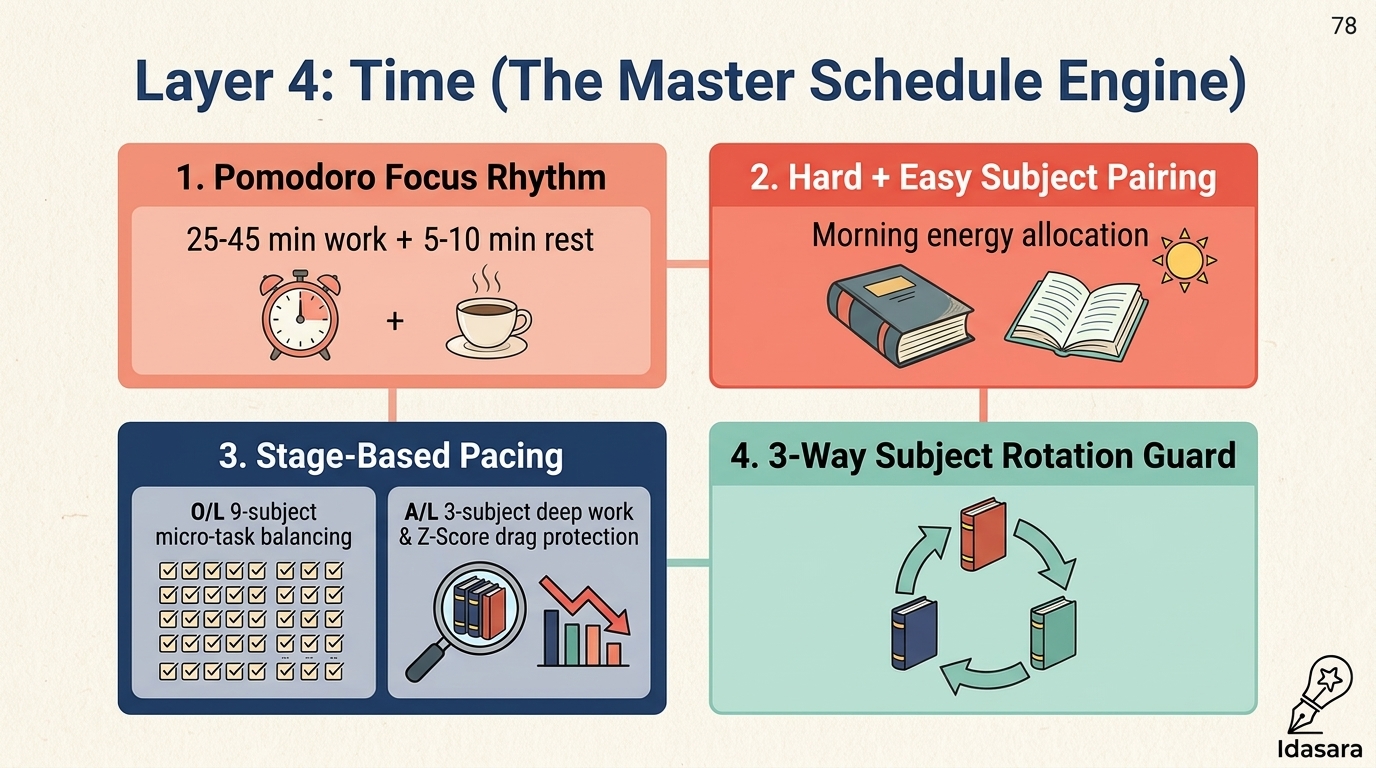
1. Step 12: Stage-Based Pacing — O/L 9 Subjects, A/L Deep Work & Z-Score
Time management is not about studying 14 hours a day until you suffer from physical and mental exhaustion. It is about allocating your finite energy scientifically across your subjects.
Depending on your academic stage, your time management strategy must adapt to the specific structural demands of your curriculum:

Scenario A: The O/L Student (Managing 9 Subjects Without Panic)
An O/L student in Grade 10 or 11 faces a massive cognitive management challenge: balancing 9 national subjects across 5 learning stages (Learn → Understand → Study → Practice → Exam Prep). That is 45 separate pieces of work to keep moving at once.
Without an automated time management engine, students experience choice paralysis, over-investing time in subjects they already enjoy (e.g., History or Aesthetics) while neglecting the subjects their marks swing on most (e.g., Mathematics or Science).
- Let the System Prioritize: Every morning, open your daily schedule on the Time Management Tab. Instead of stressing over 9 subjects at once, execute the 3 to 5 bite-sized tasks assigned for that day (e.g., 20 min Biology note review, 15 min Physics quiz, 10 min English vocabulary).
- Automatic Workload Balancing: The app continuously monitors your performance across all 9 subjects. If your Mathematics indicator dips into the RED zone (e.g., 32% mastery) while your History indicator is GREEN (85% mastery), your daily schedule will automatically direct more attention to Mathematics to bring your portfolio back into balance.
Scenario B: The A/L Student (Deep Work & Z-Score Strategy)
For an A/L Physical Science student taking Combined Mathematics, Physics, and Chemistry, the challenge is completely different. You do not need 15-minute micro-tasks; you need uninterrupted deep-work blocks to solve complex, multi-step derivations and 3-hour paper questions.
Furthermore, your university entrance is decided by your Z-Score—a competitive national benchmark where a single weak subject severely depresses your overall average:
Overall Z-Score = (Z Maths + Z Physics + Z Chemistry) ÷ 3
- 90–120 Minute Deep Work Blocks: Schedule 90- to 120-minute uninterrupted study sessions for complex calculus derivations, physics electromagnetic theory, and organic chemistry reaction mechanisms.
- Protect Against Z-Score Drag: Scoring 85% in Combined Maths and 80% in Physics will not secure an engineering university seat if your Chemistry score drops to 45%. The A/L Time Management Engine flags Z-Score Drag, warning you immediately if one subject is pulling down your aggregate potential and reallocating study hours to fix the weak link.
- 3-Way Rotation Guard: The engine enforces a strict rotation schedule across Maths, Physics, and Chemistry, ensuring no subject sits without active deep practice for more than 48 hours.
2. Pomodoro Rhythm, Subject Pairing & the 3-Way Rotation Guard
To maintain peak study efficiency over months of preparation, incorporate these six foundational habits into your daily routine:
Rule 1: Never Abandon a Subject
Ensure all enrolled subjects receive weekly attention. Rotating through your subjects keeps your knowledge structures fresh and prevents any single topic from decaying into a major learning gap.
Rule 2: Give More Time to Difficult Subjects Early
Schedule your most challenging subjects — the ones your marks swing on most — during your peak energy windows (such as early morning or immediately after a rest break). Never leave your hardest subject for late at night when your brain is exhausted.
Rule 3: Pair a Hard Subject with an Easy Subject
On any given day, pair one intensive subject (e.g., Combined Mathematics or Physics) with one lighter or enjoyable subject (e.g., English or History). This prevents cognitive fatigue and maintains daily study momentum.
Rule 4: Apply the Pomodoro Focus Technique
Work in structured, high-intensity focus intervals:
- Focus Block (25–45 minutes): Turn off phone notifications, close unrelated browser tabs, and focus entirely on your physical notebook and study task.
- Short Rest (5–10 minutes): Step away from your desk, stretch, drink water, and let your brain consolidate what you just studied.
- Repeat: Complete 3 to 4 focus blocks before taking a longer 30-minute meal or rest break.
Rule 5: Fit Self-Study Around External Tuition
Coordinate your self-study with your private tuition and paper class schedules:
- Execute a 30-minute pre-class review using Short Notes before attending a tuition lecture.
- Upload marked paper class scripts to the Exam Paper Marking Tool within 24 hours to ingest errors into your Mistake Bank.
Rule 6: Trust Your Daily Schedule Engine
Let the Time Management Tab manage your master schedule. The app automatically calculates your syllabus pace, tracks your exam countdown, and highlights your highest-yield daily tasks.
3. Actionable Student Checklist for Part 4
- ☐ Flipped Classroom Executed: Have I pre-studied upcoming textbook topics before attending school or tuition classes?
- ☐ Stage-Appropriate Time Blocks: Am I using 15–30 min micro-tasks (O/L) or 90–120 min deep-work blocks (A/L)?
- ☐ Z-Score Drag Protected: Am I giving extra focus to my weakest A/L subject to protect my overall composite rank?
- ☐ Pomodoro Technique Applied: Am I studying in structured 25–45 minute focus blocks with real rest intervals?
- ☐ Difficult Subjects Scheduled Early: Am I tackling my hardest subjects during peak energy hours?
Grand Conclusion: Your Roadmap to Lifelong Success
Academic excellence is never an accident, a stroke of luck, or the result of last-minute cramming. It is the natural, inevitable outcome of a scientific, daily habit.
By using Idasara Academy as your scientific study engine:
- You ground your knowledge in official national textbooks through Read, Check, and Clarify.
- You build physical retention and AI literacy through Handwritten Notes and Prompt Packs.
- You test yourself honestly and close the learning loop through Exam Paper Marking.
- You eliminate your weaknesses systematically using your Mistake Bank and Readiness Score.
- You master your time, whether balancing 9 O/L subjects or navigating the deep-work demands of A/L streams.
When you step into your examination hall, you will know exactly what you have covered and where you stand. That is the quiet confidence of a student who has prepared systematically, measured their progress, and owned their syllabus — and on the day it is worth far more than hoping you have done enough.
Open your daily plan today, take the very first step, and let the system guide you to victory.
The reads of The Idasara Method
- Start here: The 12-Step Master Journey — The whole method in order, from first textbook page to exam day.
- Layer 1 · The Loop — Textbook reading, handwritten notes, Question Logs, and Ask AI.
- Layer 2 · The Plan — The 3-term syllabus roadmap, your syllabus contract and term tracker, and the flipped classroom.
- Layer 3 · The Papers — C to A pass ladder, Vision OCR marking, and Mistake Bank.
- Layer 4 · Time — Pomodoro focus rhythm, hard-and-easy subject pairing, stage-based pacing and Z-score protection. (you are here)
- The Book · Learn to Learn — The complete method as a free 100-chapter book, in English, Sinhala and Tamil.
Put The Idasara Method into Practice Today
Get your personal AI Study Coach, NIE-aligned short notes, and Vision OCR paper marking. Free to start.
Start Free — Create Your Account →