For Teachers: What a Prepared Class Makes Possible
The short answer: Shift first exposure to before class — assign the textbook section, half a page written from memory, two written questions as the ticket in — and spend the period on what only a teacher can do: untangling misconceptions, exam-craft, depth, the struggling child. Starting needs no permission or infrastructure, just a changed assignment.
A chapter of the free book Learn to Learn
Published 2026-08-31 · updated 2026-08-31
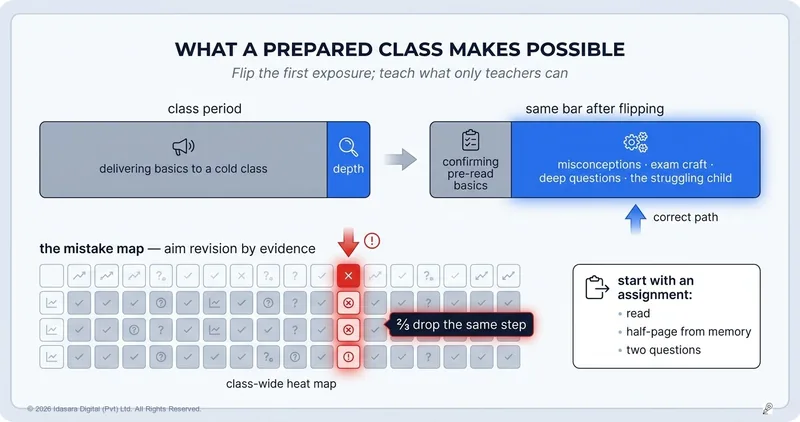
A teacher facing forty students at one pace spends most of each period on first-exposure delivery — the one job a textbook could have done — while the irreplaceable work waits. This chapter of Learn to Learn is written for teachers and school leaders: what changes when students arrive already prepared, how a class-wide view of mistakes replaces guesswork, and why the methods in this book make a teacher more central, not less.
Ask any teacher what they would do with their subject if the class arrived already knowing the basics of today's topic — and watch their face change.
"I'd finally get to the interesting problems." "I'd have time for the ones who are struggling." "We could discuss why, instead of me dictating what." Every teacher carries this list — the lesson they'd love to teach, standing permanently behind the lesson they must teach: the first-exposure delivery of definitions and basics to forty students meeting the material cold, at one pace that is too fast for a third of them and too slow for another third.
This book has spent forty chapters training students to study scientifically. This chapter is about what that training hands to you — because a class of students running these methods changes what a classroom period can be.
The flip, from your side of the desk
Your students' version of this is the flipped-learning chapter: read the official textbook section before class, write a rough note from memory, arrive carrying precise questions. University teaching centres — Carnegie Mellon's among them — have formalised the same structure from the instructor's side: shift first exposure to before class, and spend the contact hour on application, discussion, and the hard parts.
What this buys a Sri Lankan classroom is not a pedagogical fashion — it's time arithmetic. First-exposure delivery consumes the bulk of a period, and it is precisely the component of teaching that a government textbook, read in advance, can carry. What cannot be outsourced to any book — untangling a misconception live, showing the exam-craft of a marking scheme, taking a sharp question to its depth, noticing which child has quietly stopped following — is exactly what the reclaimed minutes become available for. The flip doesn't shrink the teacher's role. It concentrates it on the parts only a teacher can do.
Starting it doesn't require permission or infrastructure — it requires an assignment change: "Before Thursday: read section 5.2, write half a page from memory, bring two written questions." Students who've read this book know exactly how to do that; students who haven't will learn your subject and the method together. Expect the first weeks to be uneven — and expect the question quality to astonish you by week four. Prepared students ask surgical questions (their chapters trained them to), and surgical questions are the raw material of the lessons on your list.
Where exactly is this class weak, right now?
The second gift is diagnostic. You know the marking problem intimately: honest feedback is the most powerful thing you give students, and it arrives at a brutal price — forty scripts, per class, per exercise, at an hour each week you don't have. So feedback gets rationed, and the question you'd most like answered — where exactly is this class weak, right now? — gets answered by intuition and a handful of marked samples.
Students running this book's methods generate the answer as a by-product. Each one keeps a mistake bank — errors collected from marked exercises and papers, classified by topic and type. Aggregate those banks across a class — even manually, even crudely ("this week, bring your top three recurring error types") — and you hold something teaching rarely gets: a live map of the cohort's actual weaknesses. Not "they're weak in electricity" but "two-thirds are dropping the same step in parallel-circuit calculations." A revision period aimed by that map outperforms three aimed by guesswork; the map also tells you, mercifully, what not to re-teach.
And where the marking itself is the bottleneck: the tools that mark handwritten scripts against official schemes — the ones this book's students use for their own practice — change the economics for you too. Students arrive with practice already marked; your expertise gets spent on the deductions that puzzle them, not on the first pass through forty scripts.
Teaching the method, not just the subject
One more role this book quietly hands you — the largest one.
Most students will never read a learning-science paper; they inherit their study methods from folklore: re-read, highlight, copy notes, cram. You are the person best positioned to break that inheritance. A teacher who spends one period per term on method — how memory actually works, why blank-page retrieval beats re-reading, how marking schemes pay, how to log a question — upgrades every study hour that student spends thereafter, in every subject, including yours. The same holds for the newest folklore: students are already using AI, mostly as the vending machine this book warns about. A teacher who demonstrates tutor-mode in class — attempt first, then interrogate the tool, then verify against the textbook — is teaching the century's literacy alongside the syllabus. UNESCO's guidance for educators says precisely this: the competencies, not the tools, are the curriculum.
None of this asks more of your scarcest resource. The flip reclaims time; the map aims it; the method-teaching multiplies it. This book's entire relationship to teachers can be said in one line: it prepares your students so that your irreplaceable work — the part no book, no app, and no AI can do — gets the hours it deserves.
Do this this term
- Pick one class and flip one week: pre-reading assigned with the half-page-from-memory note, two written questions per student as the ticket in. Teach the reclaimed minutes from their questions.
- Build the crude mistake map once: collect each student's top three recurring error types after the next marked exercise. Aim one revision period with it, and compare the feel of that period to the usual.
- Spend twenty minutes of one lesson on method — the blank-page test — write it from memory, book closed — is the ideal first demonstration; it converts sceptics of all ages in real time.
At a glance
- The flip's gift to teachers is time arithmetic: textbook-carried first exposure returns the period to what only a teacher can do — misconceptions, depth, exam-craft, the struggling child.
- Start it with an assignment, not a reform: read the section, half a page from memory, two written questions. Question quality by week four will make the case.
- Aggregated student mistake banks = a live class weakness map — revision aimed by evidence, not guesswork; marked-script tools break the forty-scripts bottleneck.
- One period per term on method (retrieval, schemes, question logs, tutor-mode AI) upgrades every hour students study thereafter.
- The methods make teachers more central, not less: they concentrate the role on its irreplaceable core.
One step further with Idasara Academy
The aggregation this chapter sketches manually is what Idasara Academy's teacher classroom tools do continuously: class management with quiz building and cohort analytics — class-wide mistake patterns by topic, so you see the live weakness map without collecting anything — while the marking engine gives every student's practice scripts rubric-based feedback before they reach you. The design principle throughout is the one this chapter argued: the system carries first exposure and first-pass feedback, so the teacher's hours land where teachers are irreplaceable.
Start Free — Create Your Account →
FAQ
My students won't do pre-reading. Realistically, what then? Attach a two-minute stake: the written questions as entry ticket, or a three-question retrieval quiz on the pre-reading to open class. Compliance follows accountability, and the quiz itself is retrieval practice — the stake does double duty. Start with your senior class, where exam pressure makes the case for you.
Doesn't flipping assume every child has a textbook and home conditions for study? The government textbook is the most equitably distributed learning resource in the country — that's exactly why this book anchors on it. Where home conditions are the barrier, ten minutes of in-class pre-reading at the previous period's end achieves most of the flip. The principle is first-exposure-before-teaching, not homework-for-its-own-sake.
Aren't these apps and AI tools coming for the teaching profession? Read what the tools actually do in this book: deliver content, mark scripts, schedule revision — the components of teaching that were always rationed by time, never the ones that make teaching a profession. Every chapter here routes students toward their teachers with better questions. The judgement, the live untangling, the relationship — this book's own AI chapters argue those don't automate.
As a school leader, where would I start with this across a staff? The mistake map — it's the intervention with the fastest visible payoff (one aimed revision period), it requires no timetable change, and its evidence tends to convert the staffroom sceptics that pedagogy debates never reach. The flip follows more easily once teachers have felt evidence-aimed teaching once.
Further reading
The method's guidance for teachers and educational leaders — flipped implementation, cohort telemetry, and classroom AI literacy — is written up in the Idasara Method: the manifesto's educator guidance and Part 2 — The Plan.
Sources
- Carnegie Mellon University, Eberly Center — Flipping the Class
- UNESCO — Artificial intelligence in education: a human-centred approach (competency frameworks for teachers)
- The Idasara Method: Part 2 — The Plan