How to Win at School and Examinations: The 12-Step Master Journey
The definitive guide for Sri Lankan GCE O/L and A/L students based on The Idasara Method document. Learn how to combine official NIE textbooks, handwritten short notes, exam paper marking, and Idasara Ask AI to get A passes without burnout.
Hello Student: A Personal Message Before You Begin
If you are reading this, you are likely preparing for one of the most important milestones of your life—your GCE Ordinary Level (O/L) or GCE Advanced Level (A/L) examinations.
You may have been told that passing with distinction requires non-stop, exhausting cramming. You may feel overwhelmed by the number of subjects (9 subjects for O/L), the extreme depth of stream subjects (Combined Mathematics, Physics, Chemistry for A/L), or the fear of getting stuck on difficult topics.
Here is what we want you to understand from day one: You do not need to burn out to achieve an A pass. You need a scientific, step-by-step habit.
Idasara Academy was not built to replace your school, your teachers, or your government textbooks. It was built to work with them. This guide outlines the exact 12-step strategy (The Idasara Method) that turns your daily reading, handwritten note-taking, school attendance, and app practice into a complete, winning study system.
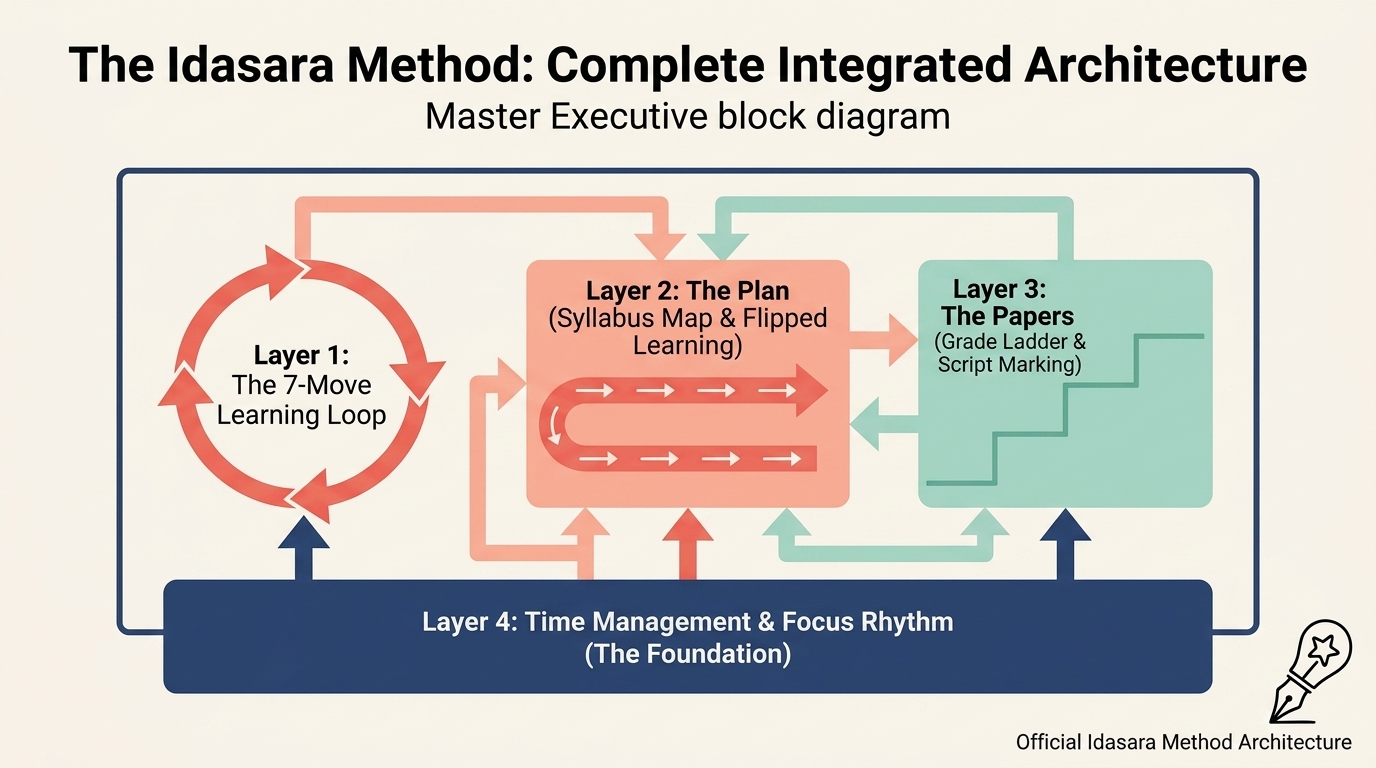
The Master Architecture: The Idasara Method
The Idasara Method operates on four structured layers:
- Layer 1 · The Loop: The 7 sequential moves you execute for every single lesson.
- Layer 2 · The Plan: Making sure the loop covers the entire national syllabus in time.
- Layer 3 · The Papers: Converting syllabus coverage into verified examination marks.
- Layer 4 · Time: The master scheduling engine that decides daily focus and prevents burnout.
Layer 1: The 7-Move Learning Loop
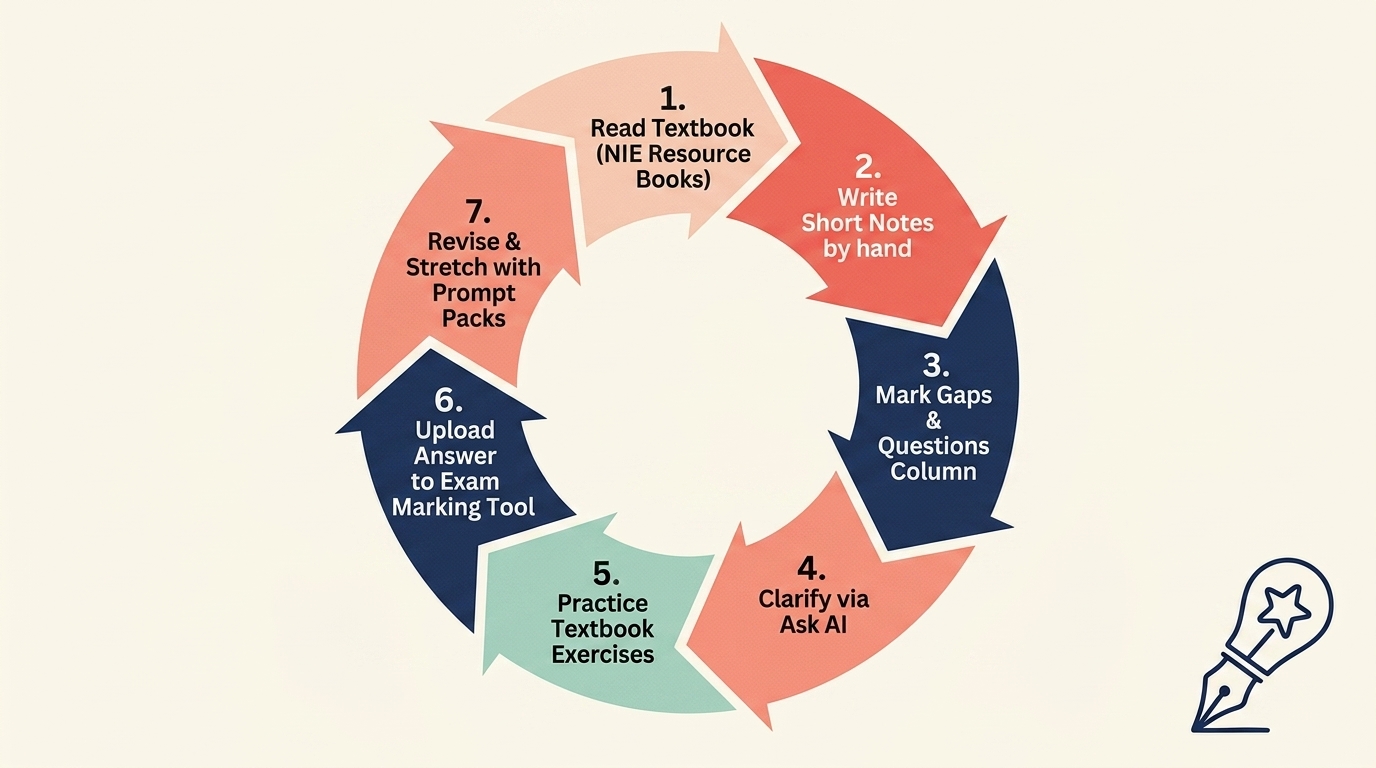
Step 1: Read Official National Textbooks & Resource Books
Never begin your study with informal internet summaries or third-party revision guides.
- For O/L (Grades 6–11): Ground every lesson in your official Educational Publications Department textbooks. Read the whole lesson through—even the parts you don't understand on the first pass. Do not stop to search; just read.
- For A/L: Anchor your study strictly in the official National Institute of Education (NIE) Resource Books.
- Why? National examination papers are constructed directly from these official government sources.
Step 2: Write Your Own Short Notes (Pen & Paper Active Recall)
Put your digital devices aside when reading a textbook section. Write your own short notes in a physical notebook using pen and paper.
- Do not copy word for word—compress the lesson into your own words.
- Once done, open the Short Notes tool in Idasara Academy. Compare your handwritten notes against our digital summary to catch missed formulas, definitions, or diagram labels. The gap between your notes and ours is your first diagnostic, and it costs you nothing.
(Deep Dive: Read Part 1: The Human Foundation & The 7-Move Learning Loop)
Step 3: Maintain a Notebook Question Log (Mark Your Gaps)
Down the side of your handwritten short notes, keep a parallel second column: everything you didn't follow, and every question that came up during reading.
- This column is the most valuable thing on the page. Don't be embarrassed by a long list—a long gap column means you were reading honestly.
- Turning emotional frustration into a written question keeps your study momentum moving forward.
(Deep Dive: Read Part 1: The Human Foundation & The 7-Move Learning Loop)
Step 4: Resolve Your Question Log with Ask AI
Take that gap column to Idasara Ask AI, one question at a time. Keep going until the column is empty. Because the AI is pre-loaded with your national syllabus and subject context, it delivers precise, hallucination-free explanations. Write the key takeaway into your notebook in red ink beside your original question.
(Deep Dive: Read Part 1: The Human Foundation & The 7-Move Learning Loop)
Step 5: Solve Textbook End-of-Chapter Exercises First
Do the exercises at the end of the lesson in the textbook on paper in your physical notebook. New questions and stuck points go straight into your notebook's gap column, and then back to Ask AI.
Step 6: Mark Written Answers with the Exam Paper Marking Tool
Photograph the question and your handwritten answer and upload them to the Exam Paper Marking Tool.
- Read the marking feedback. If you don't understand why you lost marks, or how the answer could be stronger, ask right there—the marking is an ongoing conversation, not a final verdict.
- You receive step-by-step feedback showing where Method Marks (M) or Accuracy Marks (A) were lost, fixing presentation defects before the exam.
(Deep Dive: Read Part 3: The Papers — Grade Ladder, Script Marking & the Writing Skill)
Step 7: Revise & Stretch with Revision Questions & Prompt Packs
Answer questions in our Revision Questions section: write full answers, mark them with the Exam Tool, and close the gaps.
Then move to the Prompt Pack—answer first on paper, then take what's left to Ask AI.
Why the Prompt Pack Exists & Why Ask AI Beats "Naked ChatGPT"
Prompt packs aren't extra homework. They are how you build AI literacy while you study—the second essential skill you leave school with.
Many students ask: "Why not just use free, generic ChatGPT?"
- No Prompting Tax: Standard ChatGPT requires you to type long setups to prevent it from using foreign (US/UK) syllabi. Idasara is 100% pre-grounded on NIE standards.
- Zero Hallucinations: Standard AI frequently invents formulas. Idasara operates within strict curriculum guardrails.
- Automated Telemetry & Memory: A general chatbot answers your question and forgets you. Idasara answers your question and remembers what you got wrong, building your performance insight, national ranking, and Mistake Bank.
(Deep Dive: Read Part 1: The Human Foundation & The 7-Move Learning Loop)
Steps 8 & 9: Master the Dual Superpowers — Deep Reading & Writing
Look at what the 7-move loop actually trains you to do: read something hard, understand it, compose a response, and write it down.
- That is the exam, exactly: You read the question alone, you understand it alone, and you write the answer alone.
- That is prompting, exactly: In the AI age, the person who reads and writes well is the person who can direct the machine and judge what comes back. Everyone else is guessing.
Reading and writing are the two skills that pay twice—for exams today and for AI-driven careers tomorrow.
(Deep Dive: Read Part 3: The Papers — Grade Ladder, Script Marking & the Writing Skill)
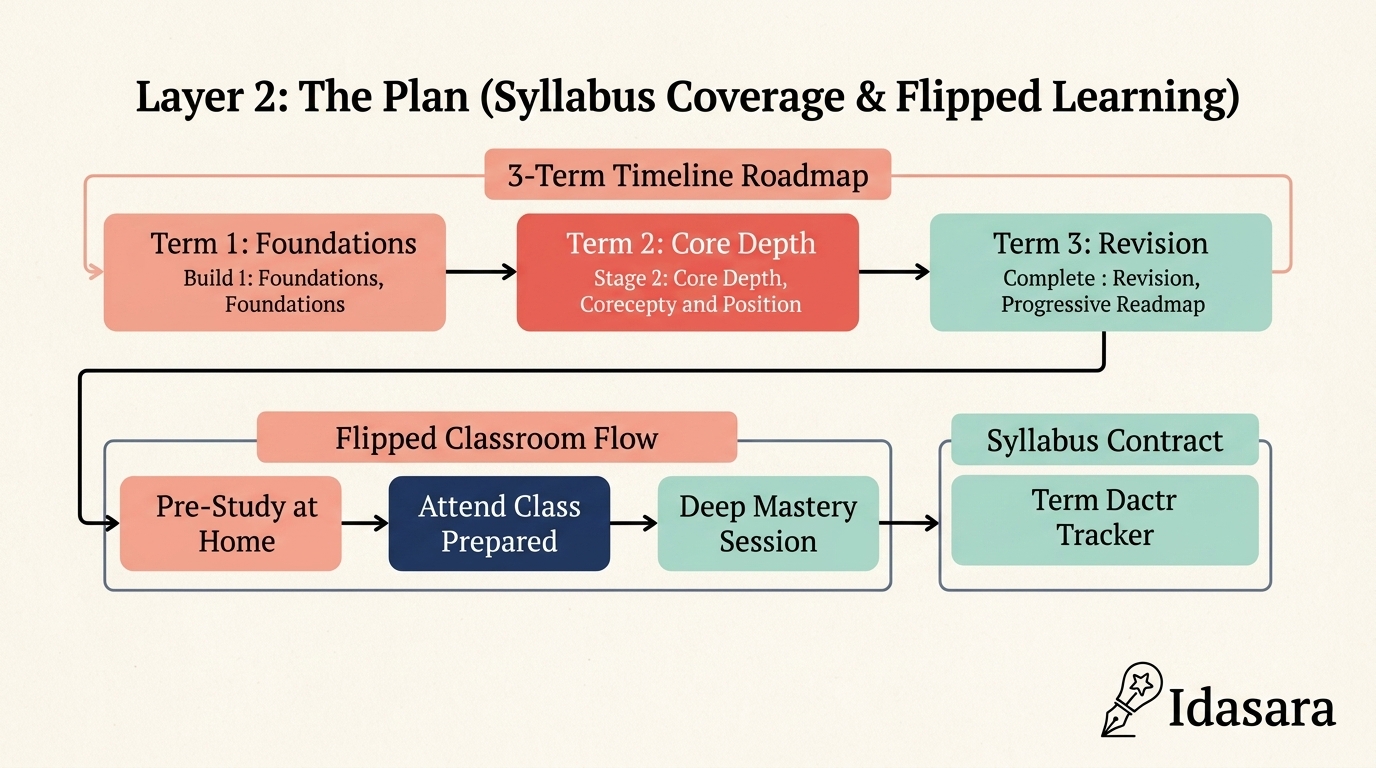
Layer 2: The Plan (Syllabus Coverage & Flipped Learning)
Steps 10 & 11: Know the Map, Run Ahead of Class, Track It
The 7-move loop is useless if you finish it in November right before exams. You must control your syllabus velocity:
- Know the Map: Open the lesson outline for your grade in Short Notes. It shows all three terms and what each term must cover. The same exists for A/L. That is your syllabus contract with yourself.
- Run Ahead of Class (Flipped Learning): Complete lessons on your own before school or tuition reaches them. Then attend—school always, tuition if you want—already knowing the lesson. You arrive to go deeper, not to hear it for the first time. That single change turns a passive class into a private tutorial.
- Track It: Use the Time Management tool to see where you actually are against where you should be. You want to find out about gaps in March, not in the examination hall.
(Deep Dive: Read Part 2: The Plan — Syllabus Coverage & Flipped Learning)
Layer 3: The Papers (Converting Coverage into Marks)
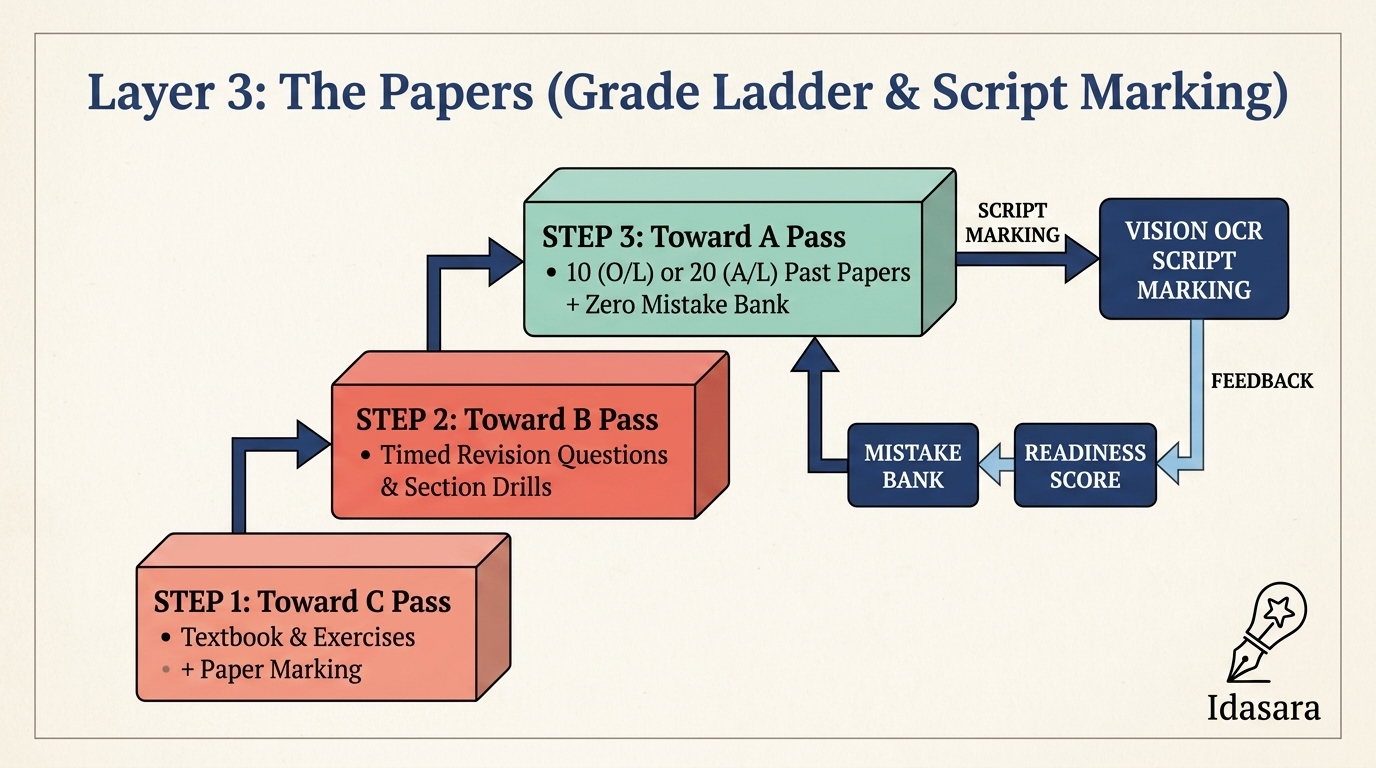
Past and practice papers cover almost the full syllabus—which is why they come last, not first. Attempting them before you have syllabus coverage only teaches you that you don't know things.
The Grade Progression Ladder, Honestly Stated

- Toward a C Pass: Textbook read, every end-of-chapter exercise done, everything marked with the Exam tool.
- Toward a B, then an A Pass: All of the above, plus your Mistake Bank worked down to zero, plus 10 or more past papers for O/L, or 20 or more for A/L.
These are targets drawn from what we see working. Every paper you mark feeds your performance insight, your ranking, and your mistake bank, so each paper marked is worth more than the last.
(Deep Dive: Read Part 3: The Papers — Grade Ladder, Script Marking & the Writing Skill)
Layer 4: Time Management (The Master Schedule Engine)
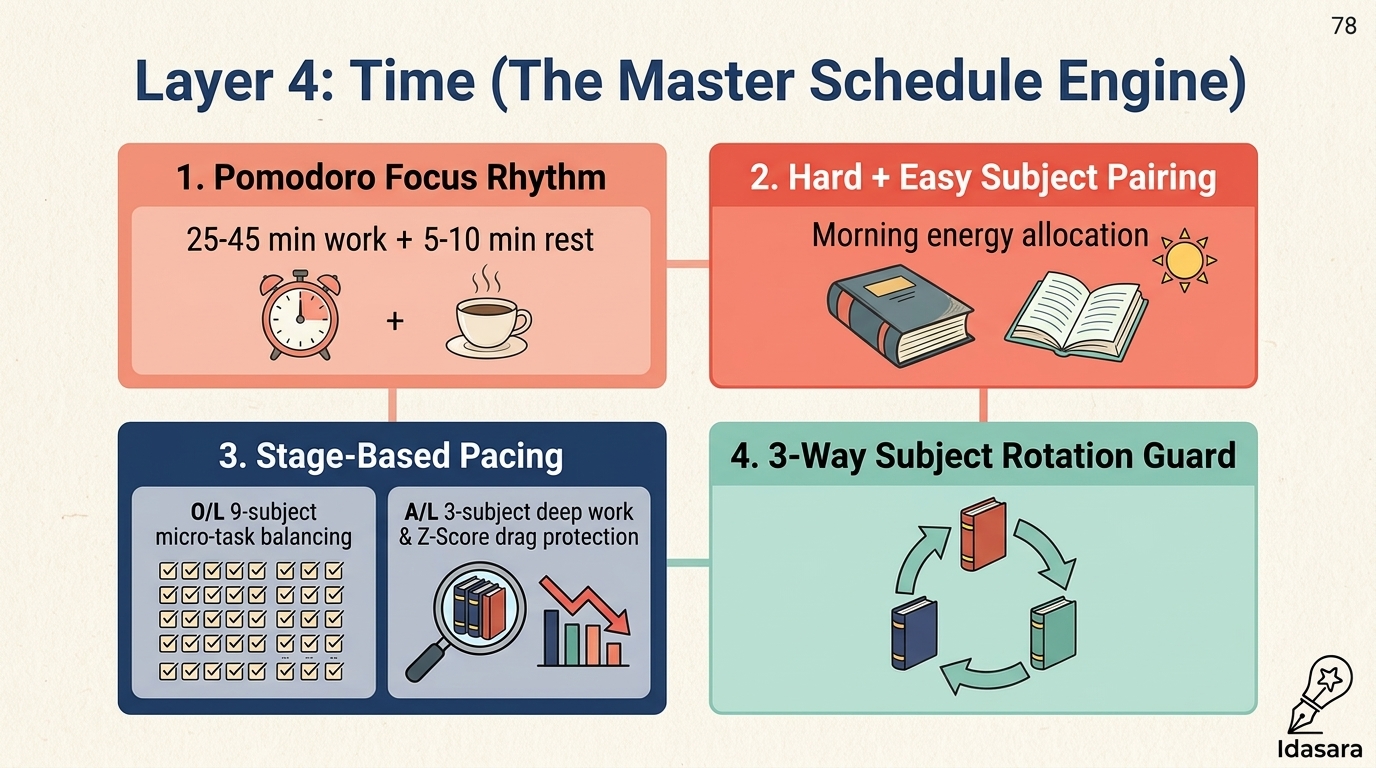
Time management is the thing that decides everything. Incorporate these six principles:
- Finish Your Own Lesson List: Use the app, Ask AI, revise, and mark at your own pace.
- Attend Every Subject: No silent drop-outs or subject abandonment.
- Give Hard Subjects More Time Early: Allocate extra time while there is still time to give.
- Pair Hard and Easy Subjects: Slot one hard subject alongside one easy subject each day. Never stack two hard ones together.
- Work in Focused Blocks (Pomodoro Technique): Use 25–45 minute deep focus blocks with 5–10 minute real rest breaks. Focus is a muscle, not a mood.
- Let the Tool Hold the Schedule: Let the Time Management tool hold the schedule so your head doesn't have to.
(Deep Dive: Read Part 4: Time — The Master Schedule Engine)
Q1: How many past papers should I complete to get an A pass in GCE O/L or A/L?
For an A pass, Idasara suggests at least 10 full past papers for O/L students and at least 20 for A/L students, under timed conditions, with every script submitted to the Exam Paper Marking Tool and every error in the Mistake Bank resolved. Those counts are our guidance, not an official threshold.
Q2: Should I rely on digital study apps instead of school textbooks?
No. Always read official Educational Publications Department textbooks (O/L) or NIE Resource Books (A/L) first. Idasara Academy is designed to amplify your textbook reading and handwritten notes, not replace primary government syllabus sources.
Q3: Why is Idasara Ask AI better than using standard ChatGPT for exam revision?
Standard ChatGPT uses generic web data, frequently hallucinates false formulas, lacks NIE syllabus context, and cannot track your progress. Idasara Ask AI operates inside strict NIE curriculum guardrails and automatically feeds your errors into your personal Mistake Bank and Readiness Score.
Q4: How does Idasara help A/L Physical Science students balance Combined Maths, Physics, and Chemistry?
The app's Time Management Engine allocates 90–120 minute deep-work blocks, enforces a 3-way subject rotation guard, and monitors Z-Score Drag—automatically directing extra study hours to your weakest subject so your overall university admission rank is protected.
Comprehensive Deep-Dive Reference Series
To explore the detailed scientific rationale, neurological evidence, and technical architecture behind each phase of this journey, read the four-part White Paper Series:
- 📄 Part 1: The Human Foundation & The 7-Move Learning Loop
Textbooks, Handwritten Short Notes, Self-Comparison Protocol & Question Logs. - 📄 Part 2: The Plan — Syllabus Coverage & Flipped Learning
Surgical AI Queries,Ask AIvs. ChatGPT, Prompt Packs & 21st-Century AI Literacy. - 📄 Part 3: The Papers — Grade Ladder, Script Marking & the Writing Skill
3-Term Syllabus Timelines, The C-to-A Grade Ladder, Vision OCR Paper Marking & Telemetry. - 📄 Part 4: Time — The Master Schedule Engine
Ahead-of-Class Pre-Study, O/L 9-Subject Balancing, A/L Deep Work & Z-Score Drag Protection.
The reads of The Idasara Method
- Start here: The 12-Step Master Journey — The whole method in order, from first textbook page to exam day. (you are here)
- Layer 1 · The Loop — Textbook reading, handwritten notes, Question Logs, and Ask AI.
- Layer 2 · The Plan — The 3-term syllabus roadmap, your syllabus contract and term tracker, and the flipped classroom.
- Layer 3 · The Papers — C to A pass ladder, Vision OCR marking, and Mistake Bank.
- Layer 4 · Time — Pomodoro focus rhythm, hard-and-easy subject pairing, stage-based pacing and Z-score protection.
- The Book · Learn to Learn — The complete method as a free 100-chapter book, in English, Sinhala and Tamil.
Put The Idasara Method into Practice Today
Get your personal AI Study Coach, NIE-aligned short notes, and Vision OCR paper marking. Free to start.
Start Free — Create Your Account →