Term 1 Debt: The Most Expensive Debt a Student Can Carry
The short answer: If new lessons have stopped making sense, you have probably not hit a ceiling — you're paying interest on a small gap from earlier, because every later topic stands on Term 1's foundations. Walk backwards from the painful topic until you find ground that holds, rebuild that one gap at full quality, and repay it beside your current work — a fixed weekly slice, oldest first.
A chapter of the free book Learn to Learn
Published 2026-08-31 · updated 2026-08-31
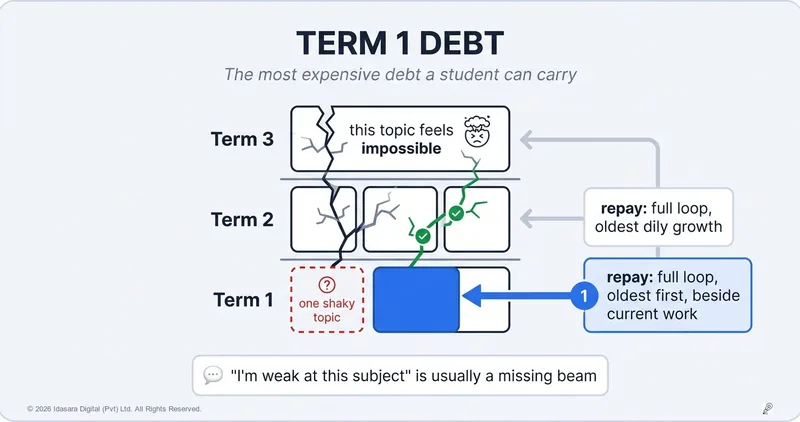
Syllabuses are built like towers — every later topic stands on earlier ones — so a gap left in Term 1 quietly charges interest on everything that follows. This chapter of Learn to Learn explains why "I don't understand the new lessons" is usually old debt talking, how to find yours, and the repayment plan that clears it beside your current work.
Here is a mystery that plays out in thousands of classrooms every year, always in the same shape.
A student does fine in Term 1 — a wobble on one or two topics, nothing dramatic, the class moved on and so did they. Term 2 feels harder; they chalk it up to harder material. By Term 3 they are sitting in lessons that might as well be in another language, working twice as hard as the students around them, understanding half as much — and drawing the obvious, wrong conclusion: "I've hit my ceiling in this subject."
No ceiling. What they've hit is compound interest. Let's trace where the loan was taken out.
Syllabuses are towers, not playlists
The mental model most students carry is that a syllabus is a playlist — a sequence of separate items, where skipping track 4 just means you don't know track 4.
But look at how your subjects are actually built. Algebra's manipulations are inside every later maths topic — calculus is made of them. The mole concept runs under half of chemistry. Force and motion carry most of physics on their shoulders. Grammar fundamentals sit inside every essay a language subject will ever ask for. A syllabus is a tower: Term 1 pours the foundation, and every later floor loads its weight onto it.
Which means a Term 1 gap never behaves like a missing track. It behaves like a missing beam. Skip "track 4" in a tower, and track 9 doesn't arrive as a fresh, separate challenge — it arrives pre-broken, because part of it stands on what isn't there. The student experiences this as "track 9 is too hard for me." The truth is that track 9 is fine; it's being asked to stand on air.
Why does a small gap keep getting worse?
Watch the debt grow through a year, because the mechanism explains everything the struggling student feels:
The original loan is small. One shaky topic — indices, say — costs perhaps two lessons' worth of understanding. Barely noticeable. In March, repaying it is one honest evening.
The interest starts in the next chapter. Every new topic touching indices now runs at partial comprehension. Class time that should build new understanding gets spent silently struggling with the old gap — so the new topics are learned shallowly too. The debt is now spreading into material that was never itself the problem.
Then the interest compounds socially and emotionally. Shallow Term 2 topics become the shaky foundation for Term 3. Homework takes longer, scores drift down, and the student — who cannot see the original two-lesson gap under all the sediment — reaches for the only explanation in view: "I'm weak at this subject." That belief is the debt's cruellest interest payment, because it stops the search for the beam. You met this pattern in the opening chapters: wrong conclusions about talent are almost always right observations standing on invisible causes.
Run the tape in reverse and the hope in this chapter appears: if the misery came from one buried gap, then repaying one gap un-breaks everything standing on it. Students who finally patch a foundational topic routinely describe the eerie experience of three current topics becoming comprehensible in the same week. Nothing magical — the floors just got their beam back.
How do you catch up without stopping current work?
Clearing old debt while the syllabus keeps moving feels impossible — it isn't, but it needs a plan rather than heroics.
Step 1 — Locate the original loan, not the crime scene. The topic where you're suffering is rarely the topic that's missing. Take the current painful topic and walk backwards: which earlier ideas does it assume? Can I actually do those, on paper, cold? Keep walking until you hit ground that holds — the boundary you cross is your debt. (This is the locating question from the question-log chapters, doing structural work.) Your marked exercises and test papers are drill cores: recurring error types usually point at one buried layer.
Step 2 — Repay at full quality, not in a panic-skim. The gap gets the complete loop — official textbook, short note from memory, red-ink audit, exercises checked. It was skimming that created the debt; skimming the repayment just refinances it. One foundational topic, properly rebuilt, outvalues three re-read ones.
Step 3 — Pay beside, not instead. Don't halt current work for a "catch-up month" — that just takes a new loan on the current term. The sustainable structure: current topics hold their place in your week, and a fixed slice — one or two blocks — is permanently assigned to debt repayment, oldest first. It feels slow. It is actually the fastest schedule that doesn't create new debt while paying old.
Step 4 — Retire the belief with the debt. When the gap is repaid and current lessons start landing again, do one deliberate thing: notice it. The evidence that "I'm weak at this subject" was a structural problem, not a verdict, is the most valuable thing the whole repair produces — carry it into the next subject that feels like a ceiling.
Do this tonight
- Pick the subject where new lessons feel hardest. Take tonight's topic and write down what it assumes — the two or three earlier ideas it stands on.
- Test each assumption honestly: one exercise from that earlier topic, on paper, cold. Where you fail cheaply, you've found the beam.
- Schedule the repayment: one block tomorrow, full loop, that topic. Not the whole debt — the oldest piece of it. Compound interest works for you the moment you reverse it.
At a glance
- Syllabuses are towers: every later topic loads weight on Term 1 foundations — a gap there breaks floors that were never themselves the problem.
- The debt compounds: one shaky topic → shallow learning of everything touching it → "I'm weak at this subject" (the cruellest interest of all).
- The suffering topic is rarely the missing topic: walk backwards to ground that holds; recurring error types are drill cores.
- Repay at full quality (complete loop), beside current work (fixed weekly slice, oldest first) — never as a panic month.
- Reversed compound interest is real: one repaid foundation un-breaks multiple current topics at once.
One step further with Idasara Academy
Debt-finding and debt-scheduling are exactly the drudgery worth automating. Idasara Academy's free curriculum browser lets you audit backwards — every earlier topic, listed, with micro-quizzes to test each one cold — and Today's Plan routes repayment beside current work automatically, feeding you the oldest gaps in bite-sized daily tasks while the current term holds its lane. The Mistake Bank does the drill-core reading for you: recurring error patterns point at the buried layer, so you dig where the beam actually is.

Start Free — Create Your Account →
FAQ
How do I know whether I'm "bad at maths" or carrying maths debt? Run the backwards walk. Genuine subject difficulty is diffuse — everything is somewhat hard. Debt has a signature: specific earlier operations fail cheaply and repeatedly (the same manipulation, the same concept), while topics not touching them feel fine. Nearly every "bad at maths" story this test meets turns out to be debt.
My Term 1 was two years ago — O/L gaps showing up in A/L. Same advice? Exactly the same, with more patience: the tower is just taller, so the walk backwards is longer and the un-breaking more dramatic. A/L students who rebuild an O/L foundation routinely watch entire A/L chapters unlock. The repayment loop doesn't care how old the loan is.
Shouldn't school or tuition have caught this? In a class of forty moving at one pace, small individual gaps are structurally invisible — nobody's fault, everybody's problem. Which is why the syllabus-contract chapter made the list your responsibility: you are the only person positioned to audit your own foundations.
Is it worth repaying debt this close to the exam? Price it like the tracker chapter taught: a foundational gap sheds marks across every question standing on it, so it's usually the highest-yield purchase left on the shelf — bought oldest-first, beside your past-paper work, for as long as the calendar allows.
Further reading
Why Term 1 debt is the most expensive in the year — and how the term tracker catches it early — is written up in the Idasara Method: Part 2 — The Plan.
Sources
- UCLA Bjork Learning and Forgetting Lab — research overview on how prior knowledge scaffolds new learning
- Novak, J. & Cañas, A. — The Theory Underlying Concept Maps (new learning assimilates into existing structures)
- The Idasara Method: Part 2 — The Plan