If Reading Itself Is Slow: The On-Ramp Nobody Built
The short answer: Reading speed is built by exposure, not talent: fifteen minutes a day of genuinely easy reading — two grades below comfort if needed — upgrades fluency automatically, and twelve weeks of graded daily volume walks you from easy stories back up to the textbook. Two checks come first: an eye test, and, if reading has been hard since the very beginning, a school-and-doctor conversation about assessment.
A chapter of the free book Learn to Learn
Published 2026-08-31 · updated 2026-08-31
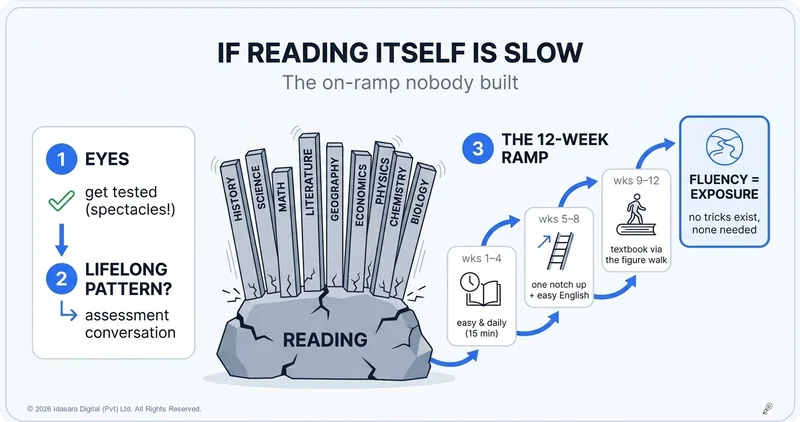
Every chapter of this book assumes one skill so basic it's invisible: that reading a page is easy. For some students — more than anyone admits — it isn't: the words come slowly, the effort of decoding eats the understanding, and every subject becomes a reading test first. This chapter of Learn to Learn is the on-ramp: why reading fluency is buildable at any age, the 12-week volume programme, and the two checks to run before blaming yourself for anything.
There is a struggle that hides inside every other struggle, and school almost never names it after Grade 5.
The student who "won't read the textbook" — who studies only from short notes, who freezes at long questions, whose every subject mysteriously underperforms — is often a student for whom reading itself is still hard work: each sentence costs real effort to decode, so little attention remains for meaning, so pages take forever and teach little, so reading gets avoided, so it never improves. A slow-reading Grade-10 student isn't failing nine subjects. They're failing one skill nine times — and because everyone assumes the skill, nobody treats it.
This chapter treats it. Three parts: the two checks that come first, the honest science, and the on-ramp.
First: two checks, before anything else
Check one — the eyes. A meaningful share of "slow readers" are squinting at blur: uncorrected vision may be the most under-diagnosed study problem there is, and spectacles are the highest-return educational purchase a family can make (the free-stack chapter said it; this is the chapter it was said for). If print swims, doubles, or headaches follow reading — eye test first. Everything else waits.
Check two — the pattern. If reading has been hard since the beginning, everywhere, despite honest effort — letters confused, sounds not attaching to symbols, the struggle lifelong rather than lately — that's the pattern the parents' chapter flagged: worth a proper conversation with the school and a doctor about assessment for learning differences. Not a verdict — a diagnosis question, and this book's methods still work either way, adapted. What must end today is the lazy-verdict: no child chooses to decode slowly.
Both checks clear? Then what remains is the common case: a fluency debt — too little reading, for too long, usually because early reading was unpleasant somewhere and avoidance did the rest. Fluency debt has a repayment plan, and it's gentler than you fear.
What actually cures slow reading? Volume, graded — the honest science
The reading-speed chapter carried the finding; here it becomes a lifeline: reading speed is exposure — the more times you've met words and sentence-shapes, the faster they process, automatically, with understanding intact. There is no trick, no eye-exercise, no course — and that is the good news, because it means the cure needs nothing but material and a rhythm: read daily, at a level that's comfortable, and the machinery upgrades itself. The one mistake that keeps slow readers slow is reading only material that's too hard (their own textbooks) — every session a defeat, avoidance re-earned. Fluency is built downhill: easy volume first, difficulty following fluency. Swallow the pride the same way the maths-from-zero chapter taught: the level is private, and it moves.
The 12-week on-ramp
Weeks 1–4 — easy and daily. Fifteen minutes a day of genuinely easy reading in your strongest language: children's books, easy stories, simple news — two grades below comfort if needed. The only goals: daily, pleasant-ish, finished. (Reading aloud quietly is allowed and helps — the ear supports the eye at this stage.) Weeks 5–8 — up one notch, add the second language. Strongest-language material at a comfortable-plus level; begin ten minutes of very easy English (or your exam's second language) alongside — the second-language chapter's fluency deposit, started at on-ramp grade. Keep a one-line log: minutes and pages. The log is your streak, and the pages-per-week number will already be moving. Weeks 9–12 — bridge to the textbook. Introduce short textbook passages of already-familiar topics (familiarity carries the vocabulary), using the figure walk as the entry point — pictures first, then the paragraphs around them. By now the daily habit exists, the decoding is cheaper, and the textbook stops being a wall and becomes merely a harder book.
After the ramp: the volume habit continues inside normal studying (the reading chapters take over), and the trajectory keeps compounding — fluency built at fifteen keeps paying at fifty. Expect the whole arc to be humbling for a fortnight and then quietly astonishing: somewhere around the middle weeks, reading starts to feel like getting something rather than paying for it.
How can the family help?
The slow reader has usually been performing okay-ness for years — covering, avoiding, memorising around the gap. What the rebuild needs from the household: material at easy levels without commentary (the library card is the tool; the librarian's help finding easy books is the ask), the fifteen minutes protected like the comeback's twenty, and absolute silence about the level. And one act of modelling worth more than any instruction: let the child see an adult reading — any adult, anything. Homes where reading is a thing people visibly do produce readers; homes where it's only a thing children are ordered to do produce avoiders.
Do this tonight
- Book the eye test if there's any doubt at all. Tonight's actual first step.
- Find tonight's easy material — genuinely easy, strongest language — and read fifteen minutes. Log the minutes and pages, and tick day one.
- If the lifelong-pattern check rang true: start the school/doctor conversation this week, with the parents'-chapter framing. A diagnosis question, not a verdict.
At a glance
- Slow reading is one skill failing nine subjects — and school stops treating it after Grade 5. This chapter is the missing on-ramp.
- Two checks first: eyes (spectacles are the country's most neglected study purchase) and the lifelong pattern (assessment conversation — a question, not a verdict).
- The science is kind: fluency = exposure — daily easy volume upgrades the machinery automatically. No tricks exist; none are needed.
- The 12-week ramp: easy & daily → one notch up + easy second-language → familiar-topic textbook passages via the figure walk. Level private; log the minutes.
- Families: easy material without commentary, the fifteen minutes protected, and an adult seen reading.
One step further with Idasara Academy
This ramp needs almost no app at all — it runs on newspapers, textbooks, and a private fifteen minutes. When bridge material is scarce, the free short notes carry short structured passages in your language; otherwise, read on paper and keep the record to yourself.
Start Free — Create Your Account →
FAQ
I'm in the exam year — is 12 weeks of easy reading a luxury I can't afford? Inverted: it's the investment everything else is waiting on — every subject's studying runs through this skill, and the exam itself is a timed reading test (the reading chapters proved it). Run the ramp alongside triaged studying (the rescue chapter balances them); even weeks 1–6 measurably cheapen every other hour.
Reading in my own language is fine; it's English reading that crawls. Then you're not this chapter's deep case — you're the second-language chapter's normal one: run its two-pass method and the daily easy-English volume from week 5's recipe. Same medicine, narrower dose.
Audiobooks and read-alongs — cheating or helpful? Helpful, early: hearing while seeing text yokes the ear to the eye and speeds the attachment. The ramp's goal is independent reading, so fade the audio as decoding cheapens — training wheels, used exactly like training wheels.
Honestly, can a Grade-10 slow reader really change? It feels fixed. It feels fixed because avoidance froze it years ago — the machinery itself never stopped being upgradeable (the exposure science has no age clause). The on-ramp's fortnight of humility buys a different decade. Every week logged is evidence against "fixed" — and by now you know which of those two this book bets on.
Further reading
The protocol this specialises: Starting From S and F. Where the road leads: Read, Then Read Fast and Studying in a Second Language. The family's part: For Parents: Help Without Hovering.
Sources
- Rayner, K. et al. (2016) — So Much to Read, So Little Time, APS (fluency through exposure; no shortcuts exist)
- UNESCO — Languages in education (strongest-language-first learning)
- NHS — when to seek help (the assessment conversation)