Read, Then Read Fast: The Exam Skill Nobody Practises
The short answer: Not with speed-reading tricks — pushed speed becomes skimming, and comprehension, the thing exams pay for, drains away. Real exam-reading speed is fluency built by daily active reading of the textbook's formal language, plus timed practice at reading every word of a question once, with full attention, before the pen moves.
A chapter of the free book Learn to Learn
Published 2026-08-31 · updated 2026-08-31
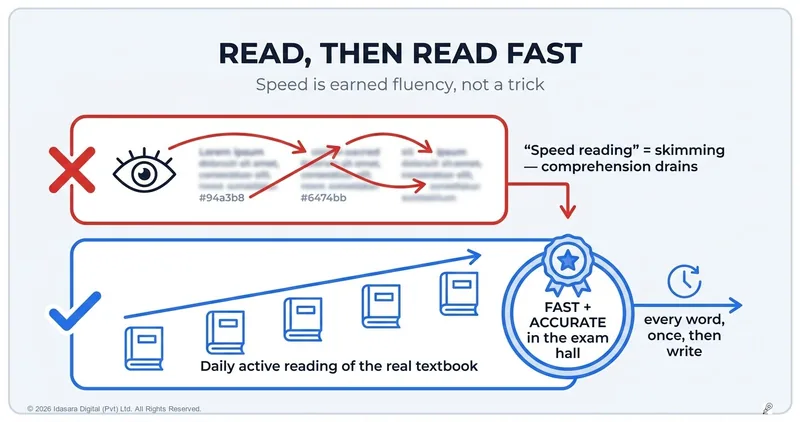
Exams are timed reading tests as much as knowledge tests — but the answer is not "speed reading" tricks, which sacrifice the comprehension exams demand. This chapter of Learn to Learn explains the real skill: active reading that has become fast through daily practice, and how to build it before the clock starts.
Ask students who walked out of a paper defeated what went wrong, and listen carefully to the answers.
"I ran out of time." — "I read the question wrong." — "I spent ten minutes on question 3 before I realised what it was actually asking."
Notice something? None of these are knowledge failures. The physics was known; the essay points were known. What failed was reading under time — the skill every exam silently tests and almost no student deliberately trains. A three-hour paper is thousands of words of dense text: instructions, questions, data, passages. Before you can earn a single mark, you must read — accurately, completely, and fast enough to leave time for the writing.
So: can you learn to read faster? Yes — but not the way the internet sells it. And the difference decides whether your speed costs you the very comprehension you're being examined on.
Does speed reading work? The honest science
You have seen the promises — apps and courses claiming to triple your reading speed, "read a page at a glance," eyes gliding in special patterns.
Reading researchers examined these claims directly, in a major review titled So Much to Read, So Little Time. The verdict was unambiguous: the tricks don't deliver. Pushing reading far beyond your natural speed doesn't accelerate understanding — it abandons it. What speed-readers actually learn is skimming: sampling headings and key words while comprehension quietly drains away. For an exam — where a single overlooked word like not, except, or hence changes what a question means — trading comprehension for velocity isn't a technique. It's a faster way to lose marks.
But the same review contains the genuinely useful finding, and it points somewhere much more hopeful: real reading speed comes from exposure. The more often you have met a word, a phrase, a sentence pattern, the faster your mind processes it — automatically, with comprehension intact. Fluent readers aren't moving their eyes faster; their minds are recognising more per glance, because practice built that recognition.
In simple terms: speed is not a gear you shift into. It is a fluency you accumulate. And that changes the question from "what trick?" to "what training?"
Fast active reading — the skill exams actually pay
Here is where this book's earlier chapters connect. You already know passive reading — eyes gliding, mind half-elsewhere — teaches almost nothing at any speed. The reading that works is active: interrogating the text, tracking the argument, noticing what you don't understand, converting confusion into questions.
The exam skill is doing that — quickly. Not skimming instead of engaging. Engaging, at a pace your training has made natural.
And this is why the training is inseparable from everything this book has already asked of you:
Volume builds the engine. Every textbook chapter read properly — in the formal, technical register your exams are written in — deposits fluency. The student who has actively read the official textbook all year has met the exam's vocabulary, sentence shapes, and diagram conventions thousands of times. On exam day, their mind processes the paper's language on sight, while the student raised on shortcut notes meets the exam's register almost as a foreign language — at the worst possible moment to be translating.
Purpose builds the speed. Active reading is naturally faster than drifting reading, for the same reason a person searching a room moves faster than a person wandering one. Reading with questions — what is this section claiming? what will they ask me about this? — pulls your attention forward. Passive reading meanders and re-reads; active reading, practised daily, quietly becomes both the deeper and the quicker way through a page.
Timed practice builds the exam gear. Fluency from reading, plus pressure-handling from the clock. Reading a past-paper question with three minutes on the timer is a different psychological act from reading it on a lazy Sunday — the panic-skim reflex ("just look for numbers and start calculating!") must be trained out, and the disciplined fast read trained in: every word of the question, once, with full attention, then the pen moves. Slower for the first ten seconds; faster for the whole paper. Exam markers see the alternative constantly — beautiful answers to questions that weren't asked.
Do this tonight
- Add ten minutes of pure active reading to tonight's plan — textbook, formal register, a section you haven't met. Read it with a running question in mind: what would an examiner ask from this? This is your fluency deposit; it compounds daily.
- Try one timed reading rep. Take one past-paper question you haven't seen. Give yourself sixty seconds to read it — every word, once — then, without answering, write in one line: what exactly is being asked? Check yourself against the question. Most students are shocked how often their one-line version is wrong. That gap is trainable, and it closes fast.
- Watch for the re-read loop. If you catch your eyes re-reading a line three times, that's drift, not diligence. Reset with a question — what am I looking for? — and continue.
At a glance
- Exams silently test reading under time: thousands of words must be processed before any mark is earned.
- "Speed reading" tricks fail the science — pushed speed becomes skimming, and comprehension (the thing being examined) drains away.
- Real speed = fluency from exposure: the more you've actively read the exam's formal register, the more your mind processes per glance.
- The skill to train is fast active reading — engaged, interrogating, at a practised pace — plus timed reps to replace the panic-skim reflex.
- Rule for the hall: every word of the question, once, with full attention — then the pen moves.
One step further with Idasara Academy
Fluency needs volume; the exam gear needs a clock. Start free with micro-quizzes — every one is a small rep of reading a question completely, accurately, at pace, then producing. The paid revision engine adds full timed revision sessions, and the exam plan adds real past papers under the clock. Do a handful of reps daily and the exam's reading load stops being an opponent; it becomes the part of the paper you've rehearsed hundreds of times.
Start Free — Create Your Account →
FAQ
Should I take a speed-reading course before my exam? No. The research is clear that comprehension pays for the speed — the exact opposite trade an exam permits. Spend the same weeks on daily active textbook reading and timed question practice; that's where real, comprehension-safe speed comes from.
When is skimming actually appropriate in an exam? For navigation, briefly: the first two minutes surveying the paper — how many questions, which sections, where your strong topics sit — is legitimate skimming. The moment you commit to a question, skimming ends and full reading begins.
I read slowly in English because it's my second language. What helps? Exactly the same medicine, with bigger returns: daily active reading in the exam's language and register. Fluency-by-exposure is precisely how second-language reading speeds up — and syllabus-aligned material means every deposit pays twice, in language and in content.
Doesn't reading every word waste time on long questions? Compare the costs. Reading a 100-word question carefully costs perhaps forty seconds. Answering the question it didn't ask costs ten minutes and the marks. The full first read is the fastest thing in your exam, counted properly.
Further reading
Independent reading under strict time limits is one half of the "universal examination contract" — the full write-up, including why reading and writing decide both the grade and the decade after it, is in the Idasara Method: Part 3 — The Grade Progression Ladder & Paper Marking.
Sources
- Rayner, K. et al. (2016). So Much to Read, So Little Time: How Do We Read, and Can Speed Reading Help? — Psychological Science in the Public Interest, at the Association for Psychological Science
- UCLA Bjork Learning and Forgetting Lab — research overview on practice and fluency
- The Idasara Method: Part 3 — The Grade Progression Ladder & Paper Marking