For Parents: How to Help Without Hovering
The short answer: Stop policing hours at the desk and marks; instead guard sleep and routine, protect uninterrupted focus time, and praise the work your child did rather than their cleverness. Then ask three calm questions weekly — is the syllabus tracker on schedule, what did the last marked paper say, is the mistake list shrinking?
A chapter of the free book Learn to Learn
Published 2026-08-31 · updated 2026-08-31
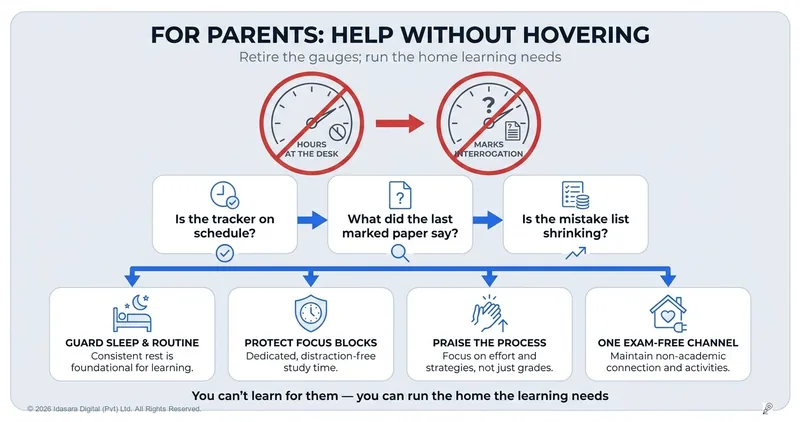
You cannot learn for your child — but the home you run, the questions you ask, and the things you choose to praise shape their studying more than any tuition class. This chapter of Learn to Learn is written for parents: what genuinely helps a student through O/L and A/L years, what quietly harms despite the best intentions, and how to trade surveillance for shared instruments.
Every evening, in homes across Sri Lanka, a parent stands at a doorway watching a child bent over books — and worries.
The worry is love. So is everything it produces: the reminders to study, the questions about marks, the comparisons meant to motivate, the tuition classes added one on another, the late-night glances to check the light is still on. Every one of these comes from the same place: I cannot sit this exam for you, and I would if I could.
This chapter is written with respect for that worry — and with some honest news from the learning science this book is built on: several of the most natural ways parents help don't help, and a handful of unglamorous things help enormously. Since your energy is finite and precious, let's spend it where it works.
Why aren't hours and marks the right gauges?
Most parental supervision runs on two gauges: hours at the desk and marks on tests. Both are honest gauges of the wrong things.
Hours measure fuel burned, not distance travelled — this book's very first chapter, and the hardest one for a watching parent, because a child re-reading and highlighting for four hours looks identical to a child learning for four hours. The desk-hours gauge cannot tell exhausted-and-stuck from productive — and pressure applied to the gauge produces more visible sitting, not more learning.
Marks arrive months late and arrive as verdicts — by the time a term test disappoints, the gap that caused it is a season old. And a home where marks are the only conversation becomes a home where a struggling child hides struggle — the precise opposite of what recovery needs.
So the first gift you can give is to retire the two gauges — and replace them with better questions. This book teaches your child a set of instruments: a syllabus tracker (is coverage keeping pace with the calendar?), marked practice papers (what do scripts actually score?), and a mistake bank (is the list of known errors shrinking?). The parent version of those instruments is three calm questions, asked weekly, not nightly: Is your tracker on schedule? What did your last marked paper say? Is the mistake list getting shorter? — questions a child can answer with evidence rather than mood, that surface real problems while they're cheap to fix, and that tell your child something powerful: my parent understands what real progress looks like.
One honest note about timing: those questions only work once the instruments exist. If your child hasn't started this book's system yet, don't open with the questions — they'll be met with "what mistake list?" and the moment sours. The first fortnight's move is different: hand them the early chapters, help them start the tracker and the mistake notebook, and keep asking nothing at all. The gauges switch after there's something to read.
What actually helps?
The evidence-backed parental contributions turn out to be homely — which is good news, because every one is fully in your power:
Guard the routine, especially sleep. Memory consolidates during sleep; the brain's learning pathways are maintained then — which makes a sane lights-out part of studying, not its rival. A parent who protects eight hours, regular meals, and a daily rhythm is doing more for retention than another tuition class ever could. In exam season this becomes your central job: the calm keeper of the routine while the child works the plan. (And the all-nighter you're tempted to permit "because they're so behind" — this book's cramming chapter prices it: it un-saves the very material it's meant to save.)
Protect the conditions. A quiet-enough corner, siblings managed during focus blocks, the household's errands scheduled off the peak study hours your child has identified — and, hardest of all, your own interruptions batched. A child using focus blocks (this book teaches them) loses far more than the interrupted minute each time; guarding the block is a real, daily contribution.
Praise the process, not the brain. "You're so clever" feels like love and quietly teaches that ability is fixed — and makes the first real struggle feel like exposure. Praise what the child did: the notes written from memory, the mistake list worked down, the paper attempted under time, the hard subject faced first. Process praise builds a student who runs toward difficulty; talent praise builds one who protects an image. Your words are the mirror they'll use for years.
Respect the method, even when it looks strange. A child running this book will do unfamiliar things: write notes with the textbook closed; deface their work in red ink; sit mock papers alone for three hours on a Saturday; stop studying at a planned time and rest on purpose. Every one of these is the science working. The instinct to intervene — "why is your book closed?", "you call that studying?", "more hours!" — breaks the machinery it's watching. When in doubt, ask them to explain the method; being asked to teach it strengthens it.
And be ready to defend it to the household. In an exam year, a resting child gets read by visiting relatives — and sometimes by the other parent — as a failing home. Arm yourself with one calm sentence: "Planned rest is part of the study method — it's how what they studied gets kept." Saying it once, in front of the child, does two jobs: it ends the relative's commentary, and it tells your child their parent is guarding the method with them.
And keep one channel that isn't about the exam. Two years is long, and a child who is only a candidate at home carries the exam into every meal. The families that come through these years healthiest keep a daily space — a walk, a meal, cricket — where the exam is not invited. Paradoxically, this protects the studying too: burnout, not laziness, is the great mid-year thief.
The hardest sentence in this chapter
If your child is genuinely struggling — hours in, marks flat — the most useful parental belief is this book's own: the problem is almost never the child's capacity. It is almost always the method. The chapters on the illusion of competence, on foundation debt, on grade ladders, exist because "working hard and stuck" has mechanical causes with mechanical fixes. A parent who says "you're not stupid — let's look at how you're studying" and puts this book's early chapters in their hands has done more than a year of pressure could. Children believe the verdicts their homes issue. Issue the recoverable one — because it's also the true one.
Do this tonight
- If your child already runs the system: tell them, out loud, that you'll ask about the tracker, the marked papers, and the mistake list — weekly, calmly — instead of hours and marks. If they don't yet: hand them this book's first chapter instead, and ask nothing for a fortnight.
- Audit the home's contribution honestly: sleep protected? focus blocks unbroken? peak hours free of errands? one exam-free channel alive?
- Catch one process behaviour today and praise it by name. It costs nothing and compounds for years.
At a glance
- The two natural gauges — desk-hours and marks — measure fuel and verdicts, not learning; pressure on them produces visible sitting and hidden struggle.
- Replace them with three weekly evidence questions: tracker on schedule? last marked paper? mistake list shrinking?
- The highest-value parental work is homely: guard sleep and routine · protect focus conditions · praise process, never "cleverness" · respect the method's strange-looking science · keep one exam-free channel.
- When marks are flat despite effort: the problem is method, not capacity — say so, and hand over the fix.
- You cannot learn for them. You can run the home the learning needs.
One step further with Idasara Academy
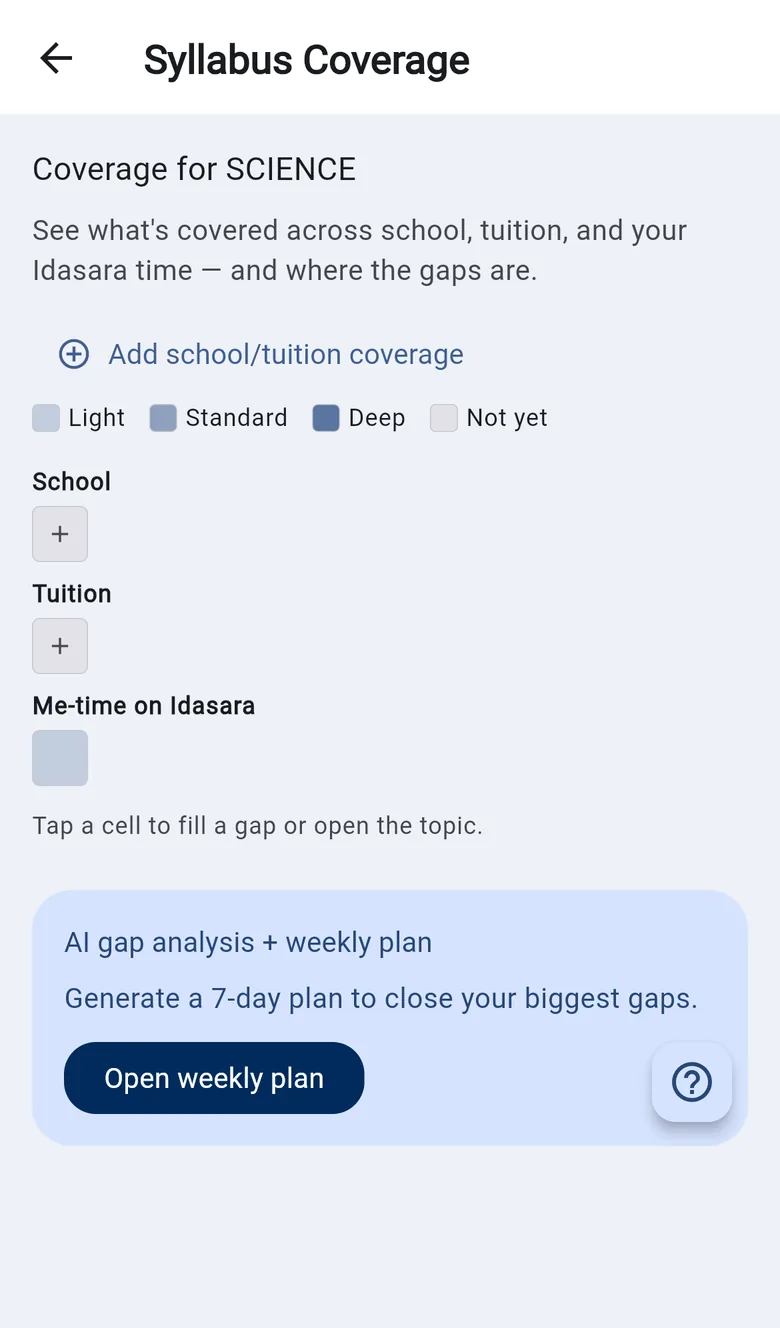
The shared-instruments conversation is exactly what Idasara Academy's parent dashboard is built for — free to open, and on the exam plan it shows your child's progress as a simple traffic light per subject, with richer alerts and an opt-in WhatsApp digest, in your language. You control the notifications, and homes sharing one device get free PIN-separated family profiles, so the shared phone stops being a fight. The weekly conversation becomes two people reading one screen: coverage on pace, chemistry needs attention — how can I help? Surveillance retired; partnership installed.
Start Free — Create Your Account →
FAQ
Isn't more tuition the answer when marks drop? Sometimes — but audit first: if coverage, honest practice, or foundations are the gap (they usually are), another delivery of more content adds load without touching the cause. The instruments will tell you which it is; add classes for a diagnosed reason, not as reflex.
My child says they study, but I never see the textbook open — just the app or notes. Should I worry? Ask them to walk you through their loop — a child running this method can show you: notes written from memory, red-ink audits, marked papers, a mistake list. The method's evidence is visible on paper. (And if the screen time is producing nothing on paper — this book's honesty chapter, "No App Can Learn For You," is the one to read together.)
How do I motivate a child who seems to have given up? Given-up is usually the end state of effort-without-results — the belief "I'm not capable" built from years of wrong method. Motivation lectures bounce off it; one small mechanical win doesn't. The foundation-debt chapter's approach — find one buried gap, repair it, let a current topic suddenly make sense — is the most reliable spark this book knows.
What if it's not method or effort — my child has struggled with reading, writing, or attention since small? Then please hear this clearly: some children carry genuine learning differences — with attention, reading, or writing — and no amount of method or pressure fixes what needs understanding first. If the struggle has been lifelong, shows up everywhere (not just in disliked subjects), and persists despite honest effort, ask your school and a doctor about an assessment before concluding anything about your child. This book's methods still help such children — often more than most — but they deserve to be built on a correct understanding, not on a verdict of laziness that was never true.
We can't provide a quiet room or expensive support. Are we failing our child? The list that matters most — sleep, routine, process praise, belief, one exam-free channel — costs nothing, and the state provides core materials free (school textbooks, the syllabi — and official past papers are easy to obtain). Families with the least have produced brilliant results on exactly that list for generations. Run what's runnable; it's the bigger half.
Further reading
The method's guidance for parents — textbook-and-notebook verification, readiness over hours, and supporting structured rest — is written up in the Idasara Method: the manifesto's parent guidance and Part 3 — the readiness instruments.
Sources
- NIH / NINDS — Brain Basics: Understanding Sleep (why guarding sleep is guarding learning)
- Dunlosky, J. et al. (2013). Improving Students' Learning With Effective Learning Techniques — overview at the Association for Psychological Science (why visible "studying" so often isn't)
- The Idasara Method: Part 3 — The Grade Progression Ladder & Paper Marking