Studying in a Language You Don't Think In: The Two-Language Method
The short answer: Split the double load into two jobs: understand each topic first in your strongest language, then build production — notes, answers, practice papers — in the exam's language from week one. Understanding can live in Sinhala or Tamil; the pen must be trained in the language the paper will speak.
A chapter of the free book Learn to Learn
Published 2026-08-31 · updated 2026-08-31
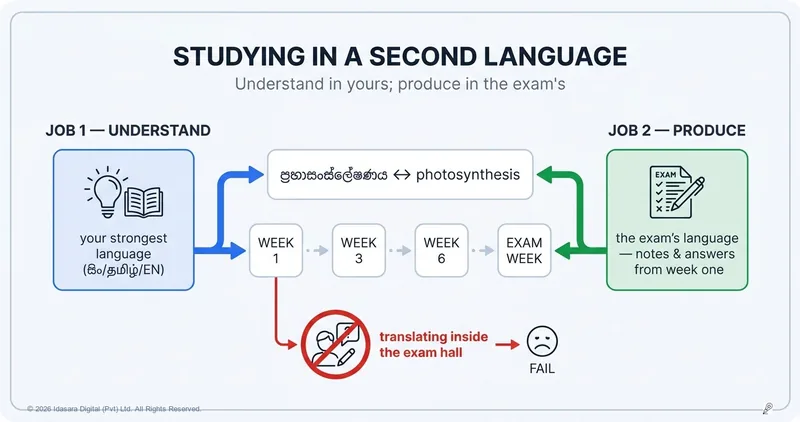
Hundreds of thousands of Sri Lankan students carry a double load nobody names: learning hard subjects and the language they're taught in, at the same time. This chapter of Learn to Learn names it, explains what the evidence says (understanding builds best in the language you know best), and gives the two-language method: understand in your strongest language, then deliberately build fluency in the exam's — because on the day, the paper speaks only one.
There is a student in almost every classroom whose struggle is systematically misread.
They sit through the English-medium science lesson translating in their head — grabbing every third sentence whole, reconstructing the rest afterwards. The textbook takes them twice as long as their classmates. In the exam, they knew the answer — in Sinhala, or in Tamil — and watched the clock eat the marks while they hunted for the English words to say it in.
Their teachers read it as weakness in science. Their marks say weakness in science. It was never weakness in science. It is the double load: content and language, learned simultaneously — real, heavy, and almost never addressed as its own problem. UNESCO's global evidence is blunt about how common and how costly this is: over a quarter of a billion learners worldwide lack education in the language they understand best, and learning outcomes measurably suffer for it. So let's do what this book does with every unnamed problem: name it, split it, and give each half its own method.
The principle: understanding and expression are two different jobs
The core mistake of second-language studying is treating it as one job — trying to understand new, hard content through the harder language, in a single pass. That's the highest-friction route possible: comprehension traffic-jams (you know that chapter), the illusion of competence gets worse (recognising English sentences you couldn't produce), and confidence erodes in a subject you might actually be good at.
The evidence points the other way: deep understanding builds best in the language you understand best — that's UNESCO's core finding, and it matches everything this book has said about comprehension. But your exam has its own non-negotiable: on the day, the paper asks and you answer in the exam's language, under time. So neither "struggle through in English only" nor "study comfortably in Sinhala/Tamil only" works. The method is both, in the right order:
Job 1 — Understand, in your strongest language. Job 2 — Build production fluency, in the exam's language. Deliberately, separately, both scheduled.
The two-language study loop
Here's how the book's ordinary loop runs bilingually:
- First pass for understanding — strongest language allowed. Meet the new topic where comprehension is cheapest: the official textbook in your medium where it exists, or your language's explanation of the concept (the state's e-thaksalawa portal carries materials in Sinhala, Tamil, and English — use them). Get the idea solid: what it is, why it works, how the parts connect. A concept genuinely understood in Sinhala is a concept understood, full stop.
- Second pass in the exam language — now it's vocabulary, not mystery. Re-read the topic in the exam's language after understanding it. The experience transforms: you're no longer decoding hard ideas through hard words — you're matching known ideas to their exam-language names. This pass is where the technical register gets built, cheaply.
- Harvest the term pairs — and treat them as the fact layer. Every topic yields its bilingual pairs (ප්රභාසංස්ලේෂණය ↔ photosynthesis). These are exactly the arbitrary paired facts the memorising chapter handles: small batches, produce-don't-recognise, spaced schedule, both directions — because the exam asks in one direction and your thinking runs in the other.
- Write your notes and answers in the exam's language — from week one. This is the rule that decides exam day, and the one strugglers skip. Understanding can live happily in your strongest language; production must be trained in the exam's, because production is what's marked, under time, with no translator. Your short notes from memory, your exercise answers, your practice papers — exam language, always. Hard at first; that's the training (this book's oldest sentence). The student who understands in Sinhala but has written five hundred English answers by December has closed the gap where the marks actually leak.
- Let volume build the reading speed. The fast-active-reading chapter told you speed is fluency from exposure — and it's doubly true in a second language. Daily active reading of the official textbook in the exam language compounds; by exam season the paper's register reads like an old acquaintance, not a translation exercise.
One warning, from every examiner's experience: don't compose in one language and translate in the hall. In-exam translation is slow, produces unnatural phrasing that misses scheme keywords, and burns the clock. The whole point of Job 2 is that by exam day, your production — not your inner world — runs natively in the exam's language. Your thoughts can be in any language they like; your pen practised in one.
English medium for the future, or our language for understanding?
Families ask: English medium for the future, or our language for understanding? This chapter's method softens the dilemma — because the skills are separable, you are never locked out of either: an English-medium student can and should use Sinhala/Tamil resources for first-pass understanding; a Sinhala/Tamil-medium student can and should build English technical vocabulary alongside (their university self will thank them — and the AI-age chapter argues that every language you can carry meaning across doubles your opportunities). Whichever medium is chosen, the two jobs remain the same two jobs; only which one is "Job 2" changes. What fails is only ever the unsplit version: one language doing everything, badly.
Do this tonight
- Take your hardest current topic in the harder language. Run pass one in your strongest language until the idea is genuinely clear — e-thaksalawa or your medium's textbook.
- Re-read it in the exam language. Notice the transformation — that's the method working.
- Harvest ten term pairs into your fact system, both directions, schedule attached.
- Write tonight's short note on it — exam language, from memory. Messy is fine. This is the rep that matters.
At a glance
- Second-language studying is a double load — content + language — and it's systematically misread as subject weakness. Name it, then split it.
- Job 1: understand in your strongest language (the evidence is emphatic — comprehension builds best there). Job 2: build production in the exam's language — separately, deliberately.
- The loop: strongest-language first pass → exam-language second pass (ideas now have names) → term pairs into the spaced fact system, both directions → notes and answers in the exam language from week one → daily exam-language reading for fluency.
- Never plan to translate in the hall: thoughts in any language; the pen trained in one.
- Choosing a medium changes which job is which — never the need for both.
One step further with Idasara Academy
This chapter's method is built into the product's foundation: the content runs fully in Sinhala, Tamil, and English — free to start — so pass one and pass two live in the same place, topic by topic, and you can flip a lesson between your understanding language and your exam language instead of hunting for parallel books. The term pairs land in flash cards (paid tiers) on the spaced schedule, and your practice answers get produced — and, on the paid tiers, marked — in the exam's language, where the marks live.
Start Free — Create Your Account →
FAQ
Isn't using Sinhala/Tamil materials "cheating" my English development? The opposite, when sequenced right: understanding built cheaply in your language frees your effort for deliberate English production — which is what actually develops exam English. The student who struggle-reads English all evening builds less of both. Sequence beats suffering.
My textbook only exists in English for my subject. What's my pass one? Then build the strongest-language pass from what exists: your language's explanations on e-thaksalawa, a teacher's or friend's explanation, even a careful AI explanation in your language (tutor mode, verified against the textbook — you know the rules). Then the English textbook becomes your pass two — and, per the textbook chapter, it remains the exam's source of truth.
How much time should Job 2 take, honestly? Less than the struggle it replaces. The daily costs are small and fixed: notes and answers in the exam language (you were writing them anyway), ten minutes of term-pair schedule, your normal textbook reading. What disappears is the nightly hour of one-pass struggle-decoding — most students come out ahead within a term.
Does this apply to English as a subject too (O/L English paper)? The production rule triples there: the English paper is almost purely a production exam. Daily written output — sentences, short answers, the fast-yet-clear disciplines — beats grammar-rule memorising, and the reading-volume habit quietly feeds it. Same engine, aimed at the language itself.
Further reading
Reading fluency by exposure and production-first training are this book's Part 2 and Part 3 — and the trilingual method write-up lives at the same address in all three languages: Part 1 — The Human Foundation & Active Recall.
Sources
- UNESCO — Languages in education (a quarter-billion learners lack education in their best-understood language; mother-tongue learning improves outcomes)
- Ministry of Education — e-thaksalawa (official materials in Sinhala, Tamil, and English)
- Rayner, K. et al. (2016). So Much to Read, So Little Time — at the Association for Psychological Science (fluency through exposure)
- The Idasara Method: Part 1 — The Human Foundation & Active Recall