Reading and Writing in the AI Age: The Old Skills Your Child Will Live On
The short answer: More than ever — AI made fluent text cheap, and that made three human literacies expensive: reading critically enough to judge a machine's output, writing precisely enough to direct it, and explaining the result in your own words, accountably. The whole-text reading and handwriting you're protecting at home are the training for exactly those seats.
A chapter of the free book Learn to Learn
Published 2026-08-31 · updated 2026-08-31
Parents watching machines write fluent essays are quietly asking whether the skills school sweats over — deep reading, clear writing — are becoming antiques. This closing chapter of Learn to Learn answers with the case this whole book has been building: literacy is not what AI replaces; it is what AI-era life runs on — and the home that protects it is making the century's best investment.
A parent watches their child's homework appear on a screen — three fluent paragraphs, machine-written in four seconds — and asks the question of the decade:
"Why am I fighting my child to read whole textbooks and write essays by hand… for a world where machines do both?"
It is the right question, asked honestly, and it deserves an honest answer — because a wrong answer here, multiplied across a generation of homes, would be a quiet catastrophe. This book has argued its case chapter by chapter; here, at the close, is the whole argument in one place.
What did AI actually make worthless — and what didn't?
Be precise about what the machines changed. AI made fluent text cheap. The production of grammatical sentences, plausible summaries, standard-format documents — that layer of literate work has genuinely collapsed in price, and pretending otherwise helps nobody.
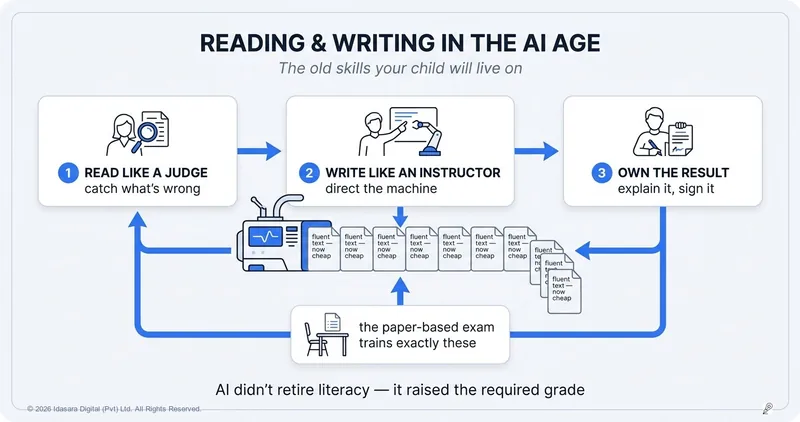
But watch closely what happens wherever cheap text flows — in the office, the clinic, the courtroom, the newsroom. Three human acts have risen in price, steeply, and all three are literacy:
Someone must read like a judge. The machine's output is confident whether it's right or wrong — its fluency carries no warranty. Every consequential use of AI now runs through a person who can read critically: catch the subtle error, notice the missing case, sense the answer that contradicts the source. That is deep reading — the slow, interrogating kind this book trained through textbooks and marking schemes — now promoted from school exercise to professional survival skill. Reading researchers have long shown there is no shortcut to it; comprehension is built by practice, not by speed tricks. The scarce readers will be the trained ones.
Someone must write like an instructor. Machines amplify the quality of what they're asked — vague requests in, expensive nonsense out. Directing them well is precise writing: knowing exactly what you want, constraining it, sequencing it — the same compression-and-clarity your child practises in every short note written from memory, every structured answer built for a marking scheme. The prompt is an essay with consequences.
And someone must own the result in their own words. No client, court, or patient accepts "the AI said so." At the end of every automated chain stands a person who must understand, decide, and explain — clearly, accountably, to other humans. That is composition, and it is the one seat automation cannot fill, because responsibility can't be handed over.
Read like a judge, write like an instructor, explain like an owner. The AI age did not retire literacy. It raised the required grade. And here is the compounding irony this book's exam chapters kept meeting: a paper-based national exam — reading dense questions alone, composing structured answers by hand, under time — is one of the last places on earth where that grade of literacy is still systematically trained. The examination your family is preparing for is not a relic standing in the future's way. It is a gymnasium for exactly the future's demands.
The fork that runs through every home
So the homework question — "why fight for the reading and the handwriting?" — has a sharper form: which child arrives in adulthood?
One child spent their school years letting the machine read for them and write for them. They received a thousand fluent answers and produced almost nothing from within. Their literacy — never exercised — stayed at the level of the tools' first arrival. As adults they can receive text endlessly and cannot judge it, direct it, or stand behind it. They are, professionally, interchangeable with the free thing — the one position no market has ever paid.
The other child did it the way this book teaches: read the whole textbook and interrogated it; wrote from memory and audited in red; used AI as a tutor — attempt first, question precisely, verify against the source, own the conclusion in their own handwriting. Their literacy grew alongside the machine, the way muscles grow alongside training equipment. As adults they sit in the seats the AI age actually pays: the judge of outputs, the instructor of systems, the owner of results.
Same tools available to both children. The fork was never about access to AI. It was about whether the home and the school treated literacy as cargo the machine could carry — or as the muscle the child must build while the machine carries cargo. That decision is being made now, in ordinary evenings, in the small moments: whether the essay gets pasted or written; whether the textbook gets read or summarised-by-bot; whether the parent praises the fluent artifact or the effortful draft.
What to protect
For the parent — and teacher — who asks "practically, then, what do we guard?", this book's answer fits in five lines:
- Whole-text reading, daily — textbooks first (the exam is built from them), anything genuinely read after. Summaries are for after the reading, never instead of it.
- Production from within, on paper — notes from memory, essays drafted by hand, working shown. The blank page is where literacy is manufactured; keep it in the house.
- AI in tutor mode only — attempt first, ask precisely, verify against the book, write the understanding back by hand. The machine as gym equipment, never as a taxi.
- The mother tongue and the second language both — the judging-and-owning seats will belong to those who can carry precise meaning across Sinhala, Tamil, and English; every language deepened doubles the seats available.
- And the honesty test, always: can you explain it, screen off, in your own words? The question that closes this book is the same one that opened it — because it is the whole of literacy, and the whole of learning, in one sentence.
Do this tonight — the book's last assignment
Whoever you are — student, parent, teacher — the assignment is the same, and it is the entire book in miniature:
Take one thing that matters — tonight's topic, this week's lesson, a decision on your desk. Read its primary source, fully. Close everything. Write what you understand, by hand, in your own words. Then let any tool you like criticise, extend, or polish it — and judge what comes back against what you read.
Read deeply. Produce from within. Direct the machine. Own the result. That is studying for the exam, and it is the working life of 2040, and they were — this was the book's secret all along — the same skill the whole time.
ඉගෙන ගන්න හැටි ඉගෙන ගන්න. Learn how to learn — and nothing that arrives in your lifetime will find you unprepared.
At a glance
- AI made fluent text cheap — and made three literacies expensive: reading like a judge, writing like an instructor, explaining like an owner.
- The paper-based exam is a gymnasium for exactly those skills — not a relic: dense reading, unassisted composition, owned results, under time.
- The generational fork isn't AI access; it's whether literacy grows alongside the machine or atrophies beneath it — decided in ordinary homework moments.
- Protect five things: whole-text reading · production from within on paper · tutor-mode AI only · both languages · the explain-it-screen-off test.
- The exam skill and the AI-age life skill were the same skill all along. That is this book's closing claim — and its opening one.
FAQ
Won't AI soon judge its own outputs, closing even that human seat? Machine cross-checking will deepen, but accountability is a legal and human fact, not a technical one: someone signs. And the signer must be able to read what they sign. Every generation of stronger tools has raised the literacy of the seats above them — there is no version of this future where the person who can't judge text outranks the one who can.
My child's school barely addresses AI at all. Are they falling behind? The foundation matters more than the tool-training, and the foundation is exactly what a rigorous, paper-based schooling still builds. Add the tutor-mode habits from this book at home (its AI chapters are a complete starter curriculum), and your child is ahead of most systems worldwide — global education bodies are still writing the frameworks for what your home can practise today.
Does handwriting itself really need protecting — or just writing in general? For the exam years, handwriting is non-negotiable (the papers are handwritten, and the brain-science chapters showed the pen's learning advantage). Beyond school, what must survive is production from within — by hand or keyboard. But the habit is most cheaply built at the desk your child sits at tonight, with the tools the exam demands anyway.
Where should a new reader of this book begin? At the beginning — the chapter on working hard versus working scientifically — and then one chapter per evening, each with its "do this tonight." The book was built so that any single chapter pays for itself the same day. This one pays for itself over a lifetime.
Further reading
The dual-benefit architecture — how examination literacy and AI-age capability mirror each other — is the closing argument of the Idasara Method: Part 3 — The Grade Progression Ladder & Paper Marking.
Sources
- UNESCO — Artificial intelligence in education: a human-centred approach (creativity and critical thinking as the irreplaceable skills)
- Rayner, K. et al. (2016). So Much to Read, So Little Time — at the Association for Psychological Science (deep comprehension has no shortcut)
- Mueller, P. & Oppenheimer, D. (2014) — Take Notes by Hand for Better Long-Term Comprehension, Association for Psychological Science
- The Idasara Method: Part 3 — The Grade Progression Ladder & Paper Marking