The First 30 Days of a Turnaround: Momentum Is Engineered, Not Summoned
The short answer: Skip the midnight vow and start tonight with twenty minutes — one subject, anchored to something you already do daily — then let the quota grow only when stopping starts to feel wrong. A turnaround survives on a streak too small to fail: never zero, and miss one day, never two.
A chapter of the free book Learn to Learn
Published 2026-08-31 · updated 2026-08-31
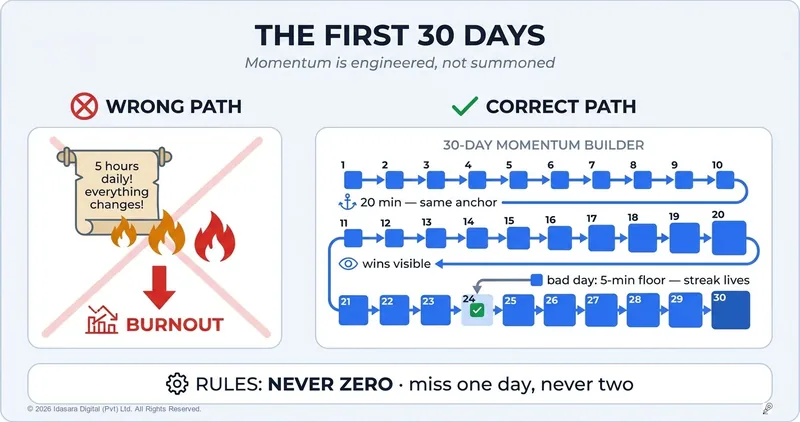
Every wasted term ends the same way: a surge of guilt, a midnight vow — "from tomorrow, everything changes" — three heroic days, and collapse into worse guilt than before. This chapter of Learn to Learn is the anti-vow: the 30-day launch design that starts absurdly small on purpose, manufactures visible wins on a schedule, and treats the inevitable bad day as a planned event instead of the end of everything.
The turnaround vow fails so predictably it deserves a diagram. Guilt builds → the midnight promise ("five hours daily, no phone, everything changes") → two or three forced, gritted-teeth days that feel wonderful → one tired evening breaks the streak → the verdict ("see, I can't do this") → deeper guilt → months later, the next vow, bigger. Each cycle doesn't just fail; it teaches failure — every collapsed vow is one more piece of evidence for the story the comeback protocol — the S-and-F chapter's rebuild — named.
The problem was never the student. It's the design: the vow demands the most on exactly the days you have the least — the opposite of how anything heavy gets moving. Engines, habits, comebacks: they all start small, catch, then build. So here is the 30-day launch, designed properly.
(Routing note: this launch is for the student coming back from a wasted term or year. If your studying basically works and you just want the method installed, use the first 7 days instead — faster, and built for a running engine. One launch plan at a time.)
Days 1–10: ignition — absurdly small, deliberately
One session a day. Twenty minutes. That's the whole program. Not five hours — twenty minutes, one subject (the comeback's priority subject if you're also running placement), at the same time daily (anchored to an existing event: straight after dinner, straight after washing up — anchors beat alarms). The session's content: the daily loop miniaturised — a little retrieval, a little new work, honestly checked.
The smallness is the engineering, so understand what it's for: a twenty-minute quota cannot be dreaded (so starting stays cheap — and starting was always the broken part), cannot really be failed (so the streak survives tired days), and finishes with appetite (stopping while you still want more is what makes tomorrow's start automatic — the vow's five-hour days finished with revulsion, which is why day four never came). You are allowed to do more when it flows. You are never required to — the quota stays twenty, and the streak chart on the wall counts sessions, not minutes.
Days 11–20: the catch — let it grow, watch it show
Momentum caught, two things happen on schedule. The quota grows by appetite, not by vow: twenty minutes becomes a full block naturally when stopping starts to feel wrong — make official what is already happening (25, then 30), never leap ahead of it. A second daily session may appear the same way. And the wins go visible: this is the comeback protocol's Step 3 running on habit-scale — the streak chart filling, the first honestly-completed homework, the notebook's pages accumulating where blankness lived. Show someone (the witness from the self-study chapter; the parent, armed with process praise — naming the work, not the child). Days 11–20 are where the story — "I can't do this" — meets its first sustained counter-evidence, and the design's job is to make that evidence impossible to miss.
Also in this window: the environment reset, done once, calmly — the phone's home during sessions decided (out of reach, per the focus chapters), the study corner cleared, tomorrow's material laid out each night. Environment carries habits that willpower drops; ten minutes of resetting buys weeks of not-deciding.
Days 21–30: what about the bad day? A plan, decided before it comes
Every launch meets its bad day — the fever, the family event, the mood from nowhere — and the vow-cycle dies there because the vow had no plan for it. The launch does: the minimum-day rule. On a bad day, the quota drops to its emergency floor — five minutes, one card-batch, done — and the streak legitimately continues. This isn't cheating; it's the whole design: the streak's job is to keep the identity alive ("I'm someone who studies daily"), and identity survives on continuity, not on volume. One five-minute day in a chain of twenties is a chain unbroken. The rule that kills comebacks is "all or nothing"; the rule that saves them is "never zero."
And if zero happens anyway — it sometimes does — the recovery plan is one sentence, agreed with yourself in advance: miss one day, never two. No punishment, no restarting-from-day-one drama (that's the vow-cycle again), just the next day's twenty, on time. By day 30, you're not "trying to study more." You're a person with a 30-day chart, a grown quota, a reset environment, and a tested bad-day protocol — which is to say: a person the rest of this book was written for. The launch is over; the ordinary machinery takes it from here.
Do this tonight
- Set the ignition quota: twenty minutes, one subject, anchored to a daily event you already never miss. Write it as one sentence.
- Do session one now — tonight, not "from Monday." The vow-cycle loves Mondays; the launch loves tonight.
- Put the chart where the household sees it, and pre-write the two rules at its top: never zero · miss one day, never two.
At a glance
- The midnight vow fails by design: maximum demand on minimum momentum. Launches start small, catch, then build.
- Days 1–10: twenty minutes, one subject, same anchor daily. Undreadable, unfailable, finished with appetite. More allowed, never required.
- Days 11–20: quota grows by appetite (ratify, don't leap) · wins made visible (chart, witness, process praise) · the one-time environment reset.
- Days 21–30: the bad day is planned — the five-minute emergency floor keeps the streak true. Never zero; miss one day, never two.
- Day 30's product isn't hours — it's an identity with evidence. The rest of the book takes over from there.
One step further with Idasara Academy
Streaks keep the chart honest and Today's Plan hands the twenty minutes its content, free. The vow needed willpower nightly; the launch needs it once — tonight.

Start Free — Create Your Account →
FAQ
Twenty minutes feels insultingly small against how far behind I am. The backlog isn't cleared in week one under any plan — the vow's five-hour days also wouldn't have lasted the month, and the month is what clears backlogs. Trust the arithmetic: thirty caught days and then a grown habit clear more by term's end than three heroic collapses ever have. Small is the fast route; it just doesn't feel like it on day two.
Should I announce my turnaround to family and friends? Announce the system, not the transformation: "I'm doing twenty minutes daily; the chart's on the wall" invites the right support (protect the slot, praise the process). The grand announcement invites the audit that killed previous vows. Let day 30's chart do the announcing.
What if my bad days aren't occasional — what if most days are chaos? Then you're launching inside Hard Mode's other chapters — the broken-day method's fragments and anchors are this launch adapted for chaos (its daily ten-minute minimum is the same never-zero rule). Run that version; the design holds, smaller.
I've done 30 days before and still collapsed later. Why would this time differ? Check what those 30 days were built on: if it was a vow (big quotas, all-or-nothing, no bad-day rule), the collapse was scheduled from the start. The launch's specific parts — appetite-led growth, the emergency floor, miss-one-never-two — are each aimed at a known failure point of round one. Engineering improves by iteration; so do comebacks.
Further reading
The deeper rebuilds this launch can carry: Starting From S and F · Maths From Zero. The habit science at full scale: Motivation That Survives Monday. The chaos version: Studying While Working or Caring.
Sources
- The Learning Scientists: Spaced Practice (daily-small beats occasional-heroic)
- Francesco Cirillo — the Pomodoro Technique (the bounded session; starting made cheap)
- The Idasara Method: Part 4 — Time Management & Flipped Learning (consistency as the engine)