Studying While Working or Caring: The Broken-Day Method
The short answer: Run the broken day on three mechanisms: fragments matched to real tasks (five minutes of cards before the shop opens), two anchors that survive anything — a ten-minute daily minimum and the Sunday twenty — and a small weekly floor of protected study blocks, negotiated with the family as a shift, not a favour. Coverage and past papers come first; everything else waits for lighter seasons.
A chapter of the free book Learn to Learn
Published 2026-08-31 · updated 2026-08-31
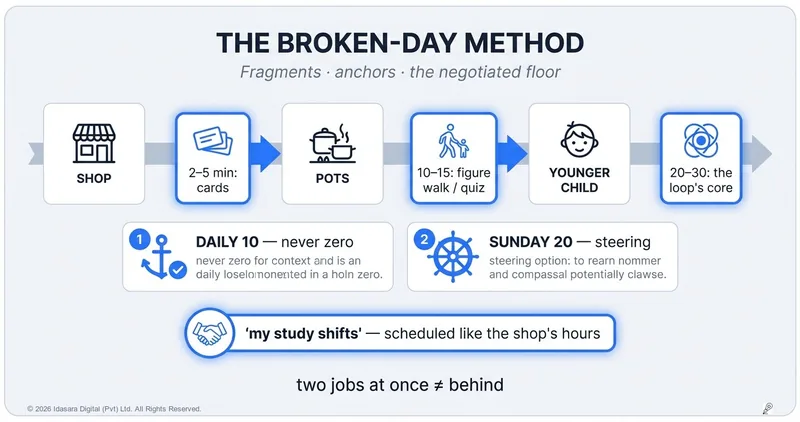
Some students' days are not theirs: the shop needs minding, the harvest needs hands, the younger ones need watching, the household runs on their hours. Study advice assumes free evenings; their evenings are shifts. This chapter of Learn to Learn is the method for broken days — fragments used precisely, anchors that survive any schedule, the weekly floor that keeps a candidate alive — and a word about the guilt that deserves to be put down.
There is a student this book has been walking toward for seventy chapters. You're up before the household because that's when the water gets carried. School, then the shop until dark because your mother's knee is bad. Homework competes with your brother's dinner. And you are still a candidate — still sitting the same paper as everyone else, on the same morning.
First, the sentence you almost never hear: carrying a household while remaining a candidate is not falling behind — it is doing two jobs at once. And the second job has already taught you things the exam year eventually demands of everyone: responsibility, endurance, and how to get real work out of small pieces of time. This chapter doesn't pretend the load is beautiful. It builds around it.
The broken-day method: three mechanisms
1. Fragments, used precisely. The broken day's resource is not blocks — it's fragments: the fifteen minutes before the shop opens, the lull while rice cooks, the bus, the queue. The method's move is matching the right work to the fragment, deliberately (the noise chapter's sorting, now sliced finer):
- 2–5 minutes: flash-card reps (the memorising chapter built these for exactly this), one formula from the derivation deck, one question-log entry.
- 10–15 minutes: a figure walk of one chapter — its diagrams retold from memory — one micro-quiz, a definition batch to clean, red-ink audit of one page.
- 20–30 minutes (the day's one real slot, wherever it falls): the daily loop's core — one section's short note from memory, or four exercises paper-first.
A day of well-matched fragments genuinely accumulates — five fragments is an hour of conversion, and the Me Time chapter proved conversion is the currency. What breaks broken-day students is not the fragments; it's spending them wondering what to do. So: the fragment menu gets written on one card, once, and lives in the pocket. No deciding at the well.
2. Anchors that survive anything. Fragments float; two anchors hold the week: the daily minimum — one fixed, tiny, non-negotiable act (ten minutes: yesterday's retrieval, or one card-batch) done every day regardless of chaos, because the streak's unbroken-ness is what keeps the candidate identity alive through harvest weeks and bad months; and the Sunday twenty minutes — the ritual, unkillable, where the tracker meets the calendar and next week's fragments get their menu. A candidate with these two anchors can lose whole days and remain in the race; a candidate without them loses the race in the days they lost.
3. The weekly floor, negotiated out loud. Fragments and anchors keep you alive; passing needs one more thing — a small number of protected real blocks per week, and these must be negotiated with the household as the working arrangement it is: "Sunday morning until ten, and Wednesday after closing, are my study shifts." The framing matters: not a favour begged, but a shift scheduled — the same standing the shop's hours get. Most families grant a named, bounded floor once it's asked for in work-language (and once the wall-tracker makes the results visible — the blame-cycle machinery, working for you). In exam season, the negotiation goes bigger, and the whole culture backs you: name the date, claim the mornings.
What do you drop, honestly?
The broken-day candidate cannot run the full program, and pretending otherwise breeds the despair this chapter exists to prevent. The honest cut: coverage and papers outrank everything (they are the marks-machine; run them first), the deep extras (stretch packs, wide reading) wait for lighter seasons, and the perfect schedule is itself dropped — the plan is the fragments-menu and the two anchors, not a beautiful timetable that dies by Tuesday. A C-to-B built on fragments and floors is a real achievement; the ladder up from there stays open forever (the earn-while-learning road was built for your adulthood too).
To the family — one paragraph that wants to be read aloud
This student is holding up two structures at once: yours, and their own future. The exam they sit will not give marks for the shop minded or the siblings raised — the paper is blind to it, unfairly but fixedly. So the family's part of the bargain is the floor: a few named hours a week, protected like the shop's opening hours, plus the daily ten minutes never interrupted. It is the cheapest investment this family will ever make, and the tracker on the wall will show you, week by week, exactly what it's buying.
Do this week
- Write the fragment menu on one pocket card: your real fragments, matched to their work.
- Install the two anchors: the daily ten-minute minimum (pick its act) and the Sunday twenty.
- Negotiate the floor — in work-language, bounded, with the wall-tracker offered as the receipt.
At a glance
- The broken day's resource is fragments — matched precisely: 2–5 min (cards, one formula) · 10–15 (figure walk, quiz, audit) · 20–30 (the daily loop's core). Menu on a pocket card; never decide at the well.
- Two anchors hold the week: the tiny daily minimum (identity, streak, ten minutes, non-negotiable) and the Sunday twenty (steering).
- The weekly floor — a few real blocks — is negotiated as a shift, not begged as a favour; exam season claims more, with the culture's backing.
- Triage honestly: coverage + papers + mistakes first; extras wait; the beautiful timetable is itself dropped.
- Two jobs done at once is not "behind." The paper is blind to your second job — the family's floor is how the household answers that unfairness.
One step further with Idasara Academy
My Schedule fits study around real shifts and duties, and Today's Plan hands each fragment its job — minutes-sized, offline, free to start. Built for the student the town timetables forgot.
Start Free — Create Your Account →
FAQ
My family says studies can wait until the season/shop crisis passes. It never passes. What do I say? Say the anchors' price out loud: "I'm asking for ten minutes a day and two shifts a week — the rest of my hours stay the family's." Smallness is the argument: a floor that tiny can't be refused reasonably, and once its results show on the wall, it grows. If it's refused anyway, keep the daily ten regardless — that anchor needs no permission, and it keeps the candidate alive until the season changes.
I fall asleep over the books after work. Every time. Then stop studying at the dead end of the day: the broken-day method moves the real work into fragments through the day and into mornings before it — the exhausted 10 p.m. slot gets only the lightest card-reps, or nothing. Sleep is part of the studying (three chapters have said it); for the working candidate it's also safety.
Is it worth sitting the exam at all with a preparation like mine? Yes — with triaged preparation and honest expectations set by the rescue chapter's arithmetic, not by comparison to untaxed students. Results earned on fragments carry forward exactly like anyone's: to retakes if needed, to the earn-and-learn ladder, to every door in Part 10. The candidacy itself — staying in the race — is the asset. Guard it.
I'm the eldest daughter; the caring load is assumed to be mine forever. This book can't fix that assumption, and won't pretend to. What it can say: the floor-negotiation is still worth attempting (framed through the family's own future — your qualification raises the household's ceiling), the mentor chapter's outside adult can sometimes say to a family what a daughter can't, and every fragment you convert is yours permanently, whatever the household assumes. Two jobs. Both real. Yours counts too.
Further reading
The lighter version: Earn While You Learn. The quiet-manufacturing toolkit: No Quiet Room. The season this all serves: Six Months Left: The Honest Rescue.
Sources
- The Idasara Method: Part 4 — Time Management & Flipped Learning (bite-sized tasks; schedule integration)
- The Learning Scientists: Spaced Practice (why fragments accumulate)
- NHS — exam-season family support