Earn While You Learn: The Path Nobody Plans and Thousands Walk
The short answer: Yes — whole routes are designed for the working student: professional qualifications on evening rhythms, the NVQ ladder, external and Open University degrees, the skills-stack. Choose the route backwards from a destination, then protect one or two small daily study blocks and a twenty-minute Sunday review; structure, not willpower, is what makes work-and-study hold.
A chapter of the free book Learn to Learn
Published 2026-08-31 · updated 2026-08-31
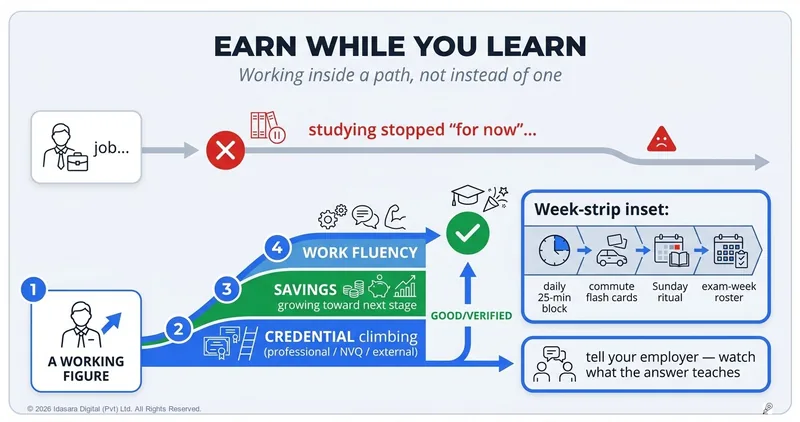
Across Sri Lanka, young people work — because the family needs it, because waiting years for a credential isn't affordable, because income now matters. Most treat working-and-studying as a compromise to apologise for. This chapter of Learn to Learn treats it as what it can be: a designed path with its own machinery — the qualification routes built for workers, the weekly structure that survives a job, and the compounding trick that makes the earner's road sometimes faster than the full-time student's.
There are two versions of the working young person, and the difference between them is not effort or luck.
The first works instead of a path: the job arrived, the studying stopped "for now," and five years later "for now" is still running — income flat, options narrowing, the old books somewhere under a bed.
The second works inside a path: the same job funds a qualification chosen backwards from a destination, the week has a structure that protects study the way this book protects Me Time — the student's own conversion hours — and each year stacks a credential, a skill, and savings. Same starting job. Entirely different decades.
This chapter is the difference, written down.
Which routes are built for earners?
The earn-while-learning student isn't improvising at the system's edges — whole routes are designed for them:
- Professional qualifications (accountancy, banking, marketing, IT, HR): staged exams, evening/weekend rhythms, and employers who often prefer — and sometimes fund — the working candidate. In several fields this route can out-earn the degree route on a five-year view.
- The NVQ ladder — built for exactly this: enter at your level, work between levels, climb to diploma and degree; apprenticeship tracks are the earn-and-learn design, formalised.
- External and Open University degrees: state credentials on a worker's timetable — no campus clock, full self-management (which is why this book is the companion this route never ships with).
- The skills-stack route: for digital-adjacent work especially, verified skills and a portfolio of real work compound into income without waiting for any single certificate — the AI-age chapters explain why this route keeps strengthening.
The choosing method is the Part's standard machinery: destination walked backwards → the route that reaches it from inside your working life → and always verify before paying a rupee — sellers of worthless courses deliberately target people in a hurry to earn.
How do you fit studying around a job?
Working-and-studying fails, when it fails, on structure — not on willpower. The adaptations that work, all from machinery you own:
- Shrink the unit, keep the daily-ness. The deep-block evening is gone; the war is won with the pomodoro chapter's smaller coin — one or two 25-minute blocks daily, protected like wages. Daily-small beats weekend-heroic (the consistency chapter's law, doubly true when weekends carry shifts).
- Anchor study to the job's rhythm, not the clock's. Before-shift mornings, the commute's fact-schedule reps (flash cards were built for buses), the post-rest evening block — map your week's real energy (the peak-hours audit works for workers too) and lay the blocks where they'll actually survive.
- The Sunday ritual is non-negotiable — for the earner it's the whole steering system: the week's coverage against the qualification's syllabus, the next week's blocks placed around the roster. Twenty minutes that keep a working year from dissolving.
- Let money join the system. Earnings tracked, a savings goal named (the next stage's fees, the laptop, the buffer) — because on this path, money management is study infrastructure: the student who can see their savings reaching next year's course fee has a reason the tired Tuesday block survives. (The money-skills chapter goes deeper.)
And one rule of self-respect that doubles as strategy: tell your employer you're studying. Not as apology — as fact. Many employers flex rosters around exam weeks for exactly the workers they want to keep; the ones who punish it are telling you something worth knowing early.
For families — and for the student carrying the family
Where the earning isn't chosen but needed: this chapter sees you, and so does the Hard Mode cluster (the working-and-caring chapter carries the heaviest version). Two things belong in writing here. To parents: a working child who is also climbing a qualification route is building the family's future twice — protect their study blocks as fiercely as their shifts, and never let "just take more hours" eat the route that raises the ceiling. To the student: the guilt that whispers "real students study full-time" is the prestige lens lying again — the earner's road is longer-looking and often arrives sooner, because it compounds three things at once: skill, credential, and the working-world fluency full-time students spend their first job painfully acquiring.
Do this month
- Name your destination and walk it backwards to a route reachable from your working week — professional staged exams, NVQ level, external degree, skills-stack. Verify it.
- Design the week on one page: daily block(s) placed by real energy, commute reps, the Sunday ritual booked.
- Open the money leg: track four weeks of earnings honestly; name the first savings goal that serves the route.
- Tell the employer. Watch what the answer teaches you.
At a glance
- Working-and-studying is a designed path, not a compromise: professional qualifications, the NVQ/apprenticeship ladder, external degrees, and the skills-stack are built for earners.
- Structure beats willpower: daily small blocks placed by real energy · commute fact-reps · the non-negotiable Sunday ritual · exam-week roster planning.
- Money joins the system: tracked earnings + a named savings goal = the reason tired blocks survive.
- Tell your employer; verify every route; let no one call this the lesser road — it compounds skill, credential, and work-fluency at once.
- The difference between working instead of a path and working inside one is a page of design.
One step further with Idasara Academy
The earner's toolkit is free where it matters most: earnings tracking (private, encrypted) and saving goals make the money side visible and calm, the apprenticeship matcher and NVQ discovery walk the route-finding, and the working-teen community means the working student's life has company — and My Schedule lays study blocks around real shifts. The path, with its logistics carried.
Start Free — Create Your Account →
FAQ
Won't working slow my qualification down too much to matter? Slower per year, yes — but count what stacks: by the time the route completes you hold the credential plus years of income, savings, and employer-world fluency. On the five-year view the earner frequently stands ahead of the graduate just starting to job-hunt. Speed of certificate is the wrong metric; trajectory is the right one.
My job leaves me too exhausted to study at night. Honestly, what then? Then stop fighting your worst hours and buy your best ones: the before-work block (even one, even 25 minutes) is the earner's classic move, commute reps carry the fact layer, and the Sunday ritual keeps direction even through brutal weeks. If no hours exist at all, the problem is the roster, not you — and that's the employer conversation, or the working-and-caring chapter's harder triage.
Should I pause studying when work gets busy season? Plan the pause instead of suffering it: drop to maintenance mode (the keep-alive doses from the nine-subjects chapter — ten minutes daily) with a named restart date. A planned trough is structure; an unplanned one is how "for now" becomes five years.
Is there shame in still being 'in studies' at 22, 25, while friends finished? Read the lifelong-learning chapter and then look at where the world is going: the person still climbing at 25 with income, skills, and a live learning engine is not behind — they're early to how everyone's career will soon work. The finish-line picture of education is the outdated one in this comparison.
Further reading
The heavier version of this life: Studying While Working or Caring (Hard Mode). The ladder built for earners: The NVQ Road. The money machinery: Money Skills for Students.
Sources
- StudentLanka — Guide to NVQ in Sri Lanka (work-between-levels design; RPL)
- VTA — course.vta.lk (apprenticeship-style tracks)
- The Idasara Method: Part 4 — Time Management & Flipped Learning (small-block architecture)