The NVQ Road: A Real Path, Fully Mapped
The short answer: NVQ is Sri Lanka's national vocational ladder — seven levels running from trade certificates all the way to a state degree at UNIVOTEC — and it is a real road, not a failure track. Choose the track backwards from a career, and verify every centre and course through TVEC, the state authority, before you enrol.
A chapter of the free book Learn to Learn
Published 2026-08-31 · updated 2026-08-31
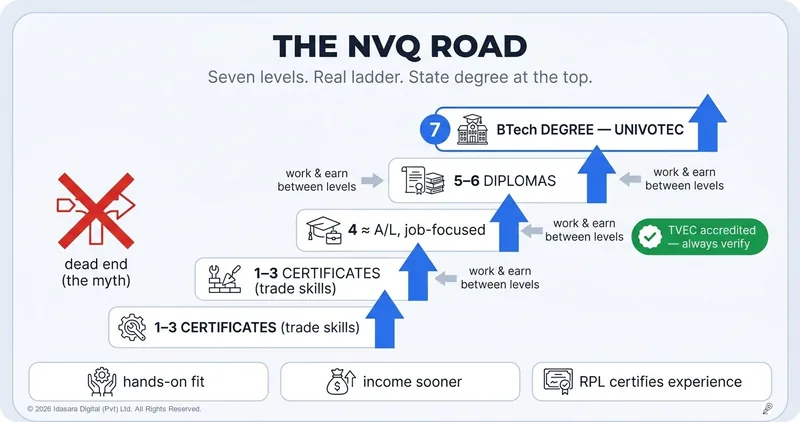
Sri Lanka runs a complete national ladder from basic job skills to a state degree — the NVQ system — and the country's prestige lens has taught families to see it as the failure track. This chapter of Learn to Learn maps the road honestly: the seven levels and where they lead, who this path genuinely serves best, how to enter and verify what you're buying — and why, for many students, this road reaches a good income faster than any other door in this book.
Here is a sentence that would change thousands of lives if families believed it:
The vocational road in Sri Lanka is a ladder, not a dead end — and it climbs all the way to a state degree.
The National Vocational Qualification system runs seven levels. Levels 1–3 are competency certificates earned at training centres — Level 3 comparable to an O/L, but aimed at a specific trade. Level 4, from technical colleges and accredited institutes, sits comparable to A/L with a job focus. Levels 5–6 are diplomas and higher diplomas. And Level 7 is a Bachelor of Technology at the University of Vocational Technology (UNIVOTEC) — a state degree, reached entirely by the vocational road. Major sectors — construction, IT, hospitality, automotive, agriculture and more — with the whole structure accredited under TVEC, the state's vocational authority. A student can step on at their level, work between levels, and climb as far as they choose; experienced workers can even have real skills certified directly through Recognition of Prior Learning.
Read that paragraph again through the eyes of the family whose child just got a hard O/L result. This is not the consolation track. This is a parallel education system with its own summit — and the stigma around it is costing exactly the families who'd benefit most.
Who does the NVQ road genuinely serve best?
Honest fit, not salesmanship — the road shines for four kinds of students:
- The hands-on capable. Some students' evidence profile screams it: weak at paper examinations, excellent at making, fixing, building, hosting, growing. The academic track measures one kind of intelligence; trades measure another — and pay for it. For this student, NVQ isn't the fallback; it's the fit.
- The income-soon household. NVQ's levels are short and stackable — employable certificates in months, not years, then climb while earning. Where a family needs income near-term, this road's economics beat every degree door.
- The hard-results student who still wants a real ladder: entry requirements are gentler at the lower rungs, and the ladder judges you by what you can do now — not by re-judging your O/L slip forever.
- The practical-field aspirant for whom this is simply the direct route: many technical and hospitality careers hire NVQ 4–6 holders into exactly the jobs degree-holders also queue for.
And the honest trade-offs, so this chapter isn't propaganda: social prestige still lags reality (that's changing with skilled-worker scarcity, at home and abroad — trades travel remarkably well); training quality varies by centre (the verification habit below is non-negotiable); and the academic doors (medicine, law, research) genuinely do need the academic road — the streams chapter's bridge logic applies in both directions.
How do you walk the NVQ road?
Choose the track by the backwards walk, not by what the nearest centre happens to offer: career → sector → which NVQ track and level reaches it (the careers-backwards chapter, unchanged). The sector list is wide; walk at least three candidates.
Verify before enrolling — always: is the centre TVEC-accredited for this course? Which NVQ level does it actually award? What did last year's completers do next? Twenty minutes on the authority's channels and one conversation with a past student — the five-door chapter's verification law, applied here where quality variance is real.
Study it with this book. A myth worth killing: vocational study is still study — theory components, assessments, and practical competency tests (TVEC readiness assessments have their own preparation craft). The loop — the daily study cycle — the practice-first rule, the mistake habits: they all transfer. The student who brings method to a training centre stands out fast — and standing out in a trade converts to income unusually quickly.
Plan the climb, loosely: which level gets you working, which level you'll return for, whether the UNIVOTEC summit is on your map. The ladder's power is that the plan can change while you earn — no other path in this book forgives a change of plan so well, or restarts so easily.
For parents: the conversation this chapter wants to start
The prestige objection deserves a straight answer, so here it is: prestige doesn't pay salaries or build lives — fit, skill, and income paths do. A child thriving at NVQ Level 4, earning at nineteen, climbing toward a diploma, is objectively ahead of a child repeating academic years toward a track that was never their fit — in money, in confidence, and in options (the summit is still there if they want it). The families who walk this road well are the ones who chose it on evidence and destination, out loud, without shame. The neighbours usually catch up — at about the time the skilled child starts earning.
Do this month
- If any of the four fits above sounds like you (or your child): run the backwards walk over three vocational sectors. Real careers, real tracks, real levels.
- Identify the accredited centres for the winning track; run the verification habit on each.
- Have the family conversation with this chapter's map on the table — ladder drawn, summit marked, income timeline honest.
At a glance
- NVQ = seven levels: certificates (1–3) → A/L-comparable Level 4 → diplomas (5–6) → state degree at UNIVOTEC (7). Accredited by TVEC; enter at your level; climb while earning; RPL certifies experience.
- Best fits: hands-on evidence profiles · income-soon households · hard-results students wanting a real ladder · direct-route practical careers.
- Honest trade-offs: lagging prestige (changing), centre-quality variance (verify TVEC accreditation, always), and academic-only doors still need the academic road.
- Choose the track backwards from the career; study it with this book's methods — method stands out fast in the trades.
- The ladder degrades gracefully and resumes easily — no other door does both.
One step further with Idasara Academy
The road has free tools built for it: Find Your NVQ Path walks sectors and tracks to accredited institutes, TVEC readiness preps the practical assessments the certificates hang on, and the industry-practice modules build the workplace skills between levels — with the same learning engine underneath, because vocational study is still study. The ladder, with a map and a training plan.
Start Free — Create Your Account →
FAQ
Can you really go from NVQ certificates to a degree? That's the system's design: stack levels to 5–6 diplomas and onward to UNIVOTEC's Level-7 BTech — with work experience strengthening rather than interrupting the climb. Verify current progression rules per track through TVEC channels when planning, as with every living-rules document in this Part.
Is NVQ only for students who "failed"? The entry rungs are forgiving — that's a feature — but the road is full of students who chose it from strength: A/L-qualified students taking Level 4–5 tracks into IT or hospitality because the backwards walk said it was the faster bridge. Failure is a story the prestige lens tells; fit and economics tell a different one.
What about going abroad with NVQ qualifications? Skilled trades are among the most internationally mobile qualifications Sri Lanka produces — with country-specific recognition rules that your track's institute and licensed agencies can detail. Verify per destination (the recognition law travels too), but the short answer is: trades travel.
Our area has few centres and fewer options. (rural readers) Start from the authority's institute listings rather than word of mouth — coverage is wider than local visibility suggests (VTA and technical-college networks reach deep), several tracks include residential or short-block formats, and the free-stack chapter's logic applies: the state's vocational provision is one of its most distributed assets. The verification habit matters doubly where choices are fewer.
Further reading
The door-map this road belongs to: After A/L: The University Question. Choosing by destination: Pick the Career, Then Walk Backwards. Earning alongside: Earn While You Learn.
Sources
- StudentLanka — Guide to NVQ in Sri Lanka (levels 1–7, institutions, RPL)
- TVEC — tvec.gov.lk (accreditation authority — verify every centre here)
- VTA — course.vta.lk (national training-centre network and qualifications)
- The Idasara Method: Part 1 — The Human Foundation & Active Recall (the study engine, road-agnostic)