After A/L: The University Question, Answered Honestly
The short answer: The Z-score opens one door — state selection through the UGC's current admissions handbook — but the real map after A/L has five: state university, external and open degrees, professional qualifications, the NVQ ladder, and verified private or foreign study. Walk all five for your own case before results arrive, and spend the waiting months building skills every door values.
A chapter of the free book Learn to Learn
Published 2026-08-31 · updated 2026-08-31
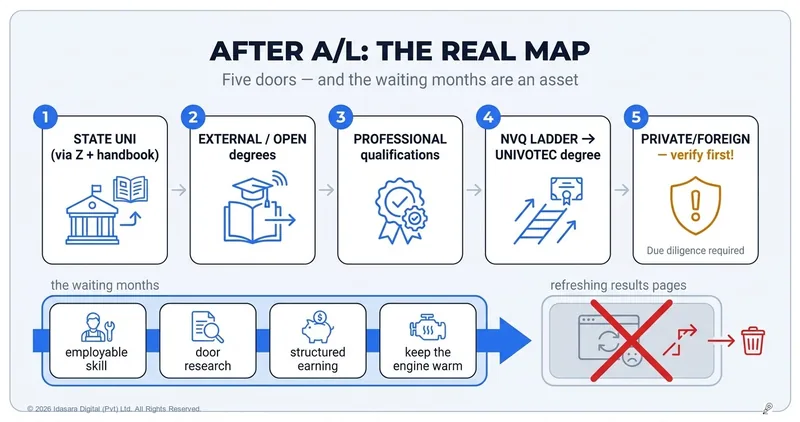
For most Sri Lankan families, "university" means one door — the state campus the Z-score opens — and everything else feels like failure. This chapter of Learn to Learn redraws the real map: what the Z actually decides, the five-door reality beyond it, why the long waiting months are the most wasted asset in a student's life — and how to spend them deliberately instead.
The A/L result arrives, and then Sri Lanka does something strange to its students: it makes them wait — months of results, re-corrections, handbook seasons, selection lists — with the family's whole future-picture riding on one narrowing question: will the Z be enough for a state campus seat?
That waiting room is where this chapter lives. Not to lower anyone's ambition — the state campuses are excellent and worth wanting — but to fix the map, because families who see one door treat every other outcome as grief, and grief makes terrible decisions. There are five doors. Let's walk them honestly.
Door 1 — State university, via the Z
The famous door: selection by Z-score within your stream, course by course, per the UGC's annual admissions handbook — a free public document published by the University Grants Commission (download it from ugc.ac.lk; your school can help, but you don't need anyone's permission to read it). Its rules are the ones that count — not last year's rumours, not this book.
Three honest facts about this door. First: selection runs through a quota system, not marks alone — seats for most courses are allocated partly on all-island merit and largely by district quotas, so the Z that wins a seat differs by district, and students in high-competition districts (Colombo above all) face the country's toughest cutoffs. The handbook explains the current scheme; read it before setting expectations, because a family that doesn't know the district system is planning blind. Second: seats are genuinely scarce relative to qualified applicants — a strong result missing a competitive course is normal arithmetic, not personal failure — and the UGC publishes each year's course-by-course cutoff tables, so last year's real numbers are checkable, not folklore. Third: some courses add their own gates (aptitude tests, interviews) announced in that same handbook, which reward the students who read it early. If your Z is in range: apply with the handbook open and every eligible preference listed thoughtfully — preference-order mistakes cost real seats every year.
Doors 2–5 — the rest of the real map
Door 2 — External and open degrees. State universities themselves run external degree programmes, and the Open University runs full degree paths — real state credentials, entered without the Z-race, studied while working or alongside other plans. The self-discipline demands are high (there's no campus timetable carrying you), which is exactly why students who own this book's methods thrive in them disproportionately.
Door 3 — Professional qualifications. Accountancy, banking, marketing, IT, HR — the professional bodies' ladders (entered on A/L results, no Z contest) that in several fields rival or beat degrees for employment. Earn-while-you-qualify is standard here; the next chapters map it.
Door 4 — The vocational ladder. NVQ's seven levels climb from certificates through diplomas to degree level at the University of Vocational Technology — a state-recognised route the prestige lens refuses to see clearly (the NVQ chapter gives it the full honest treatment). For hands-on fields, this door is frequently the fastest route to good income of all five.
Door 5 — Private and foreign institutions. Real options with one non-negotiable rule: verify recognition before paying — accreditation, the credential's acceptance for your destination (jobs, further study, professional bodies). The family-budget chapter's scam checklist exists because this door attracts predators; walked with verification, it's a legitimate door like the rest.
The map's point isn't that all doors are identical — costs, timelines, and fits differ hugely. It's that the question was never "university or failure." It's the same question as every fork in this Part: which door bridges your evidence to your destination — walked backwards from the career, per the next chapter, with the comparison made on facts.
What should you do with the waiting months — Sri Lanka's most wasted asset?
Between the exam and the outcomes stretch many months — and the national default is to spend them in an anxious nothing: too "done" to study, too uncertain to commit, refreshing results pages. Treat those months as what they are: the largest block of free, obligation-light time you may see for a decade. Spend it deliberately:
- Build the employable layer now: English (the ten-lines habit, aimed at interviews), real digital skills, a professional-qualification first stage, an NVQ certificate — things every door values and no door refunds you for lacking.
- Walk the doors properly: handbook study, careers-backwards research, one honest conversation with someone inside each candidate destination. Decision-quality work, done while there's time to do it well.
- Earn, if your family needs it or you want it — with the working-and-studying chapter's structure, so the job funds the plan instead of replacing it.
- Keep one learning habit alive — the engine chapter warned you: the skill rusts. An hour a day on anything real keeps the machine warm for whichever door opens.
Six well-spent months routinely change which doors are reachable — and they change the person walking through.
Do this — in results-wait season
- Draw the five-door map for your case: under each door, what your results + evidence actually reach. Get the current handbook via your school for Door 1's facts.
- Pick your waiting-months plan: one employable skill + the door-research + (if needed) structured work. Write the week's shape — the time-layer chapters still apply to free months.
- Family meeting with the map on the table — before results, not after. Deciding the response to every outcome in advance is what turns results day from a verdict into a routing step.
At a glance
- The Z opens one door — state selection per the UGC's current handbook (a free download from ugc.ac.lk), through merit + district quotas: cutoffs differ by district, last year's tables are published, and some courses add aptitude tests. Scarcity means strong-but-unselected is arithmetic, not failure.
- The real map has five doors: state via Z · external/open degrees · professional qualifications · the NVQ ladder to degree level · verified private/foreign — each judged by the evidence→destination bridge.
- Verify recognition before paying, always — door 5's one law.
- The waiting months are the decade's biggest free asset: employable skills + door-research + structured earning + one live learning habit.
- Decide the response to every outcome before results day.
One step further with Idasara Academy
The five-door walk is what the path tools run: the University Prep Hub (on the A/L tiers) organises Door 1 (courses, requirements, preparation for the add-on gates), the free-to-start Degree Explorer and path comparison cards put Doors 2–5 beside it with cited destinations, and the Look Ahead and skills tracks turn the waiting months into the invested version of themselves. The map, out of the rumour economy and onto one screen.
Start Free — Create Your Account →
FAQ
My Z misses the course I wanted by a little. Re-sit or take another door? That's the repeat-year chapter's diagnosis-first method, unchanged: near-miss + nameable leak + a destination that truly needs that exact course = a strong repeat case; otherwise walk the other doors for the same destination — several usually reach it, and the comparison belongs on paper, not in grief.
Are external degrees and NVQ paths respected by employers, really? Increasingly and demonstrably — and the AI-age chapters explain the direction of travel: capability evidence keeps gaining on credential prestige. The honest caveats: door-by-door quality varies (verify programmes like door 5), and these paths demand the self-management this book teaches. Respect follows the graduate who can do.
Should we pay for a private degree now or wait a year and re-sit? Run both through the family-budget chapter's machinery: total cost, recognition verified, destination reached, versus the repeat-year's honest odds. The one answer that's always wrong is the panic-purchase in results week — every legitimate institution will still exist in a month.
The waiting is destroying my motivation and my family's peace. The uncertainty chapter-set applies (nerves, results-day-at-home) — but the deepest fix is this chapter's: uncertainty shrinks when every outcome already has a plan, and anxious months shrink when they have a plan. Structure is what calms here, too.
Further reading
The backwards walk that ranks the doors: Pick the Career, Then Walk Backwards. The vocational door in full: The NVQ Road. Funding any door: Scholarships & Funding.
Sources
- StudentLanka — Guide to NVQ in Sri Lanka (the ladder to UNIVOTEC degree level)
- TVEC — tvec.gov.lk (vocational accreditation authority)
- The Idasara Method: Part 4 — Time Management & Flipped Learning (structuring free months)