Scholarships and Funding: The Money Goes to Students Who Apply Systematically
The short answer: Scholarship money goes to students who apply systematically, not to the lucky or the connected: build a one-page calendar of every scheme and deadline, assemble the documents kit before you need it, and apply wide. For Mahapola and the bursary, current rules and amounts live with the official bodies — verify there, then apply.
A chapter of the free book Learn to Learn
Published 2026-08-31 · updated 2026-08-31
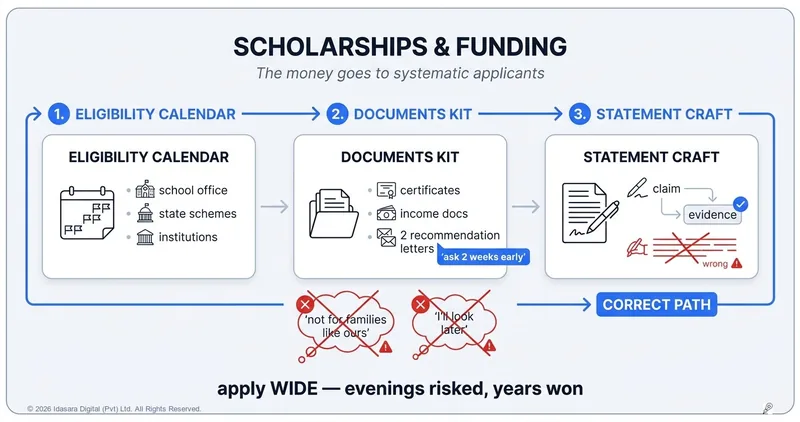
Every year, real money for students — state schemes, university bursaries, corporate and foundation scholarships — goes unclaimed or under-contested, while families who needed it never applied. This chapter of Learn to Learn treats funding as what it actually is: not luck, not connections, but a systems problem — an eligibility calendar, a documents kit, and application craft — the same machinery this book has taught all along, pointed at rupees.
Ask around any classroom: who here has ever applied for a scholarship? A hand or two. Now the follow-up that explains the silence: who knows what scholarships even exist for someone like you? Almost none.
That's the funding gap in one scene. The money is real — the state's schemes for university entrants (Mahapola and bursary support are the famous names — current rules and amounts live with the official bodies, so verify there), school-level and district awards, corporate and bank scholarship programmes, foundation and alumni funds, and international awards at the higher rungs. What's missing isn't money or merit. It's systematic application — and three beliefs stand in the way, all wrong: "I don't know what exists" (a research problem, solvable this week), "those things aren't for families like ours" (need-based schemes exist precisely for families like yours), and "I'll look into it when the time comes" (deadlines don't announce themselves — the time came, and went, quietly).
How do you apply systematically?
1. The eligibility calendar. One page, built once, updated termly: every scheme you could plausibly touch in the next two years — its window, its criteria, its documents. Sources for building it: your school's office (schemes flow through schools far more than students realise — ask directly: "what scholarships do our students apply for?"), the official bodies for the state schemes, the institutions you're heading toward (every university and professional body lists its aid), and the banks/corporates whose programmes recur annually. Two hours of building; then deadlines stop being ambushes. (This is the syllabus-contract chapter's machinery — a public, finite list, tracked weekly — pointed at money.)
2. The documents kit. Applications die on paperwork gathered in a panic: certificates, results slips, income documentation, Grama Niladhari certifications, recommendation letters. Build the kit before any specific application — one folder, physical and photographed, refreshed when documents age. A recommendation letter is an ask with lead time: teachers write far better ones given two weeks and your one-page summary (what you're applying for, your evidence highlights) than given two days and a blank stare.
3. The statement craft. Where applications are won — and it's this book's writing machinery, redeployed: the verb rules the answer (what is this scheme actually funding? Merit? Need? Leadership? A field? — answer their question, not a generic plea); claim + evidence + link (every assertion about yourself carried by a specific: the mistake-bank turnaround — errors logged, then beaten — the self-taught subject, the responsibility carried at home — your Hard Mode story, told with its evidence attached, is exactly what need-and-merit committees fund); and drafts get the loop (written early, marked honestly by a teacher or capable adult, revised — never composed the night before).
And a fourth component that isn't paperwork: apply wide. Funding is a numbers game with asymmetric stakes — applications cost evenings; awards change years. The student who applies to six schemes with a reusable kit and tailored statements beats the student who perfected one application, every time.
For parents
Two jobs. First, the kit's adult documents are yours to gather — income certifications and the like — and gathering them before they're urgently needed is a gift of dignity as much as logistics. Second, watch the pride trap from both sides: some families refuse need-based aid the family genuinely qualifies for ("we don't take charity" — it isn't; it's the system working as designed), while others push children toward misrepresenting circumstances (which fails, and teaches worse). The honest middle: apply for everything you truthfully qualify for, present it fully, and treat the asking as what it is — the same evidence-based self-advocacy this book teaches everywhere else.
Do this month
- Build the calendar: school office ask + official bodies + destination institutions. One page, deadlines highlighted.
- Assemble the documents kit; identify the two recommendation-letter writers and warm them up now.
- Draft the master statement — your evidence story with receipts — and put it through one honest marking loop. Every future application starts from this draft, tailored.
At a glance
- The money is real (state schemes like Mahapola and bursaries, school/district awards, corporate, foundation, institutional aid); the gap is systematic application, not merit.
- Three killers, all false: don't know what exists · not for families like ours · I'll look later.
- The system: eligibility calendar (built from school office + official bodies + destinations) · documents kit (assembled before urgency; letters asked with lead time) · statement craft (their verb, your receipts, the drafting loop).
- Apply wide — evenings risked, years won.
- Verify every scheme's current rules with its official body; truth in every application, always.
One step further with Idasara Academy
The calendar's research half is what the scholarship matches feature runs: schemes surfaced and ranked against your profile, so "I don't know what exists" stops being the killer it is. The statement craft stays yours — and every writing chapter in this book was quietly training it.
Start Free — Create Your Account →
FAQ
Are scholarships only for top-of-the-class students? Merit schemes contest marks; need-based and field-based schemes contest circumstances and direction — different doors, and the calendar should hold both. Many awards weigh the story-with-receipts (persistence, responsibility, trajectory) far more heavily than rank. The comeback student's documented turnaround is a strong application, not a weak one.
Where exactly do I find these schemes? Every article is vague. Because lists rot — schemes change yearly, which is why this chapter teaches the building method instead of printing a list: your school office (the single most under-used source), the official state bodies for the national schemes, every destination institution's aid page, and the recurring corporate programmes your calendar will accumulate. Two hours of building beats any printed list within a year.
Is it worth applying for small awards — a few thousand rupees? Small awards buy books, data, and travel — and they compound differently: each successful application strengthens the kit, the statement, and the confidence for the larger ones. Treat small awards as the practice papers of funding.
What about scholarships to study abroad? Real, competitive, and rung-dependent — mostly contesting at degree level and above, with English evidence and long lead times. They belong on the calendar's far column now (so the lead-time work starts early), and the verification law applies doubly: legitimate international schemes never ask you for processing fees. That sentence is a scam filter; keep it.
Further reading
The budget this funding serves: The Family Education Budget (arriving in the parents' cluster) and What It Costs. The writing machinery: Essay Subjects' two engines.
Sources
- Mahapola Higher Education Scholarship Trust Fund — mahapola.lk (the flagship state scheme; verify current rules there)
- StudentLanka — NVQ guide (funding-adjacent vocational routes)
- The Idasara Method: Part 2 — The Plan (tracked lists beat ambush deadlines)