For Parents: What It Costs, What It Replaces, and the Phone Question
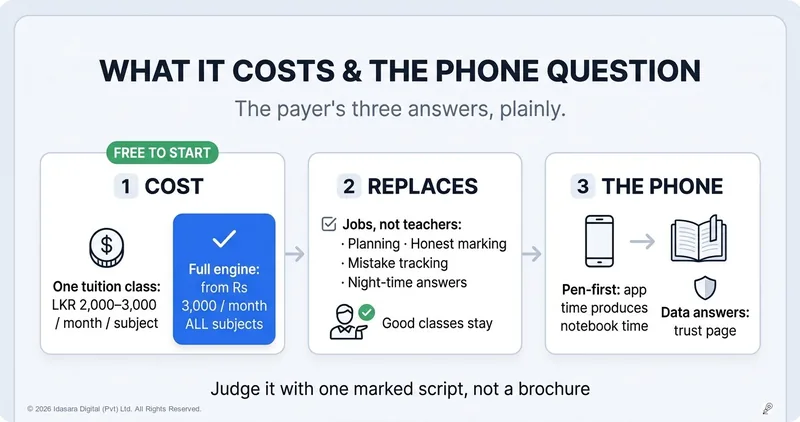
The short answer: Idasara Academy is free to start — a student can begin the daily plan and study materials without paying anything — a paid plan starts from Rs 3,000 a month per student for all subjects together, and the full engine — marking and the readiness picture — from Rs 4,500 (Rs 9,000 at A/L): about the price of one tuition class, covering every subject instead of one. It replaces jobs, not teachers, and the phone stays governed by your house rules.
A chapter of the free book Learn to Learn
Published 2026-08-31 · updated 2026-08-31
Every other chapter of this book teaches method and mentions our app in one small optional paragraph. This chapter is the opposite — it answers, plainly, the three questions a paying parent actually decides on: what does it cost, what does it replace, and what happens on the phone.
By now — if you've read the parent chapter, or your child has been quoting this book at the dinner table — you know our position: no app can learn for your child, the method works with pen and paper, and the government textbooks are the core. All of that stays true on this page.
But you are the payer in a household that already spends real money on education, and you deserve the answers sales pages bury. Here they are, in the order you'd ask them.
What does it cost, against the number you already know?
Your measuring stick is a tuition class: roughly LKR 2,000–3,000 a month, per subject, plus travel and time. Against that stick:
- Free to start. A student can sign up and begin — the daily plan, study materials, and first steps — without paying anything. No card, no commitment. Judge it with your own eyes before a rupee moves.
- A paid plan starts from Rs 3,000 a month, per student — all subjects together, not per subject, and about the price of one tuition class. That tier carries the daily plan, the mistake bank — every error logged for revision — the parent's view and the AI tutor grounded in the national syllabus. The full engine is the next tier up, from Rs 4,500 (Rs 9,000 at A/L): that is where handwritten answers are marked against official schemes and the exam plan's readiness picture appears. The parts that start free stay free. And let's do the multi-child sum out loud, since leaflets never do: two exam-age O/L children ≈ from Rs 6,000 a month on the first paid tier, Rs 9,000 with the full engine — two or three classes' money, covering every subject both children take.
- Current details are always at academy.idasara.org/pricing — and whatever that page says outranks this paragraph, because prices change and honesty means saying so.
The trial that actually answers your question: don't evaluate features — run one real loop. Start free the same evening — every new account opens with 42 days of the full engine, so the test costs you nothing: have your child photograph one handwritten answer and get it marked. What you're buying, if you keep buying, is that loop running daily. One marked script tells you more than any brochure, including this one.
What does it replace — and what doesn't it?
The honest answer is: it replaces jobs, not teachers.
The jobs it does well are the ones this book kept meeting: deciding what tonight's hour is for, marking practice honestly and immediately, remembering every mistake, scheduling revision before forgetting wins, and answering syllabus questions at 9 p.m. If you currently pay for a class mainly to get one of those jobs done — a class that mostly re-delivers notes, or a paper class whose real value is the marking queue — then after a month of the app doing that job visibly, you have a fair comparison to make, and the parent chapter's rule applies: audit by diagnosis, not by reflex.
What it does not replace: a teacher who explains brilliantly, a class your child genuinely learns in, the school, or — this book's oldest point — your child's own pen-and-paper hours. If a tuition class is working, keep it; the app's jobs sit around good teaching, not against it. The realistic outcomes for most families are: the same classes plus far better use of the hours between them — or, over time, one redundant class quietly dropped, which pays for the app many times over.
The phone question
You worry about the phone. You are right to — and this book's own chapters armed you already: screen time only counts as studying if something comes out onto paper (the honesty chapter's ten-minute test), and you can check any claim of "studying on the app" by asking for the notebook it produced.
The specific answers a parent needs:
- "Whose phone?" comes first — and the shared phone is a supported answer. Most Grade-10 children don't need their own smartphone for this: free PIN-separated family profiles let each child (and your parent view) live privately on one shared device, with a booked daily half-hour instead of a nightly fight — the shared-phone chapter of this book turns that into a full family arrangement. A child's own phone is a separate decision, on its own timeline.
- The app is built pen-first. Its central loop requires the notebook: study happens on paper, and the phone's main job is to photograph, check, plan, and schedule. A child using it as designed spends most of "app time" not looking at the app.
- Sessions are short by design. The daily plan hands out a handful of small tasks, not an endless feed. There is nothing to scroll. When the tasks are done, the app's honest next step is a notebook, a textbook, or rest.
- It speaks your language. The whole system works in Sinhala, Tamil, and English — including what you see in the parent view.
- Your child's data: the scripts they photograph and the progress they generate exist to serve their learning and your visibility of it. The full data-safety answers — written for parents, not lawyers — are published at academy.idasara.org/trust. Read them before you decide; a company that can't show you that page plainly doesn't deserve the photographs of your child's handwriting.
- And the door problem is still yours. No app can promise you what else happens on an unlocked phone. The house rules this book already gave you — focus blocks with the phone doing only its job, the exam-free channel, sleep before screens — are the real controls, and they cost nothing.
Do this week
- Run one real loop: start free tonight, inside the 42 free days, and give the full engine its marking test — one handwritten answer, photographed, marked. Sit with your child while it happens — you're evaluating, and you're also showing them you take their tools seriously.
- Read the trust page yourself, in your language.
- Then price it honestly against your current spend — not "can we afford Rs 3,000" but "which of our current thousands is doing less than this would." That's the payer's real question, and you're the only one who can answer it.
At a glance
- Free to start, with 42 free days of the full engine; a paid plan from Rs 3,000/month per student, all subjects; the full engine from Rs 4,500 (Rs 9,000 at A/L) (two O/L children from ≈ Rs 6,000, or Rs 9,000 with the full engine — every subject covered). Current details: pricing.
- It replaces jobs, not teachers: planning, honest marking, mistake tracking, scheduled revision, syllabus answers at night. Good classes stay; redundant jobs go.
- The real trial is one loop: one handwritten answer, photographed, marked — judged with your own eyes.
- Pen-first by design: app time mostly produces notebook time. Short tasks, no feed, trilingual, parent view included.
- Data answers, in parent language: trust page. The phone's house rules remain yours — and this book already gave you them.
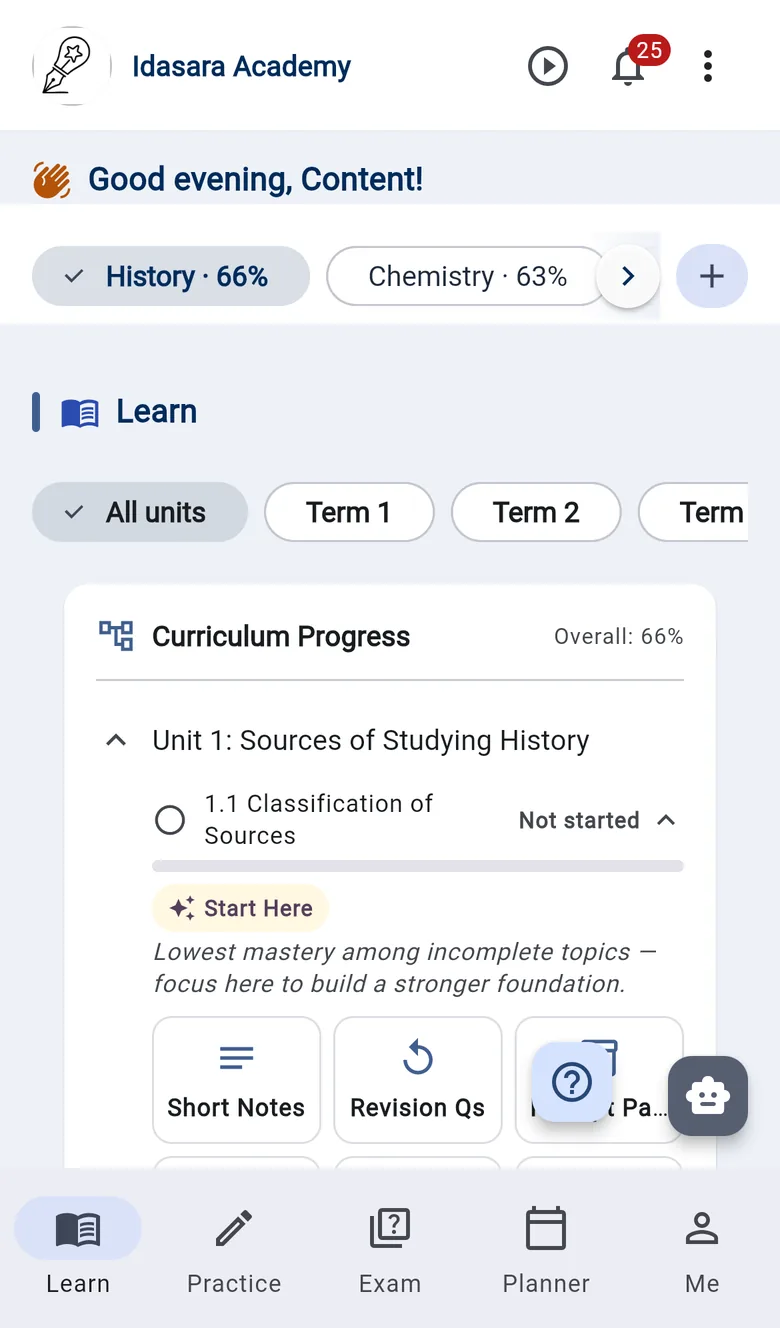
Start Free — Create Your Account →
FAQ
Why should I trust pricing printed in a book? Prices change. You shouldn't — that's why this chapter says the live pricing page outranks it. What this chapter promises is the shape: free to genuinely start, and a full tier priced against a fraction of one tuition class, all subjects included. If you ever find that shape broken, this book owes you an update.
My child already uses free ChatGPT. Why pay anything? Read the four-questions chapter with them — the honest answer is "keep using it for what it's good at." What the paid engine adds is the loop no chat tool runs: answers checked against the national syllabus, handwritten scripts marked against real schemes, and every mistake feeding a revision plan. If those jobs don't matter to your household, don't pay. If you're currently paying a class mainly to get them — compare.
Is one subscription per child, or per family? Per student account — each child needs their own, because the whole engine is personal: their mistakes, their readiness, their plan. Check the pricing page for current family arrangements.
What if we try it and it isn't working? The same instruments this book gave you answer that too: after a month, is the notebook fuller? Are marked scripts improving? Is the mistake list shrinking? If the evidence says no, stop paying — and tell us why. An app built on honest marking should expect to be honestly marked.
Further reading
The method this pricing serves is the whole book — start at the shelf. The product's own pages: pricing · trust & data safety · the method write-up.
Sources
- Idasara Academy — Pricing (the live page outranks this chapter)
- Idasara Academy — Trust & data safety
- The Idasara Method: Part 1 — The Human Foundation & Active Recall