How to Study History, Civics, and Every Essay Subject: Two Engines, Not One
The short answer: Study History, Civics, and every essay subject as two subjects at once: put the facts — dates, names, provisions — on a spaced revision schedule, stored on timelines and diagrams you draw from memory, and separately train timed essays built as claim + specific evidence + link. Facts alone or storytelling alone both cap at a C; run both engines and the essay finally pays.
A chapter of the free book Learn to Learn
Published 2026-08-31 · updated 2026-08-31
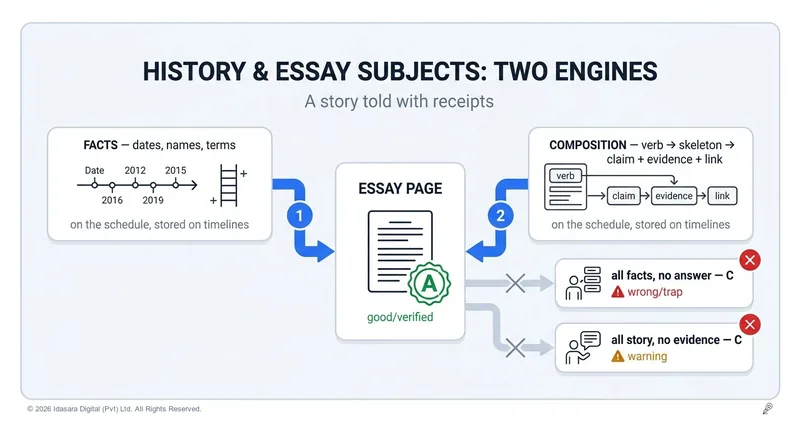
Essay subjects defeat students in a peculiar way: they memorise mountains of facts and still write essays that score C — or they "understand the story" and can't produce a single dated fact. This chapter of Learn to Learn names the reason: essay subjects are TWO subjects wearing one name — a fact subject and a writing subject — and each needs its own engine, run separately.
Every History class contains these two students, and both are stuck.
The first is the memoriser: notebooks of dates, kings, commissions, clauses — recited perfectly the night before, poured onto the paper in heaps. Result: a C, with the marker's silent complaint written between the lines: facts everywhere, answer nowhere.
The second is the storyteller: genuinely gets it — why the kingdom fell, what the reforms changed — and writes flowing essays with almost no dates, names, or specifics. Result: also a C: argument everywhere, evidence nowhere.
Neither student is weak. Each is running one engine of a two-engine subject. Every essay subject — History, Civics, Geography, Health, Buddhism/religion papers, Literature — pays for exactly two things: specific retrievable facts and structured composition that deploys them. The marking scheme lists points-with-specifics; the essay question demands shape and argument. Miss either engine and the ceiling is a C, no matter how hard the other engine works.
Engine one: how do you remember the facts? Scheduled, not crammed
The dates, names, terms, articles, provisions, examples: this is exactly the arbitrary-fact territory the memorising chapter mapped, so its rules run unchanged — small batches, produce-don't-recognise, the spaced ladder, handles for the slippery ones (first-letter chains for ordered lists; the sillier the better).
Two essay-subject upgrades:
Facts live on timelines and maps, not in lists. The pictures chapter's tool-matching applies with full force: History's natural short note is a timeline (causes hung above the line, effects below), Geography's is the sketched map, Civics' the structure diagram (who answers to whom). A date remembered as a point-on-a-line carries its neighbours with it — order, cause, consequence — where a date in a list carries nothing. Draw them from memory; audit in red; figure-walk them weekly — one pass through every figure you own.
Every fact earns its place by serving an argument. Don't collect facts flat; collect them attached — "1833, Colebrooke–Cameron: the reform that did X, evidence for Y." A fact stored with its so-what arrives in essays pre-loaded, which is precisely what the memoriser never had.
Engine two: how do you build the essay itself?
The storyteller's missing engine. Essay-subject answers are constructed, and the construction is trainable — it's the writing chapters' machinery pointed at content essays:
- The verb rules the answer (the command-words chapter, at maximum relevance): describe the reforms ≠ explain their consequences ≠ evaluate their success. Circle it; let it choose the skeleton.
- Skeleton before sentences, always: three to five points, each point = claim + specific evidence (a fact from engine one) + link back to the question. That claim-evidence-link beat, repeated, is the essay-subject answer — schemes pay per developed point, and points without specifics develop nothing.
- Paragraph = point. One point, one paragraph, first sentence carrying the claim — the structure a tired marker can pay at reading speed (the handwriting chapter's economics, essay edition).
- Train under time, marked against schemes. Essay fluency is built exactly like every performance in this book: weekly timed essays, checked against the scheme's listed points, errors banked — which points did I miss? was my evidence specific? did I answer the verb?
The two engines, meshed
Run separately, checked together: the weekly essay is where you audit both — did engine one supply specifics? did engine two deploy them in shape? A term of that weekly mesh turns the memoriser into a student whose facts argue, and the storyteller into one whose arguments land. That combination is what A-grade essay answers are: a story with its evidence attached.
And underneath, the loop unchanged: the textbook's narrative read fully (essay subjects reward the read-to-the-end discipline — the because usually sits two paragraphs past the what), question-log the whys (why did the reform fail? is both a study question and a future essay skeleton), short notes as timelines, past papers in season.
Do this tonight
- Take your current History/Civics topic. Build its timeline or structure-diagram from memory; audit in red. That's engine one's note.
- Pick five facts from it and attach a so-what to each, one line: what does this fact prove?
- Take one past-paper essay question on the topic: circle the verb, write only the skeleton — three claims, each with its evidence fact named. Ten minutes, no essay. You've just rehearsed the exact act the paper pays.
At a glance
- Essay subjects are two subjects: a fact subject (dates, names, terms, provisions) + a writing subject (structured argument). One engine alone caps at C.
- Engine one: facts on the spaced schedule — stored on timelines, maps, structure-diagrams (drawn from memory), each fact attached to its so-what.
- Engine two: verb → skeleton → claim + specific evidence + link, paragraph per point, trained weekly under time against schemes.
- The weekly timed essay is where the engines mesh and get audited together.
- A-grade essay answers = a story with its evidence attached.
One step further with Idasara Academy
Engine one runs on flash cards — on the paid tiers — with your fact-pairs and their so-whats on the spaced ladder, slips banked automatically. Engine two runs on the paid tiers' Exam Paper Marking: your handwritten timed essays checked against the scheme's listed points — which claims paid, which evidence was too vague, whether the verb was answered. Two engines, each with its own honest mechanic.
Start Free — Create Your Account →
FAQ
There's SO much to memorise — the History syllabus feels endless. Sort before you memorise: schemes pay specific facts attached to examinable arguments, not every sentence in the book. Build the timelines first (they compress a chapter into one drawable object), then schedule only the facts your skeletons actually deploy. The endless feeling is what an unsorted fact-pile feels like; sorted, it's finite and walkable.
Can I use the same prepared points for different essay questions? Your fact-arsenal transfers; your skeletons must not. The verb and the question choose which facts deploy and in what shape — that's why tonight's exercise trains skeleton-building speed, not essay memorising. Prepared evidence, fresh architecture: that combination handles any question the paper invents.
How long should an essay answer actually be? As long as its points, no longer — the shopping chapter's marks-per-word rule. Three to five developed claim-evidence-link paragraphs beats six pages of unstructured narration, in marks and in time saved for the rest of the paper.
Does this work for Literature, where the "facts" are quotes and scenes? Perfectly — quotes are the evidence layer (schedule the key ones exactly like dates), and the claim-evidence-link beat is literature analysis by definition: the claim about the character, the quoted line, the link to the question. Same two engines, bookish fuel.
Further reading
Command verbs, keyword rubrics, and how essays are actually paid: Part 3 — The Grade Progression Ladder & Paper Marking.
Sources
- Dunlosky, J. et al. (2013) — overview at APS (spaced practice; practice testing)
- The Learning Scientists: Dual Coding (timelines and structure diagrams)
- Cambridge International — Command words
- The Idasara Method: Part 3 — The Grade Progression Ladder & Paper Marking