The Family Education Budget: Rupees Follow Diagnosis
The short answer: A tuition class in Sri Lanka typically costs Rs. 2,000–3,000 per subject, so a stacked timetable is real money — and the way to spend it well is an evidence audit, not a blanket cut: keep what the child can demonstrably reproduce afterwards, redirect what they can't, and fund the small purchases (spectacles, past papers, data) first.
A chapter of the free book Learn to Learn
Published 2026-08-31 · updated 2026-08-31
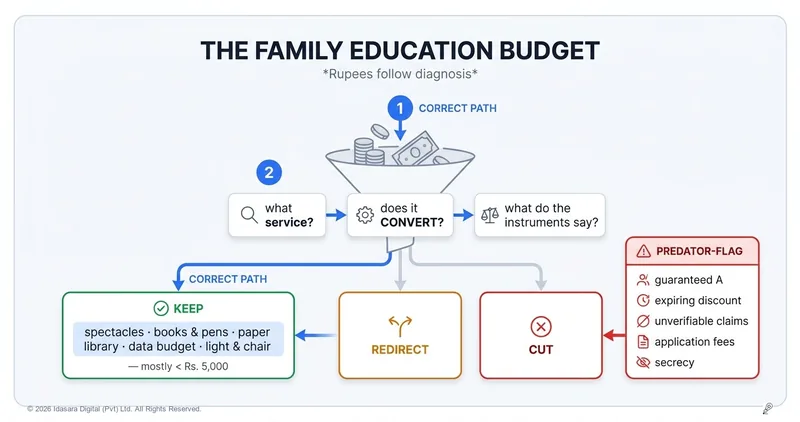
Sri Lankan families give everything for education — class stacked on class, guides on seminars, sometimes debt on hope. This chapter of Learn to Learn closes the parents' arc with the money conversation nobody hosts: the audit that ranks every education rupee by what it converts to, the short list of purchases that outperform everything, and the checklist that spots the predators circling exam-anxious families.
Two households, same income, same Grade-11 child. The first spends heavily and vaguely: four classes because the neighbours' children attend them, the seminar because the leaflet frightened them, the second guide-book set because the first didn't work. The second spends less and precisely: two classes that survived an audit, the paper library, the spectacles appointment, a protected data budget — and banked the difference against next year's real fees.
The difference isn't income or love. It's a principle this book has taught the student a hundred times, now applied to the household ledger: evidence before spending — rupees follow diagnosis, never fear. Here is the family version of the machinery.
How do you tell which classes are worth the money?
List the current education spending — every class, subscription, purchase — and ask each item the family versions of this book's oldest questions:
- What service is this actually buying? (The tuition chapter's trio: delivery, feedback, or pacing? "Delivery of material the school already delivers, a third time" is the most commonly purchased and least valuable service in the country.)
- Does it convert? The Me Time test at rupee-scale: after this class/product, can the child produce — reproduce the material cold, show marked work, point to closed mistakes? A class that converts is worth buses and fees; a class that's watched is an expensive evening out, weekly.
- What did the instruments say? The tracker — the syllabus coverage chart — and marked papers know which subjects need money: funding the diagnosed weak subject's feedback (a marking-heavy class, a paper stock) beats funding the comfortable subject's fourth repetition — the Z chapter's floor-first arithmetic, in rupees.
Then rebalance without guilt: cutting a non-converting class isn't withdrawing support — it's redirecting it, and the child consulted on the audit (old enough to run the conversion test themselves) learns the century's most useful money lesson free of charge.
The short list that outperforms everything
Before any new class, check the small purchases with embarrassing returns (Hard Mode — the low-resource studying chapter — priced them): the spectacles appointment (the most neglected education purchase in the country — the slow-reading chapter's first check), exercise books, pens, and the paper library (the volume chapters' raw material; astonishing how many heavily-tuitioned students lack past papers), the protected data budget (small, named, weekly — fuel for the supply run, the planned download session), the light and the chair where the studying happens, and sleep-protecting boundaries that cost nothing but outperform every paid intervention on this list. The pattern: the highest-return education purchases are almost all under five thousand rupees, and almost all unmade — because they're too humble to advertise.
How do you spot an education scam?
Exam-anxious families are a market, and the market has teeth. The checklist for any institute, program, "guaranteed" course, or miracle product — one red flag is caution; two is a wall:
- Guarantees of results — no honest educator guarantees grades; the ladder's climb has too many student-owned rungs. "Guaranteed A" is a marketing claim about your fear, not their method.
- Pressure tactics and expiring discounts — "enrol today, the price doubles Monday" is the signature of a sale, not a school. Legitimate institutions survive a week's thought (the after-A/L chapter's rule: every real option still exists in a month).
- Unverifiable claims — toppers with no names, results with no cohort sizes, accreditations that don't check out (the recognition law from Part 10: verify before paying, at TVEC/professional bodies/the institutions themselves — twenty minutes against fee-scale losses).
- Fees demanded for the application — real scholarships and legitimate programs don't charge you to be considered (the scholarship chapter's scam filter, generalised).
- The product is secrecy — "techniques the schools don't want you to know" sells everywhere and delivers nowhere; this book's whole existence is the counter-evidence: the real methods are public, cited, and mostly free.
And the debt question, faced honestly: borrowing for education can be rational (a verified qualification with a real income path — Part 10's doors have honest arithmetic) and can be tragic (debt for a predator's promise, or for prestige's sake when a free road reaches the same destination). The rule that separates them is this chapter's title — the diagnosis first, the recognition verified, the alternatives (the free stack, the state schemes, the earn-and-learn roads) genuinely priced before the signature. No legitimate opportunity punishes a family for checking.
Do this month
- Run the audit: every education rupee listed, the three questions asked, the instruments consulted. Rebalance one item.
- Fund the short list first — spectacles-check included, this month, if it's never been done.
- Put the predator checklist in the family's shared knowledge — the almirah door, next to the free-stack chapter. The season of leaflets is always coming.
At a glance
- Rupees follow diagnosis: every education expense audited by service (delivery/feedback/pacing?), conversion (can the child produce afterwards?), and the instruments (fund the diagnosed floor, not the comfortable fourth repetition).
- The outperforming short list, mostly under Rs. 5,000: spectacles · books/pens/the paper library · the named data budget · light and chair — humble, unadvertised, decisive.
- The predator checklist: guaranteed results · expiring-discount pressure · unverifiable claims · application fees · secrecy-as-product. One flag = caution; two = wall.
- Debt divides on the same rule: diagnosis + verified recognition + free-alternatives priced, before the signature.
- The audited household spends less, converts more — and teaches the money lesson by running it.
One step further with Idasara Academy
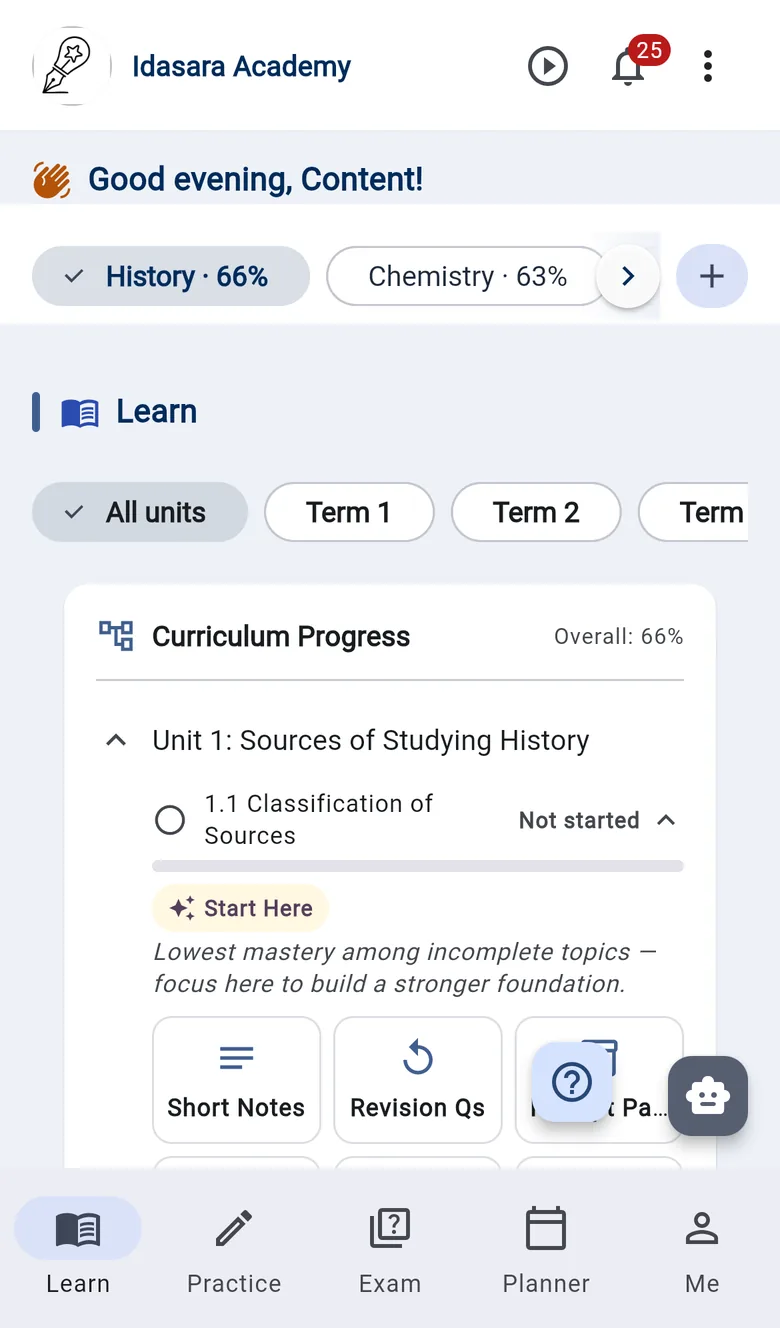
The budget conversation is where this product's positioning was always aimed, so once more with the numbers on the table: the method is free, the state's stack is free, the app starts free with 42 days of the full engine, a paid plan costs from Rs 3,000 a month — about one Rs. 2,000–3,000-per-subject class, but covering all subjects — and the full engine from Rs 4,500 (Rs 9,000 at A/L) — — judged, like everything on your audit, by the conversion test and cancellable the moment it fails it (pricing · trust). We wrote the audit knowing we'd be subject to it. That was the point.
Start Free — Create Your Account →
FAQ
Cutting a class feels like gambling with my child's future — what if I'm wrong? That's why the audit cuts by evidence, reversibly: drop the weakest-converting class for one term, watch the instruments (the freed hours go to Me Time, whose returns the tracker will show), and re-add if the data argues back. It rarely does — and the option is what makes the decision safe — versus the truly irreversible gamble: years of unaudited spending.
Our relatives judge us by how many classes the children attend. The armor-line, budget edition: "we fund what the marked papers say — it's working" — said once, cheerfully, with the results doing the long-term arguing. The neighbours' spending is the prestige-ranking wearing a fee structure; you've retired that ranking twice already in this Part.
Is the expensive 'international' institute worth it for O/L support? Run it through the same three questions plus the recognition check — price is not on the checklist because price proves nothing either way. Expensive-and-converting exists; so does expensive-and-theatrical. The audit is brand-blind, which is precisely its power.
We simply have no money at all — is this chapter mocking us? The opposite — re-read its arithmetic: the decisive purchases are the tiny ones, the stack is free, and the state schemes (the scholarship chapter) exist for exactly your household. The families this chapter mourns aren't the ones spending nothing; they're the ones spending everything on the wrong list. Yours starts even.
Further reading
The audit's machinery: Me Time (the conversion test) · What It Costs (the app's own audit) · The Free Education Stack (what's already owned) · Scholarships & Funding (the incoming side of the ledger).
Sources
- Wikipedia — Private tuition in Sri Lanka (the spending culture's scale)
- TVEC — tvec.gov.lk (verification before payment)
- Mahapola — mahapola.lk (the state's incoming side)
- Idasara Academy — Pricing (the anchor, auditable)