Me Time: The Hours You Spend Alone With a Subject Decide Everything
The short answer: Classes — school or tuition — can only deliver material; learning is manufactured in the hours you spend alone with a subject, converting it with your own pen. Those hours, not the class count, are what results secretly track — which is why the fourth tuition class, paid for with the hours where keeping happens, so rarely moves the marks.
A chapter of the free book Learn to Learn
Published 2026-08-31 · updated 2026-08-31
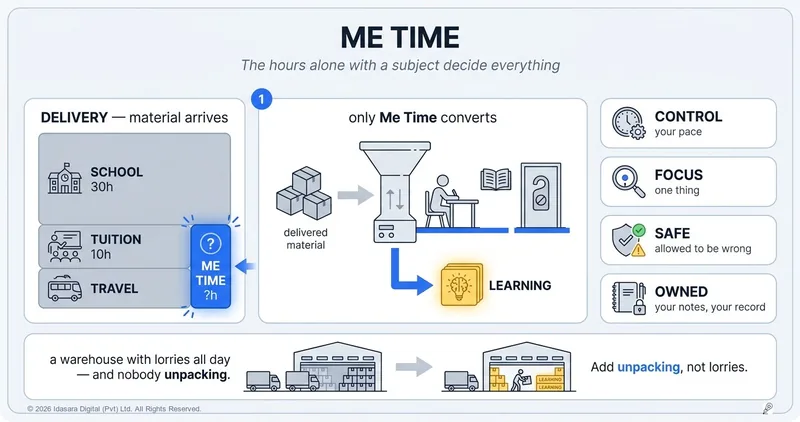
Count your week: thirty hours of school, ten of tuition, hours of travel between them — and how many hours alone with each subject, just you, your pen, and the book? This chapter of Learn to Learn makes the book's deepest claim explicit: classes deliver material, but learning is manufactured only in Me Time — the hours that are yours — and everything in this book is, in the end, a way of running those hours well.
Count a serious Sri Lankan student's week, honestly.
Thirty-plus hours of school. Eight, ten, twelve hours of tuition. Hours in buses between them. The child leaves at six-thirty and comes home at seven. A life completely full of education — and the marks stand still. The family's answer is usually one more class.
Now ask the question the timetable never asks: in all of that, how many hours is the student alone with a subject — no teacher talking, no board to copy, just their mind, their pen, and the book? For many students, the honest answer is: almost none. And that number — not the thirty, not the twelve — is the number the results are secretly tracking.
Classes give. Only Me Time keeps.
Here is the model, in three short rules.
Rule 1: A class can only give you material. School or tuition, good or bad — a lesson is knowledge flowing in. That is valuable. But you have known since this book's first chapters: knowledge flowing in is not yet learning.
Rule 2: Learning happens when knowledge comes out of you. Written from memory. Answered on a blank page. Solved with your own pen. Tested and corrected. And look where every one of those acts lives: the short note, the blank-page test, the question log, the exercises, the past paper, the mistake worked to zero — every technique in this book is a Me Time technique. No teacher can do them to you. They happen only in the hours that are yours. The method's own manifesto says it in one line: real learning happens "in the quiet space between a student's mind, their pen, their textbook, and their daily practice."
Rule 3: Every extra class is paid for with a Me Time hour. This is why the fourth tuition class so rarely moves the marks. The class isn't bad — but its hours, travel, and tiredness come out of exactly the hours where the keeping would have happened. Picture a shop that takes deliveries all day and never unpacks a box. More deliveries don't help. Unpacking does.
Yours — the other half of the name
But "self-study time" would have been the wrong name for this chapter, because the hours matter for a second reason that the timetable-arithmetic misses.
Think about who controls a Sri Lankan student's learning. The school sets the pace. The tuition master dictates the notes. The parent applies the pressure. The exam clock terrifies from the wall. Everyone runs the student's education at them — and the student, the one person the whole machine is for, controls none of it. Me Time is the exception, and that is its quiet power:
- Control — you choose the subject, the pace, the next step. For one hour, the education is finally pointed by its owner.
- Focus — one thing at a time, no comparison to the fast kid in the second row, no noise.
- Safety — and maybe the deepest one: Me Time is the one place you are allowed to be wrong. No class laughing, no red pen but your own. Every blank-page failure, every mistake caught in private, costs nothing and teaches everything. This book's whole engine runs on honest error — and honest error needs a room without an audience.
- Ownership — the notes, the maps, the mistake list, the tracker: a record that is yours, built by your own hand. Nobody graduates owning their tuition master's handouts. The student who owns their learning record owns the skill for life — which is where the final chapters of this book have been pointing all along.
A student who tastes this usually says some version of the same sentence: "I can finally think." That sentence is what this book has been building since page one.
How do you protect the hours that matter?
If Me Time is where results are manufactured, then the week must be built around it — not from its leftovers.
Students: schedule Me Time first, like the precious thing it is — the peak-hour rule, the paired evenings, the daily blocks: the whole time section of this book exists to protect these hours. And spend them on keeping, not on more receiving: an evening re-watching lessons is still a class in disguise; an evening of notes-from-memory, exercises, and mistake work is the real thing.
Parents: before adding the next class, run the audit this chapter taught you — how many alone-with-the-subject hours does my child have left, and what will this class eat? Sometimes the class is right. But often the highest-return "class" you can give your child is a protected, quiet, undisturbed hour at their own desk — it costs nothing, and it is the hour everything else was supposed to serve. Respecting a child's Me Time — not interrupting it, not reading it as idleness (you've read the visibility chapter), not scheduling over it — is itself an act of educational investment.
Do this tonight
- Count last week's true Me Time per subject — alone, converting, no delivery. Most students are shocked twice: by the total, and by which subjects got none.
- Claim one hour tomorrow — hardest subject, best energy, door shut, phone away — and run it as this book taught: retrieve, produce, correct.
- Name it out loud to the household: "This is my study hour." The name does work: it tells the family what's happening behind the quiet, and it tells you that this hour is yours.
At a glance
- The week's hidden number: hours alone with each subject — not class hours — is what results track.
- Classes give; only Me Time keeps: every technique in this book (notes from memory, blank-page tests, papers, mistake work) happens in the hours that are yours.
- The fourth tuition class fails because its hours come out of the keeping hours — deliveries all day, and nobody unpacking.
- Me Time's second half: control, focus, safety-to-be-wrong, ownership — the one hour the student runs their own education.
- Build the week around Me Time, not from its leftovers — and parents: a protected quiet hour is an educational investment that costs nothing.
One step further with Idasara Academy
Here is the honest place to say what the app actually is, underneath all its tools: a Me Time container. Your pace, your plan, your notes checked, your mistakes remembered, your practice marked — with nobody watching you be wrong and nobody setting the pace but you. Free to start; the method's hours stay yours either way. That's not a feature list — it's the design philosophy: your learning, your pace, your focus — and the tools to run your own learning, for life.
Start Free — Create Your Account →
FAQ
Isn't class time more valuable, since a teacher explains things I can't teach myself? A good teacher's explanation is genuinely precious — as delivery. But an explanation you never convert (never retrieve, never produce, never test) fades like everything else this book has measured. The pairing is the point: classes are worth the most to students with Me Time to convert them — which is exactly why the flipped chapters put your own hour before the lesson.
How many Me Time hours do I actually need? Fewer than you fear — because these hours are dense. Two to three genuine alone-with-the-subject hours on a school day (the time chapters show where they fit) outweigh any number of extra classes. The ratio to watch: if class hours are more than double your own-work hours, the boxes are piling up unopened.
My Me Time gets eaten by homework. Doesn't that count? It counts if you run it right: homework done paper-first, from memory where possible, checked and mined for mistakes, is Me Time working. Homework done as copying-to-finish is just more receiving. Same hour, same desk — the difference is everything this book has taught.
I focus better in a group with friends. Is alone really necessary? A good study group is valuable for testing each other — which is retrieval, and honest. But watch the safety dimension: the group is where you perform; Me Time is where you're allowed to fail cheaply, and cheap failure is where the fastest learning lives. Keep both; protect the private hour first.
Further reading
The quiet space this chapter names is the method's opening claim — Part 1 — The Human Foundation & Active Recall — and the life-philosophy behind it is the essay that started this whole project: The Independence Curriculum.
Sources
- The Idasara Method: Part 1 — The Human Foundation & Active Recall ("the quiet space between a student's mind, their pen, their textbook")
- Samisa Abeysinghe — The Independence Curriculum (the Me Time manifesto)
- Dunlosky, J. et al. (2013) — overview at the Association for Psychological Science (why conversion techniques beat added exposure)