The Free Education Stack: Everything a Zero-Rupee Student Actually Needs
The short answer: Every load-bearing study material is free: official textbooks from edupub.gov.lk, syllabi from the NIE, trilingual lessons on e-thaksalawa, and past papers with marking schemes through schools, libraries, and the Department of Examinations. The expensive part of education was never the materials — it was knowing how to use them, and that is this book's whole job.
A chapter of the free book Learn to Learn
Published 2026-08-31 · updated 2026-08-31
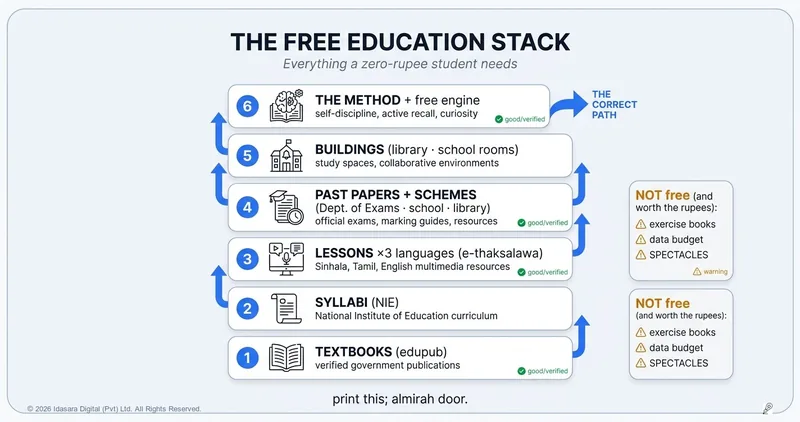
Families believe results are bought — classes, papers, guides, seminars — and families without the money believe they've already lost. This chapter of Learn to Learn is the inventory that breaks that belief: the complete stack of genuinely free materials the state and the public system already provide, layer by layer, with where to get each — because the expensive part of education was never the materials. It was knowing how to use them.
Put the two facts of this chapter side by side and let them argue.
Fact one: Sri Lankan families spend staggering sums on education extras — classes, printed papers, guides, seminars — and the spending is so normal that not spending feels like neglect.
Fact two: every load-bearing material in this entire book is available free. The textbooks the exams are built from. The syllabi that define the examinable universe. The past papers and marking schemes that manufacture A-passes. The lessons re-explained, in three languages. The library buildings sitting quiet in every town.
The gap between those facts is where this chapter lives. What follows is the stack, layer by layer — each source named, each layer mapped to the chapters that use it. Print this one and put it inside the almirah door.
Layer 1 — The core: official textbooks
The Educational Publications Department distributes the government textbooks — the books the papers are set from — free in schools, and publishes them for download at edupub.gov.lk. Lost yours? Sibling's copy gone missing? The download replaces it for the cost of a supply-run — one planned fetch where the signal lives. For A/L, the NIE's syllabi and resource materials live at nie.ac.lk. This layer alone, plus this book's methods, is the C-pass machine (the ladder chapter's Rung 1) — and it costs nothing.
Layer 2 — The map: syllabi and term structure
The same NIE source publishes the syllabus outlines — the examinable universe the contract chapter had you sign. Your school has them; the curriculum browser carries them structured by term. Free, and worth more than any paid seminar, because the map is what makes every other hour aimable.
Layer 3 — The delivery: lessons re-explained, trilingually
The Ministry of Education's e-thaksalawa (e-thaksalawa.moe.gov.lk) carries official lessons and materials in Sinhala, Tamil, and English — the second-telling that tuition sells, published by the state for free. Downloadable, supply-run friendly, and syllabus-faithful by construction. The second-language chapter's two-pass method runs on this layer.
Layer 4 — The grade-maker: past papers and schemes
The Department of Examinations (doenets.lk) is the official home of the national examinations — and past papers with marking schemes are the most valuable free objects in the entire stack (the volume chapter priced them). Schools hold years of them; libraries stock collections; the official channels anchor authenticity. Rung 3's whole machinery — 10 to 20 papers, marked ruthlessly — runs on this free layer.
Layer 5 — The buildings: libraries and the school itself
The public library network — a building of quiet, reference collections, paper stocks, sometimes the connection for your supply-run — sits underused in almost every town, free. And the school beyond its timetable: study rooms, teacher time for precise questions, paper stocks, the computer room. The no-quiet-room chapter's geography audit mostly lists this layer — the free square footage families forget they own.
Layer 6 — The engine: the method and its tools
The method itself — this book — is free, deliberately (the shelf chapter's promise). And the app's free tier carries the engine's automation: the curriculum browser, Today's Plan, micro-quizzes, the mistake bank's start, prompt packs, data-lite mode. The paid tiers deepen it; the free layer is honestly usable alone — that's a design position, stated in the honesty chapter and kept.
What's genuinely NOT free — so this chapter stays trustworthy: exercise books and pens (small but real — the one purchase that matters most), data for supply-runs (a budget, per the little-data chapter), spectacles if reading is blurry (the single most neglected educational purchase in the country), and time — the hardest currency in Hard Mode homes. Naming these keeps the claim honest: the materials are free; the family's real spending decisions belong on this short list, not on the long expensive one.
Do this month
- Run the stack audit: which of the six layers does your household actually have in hand? Fill the gaps in one supply-run + one library visit + one school ask.
- Build the paper library (Layer 4) for your exam year — the term-1 asset the volume chapter demands.
- Show a parent this chapter — specifically the two-facts opening. The family conversation about money and education goes differently with the inventory on the table.
At a glance
- Every load-bearing material in this book is free: textbooks (edupub) · syllabi (NIE) · trilingual lessons (e-thaksalawa) · past papers & schemes (Dept. of Examinations, schools, libraries) · the library and school buildings · the method + free-tier engine.
- The expensive part was never the materials — it was knowing how to use them, which is this book's whole job.
- Genuinely not free, and worth the family's focus: exercise books & pens, supply-run data, spectacles if needed, and time.
- The stack + the method = the ladder's Rung 1 at zero rupees; Layers 4 and 6 carry the climb to A.
- Print this chapter; put it inside the almirah door.
One step further with Idasara Academy
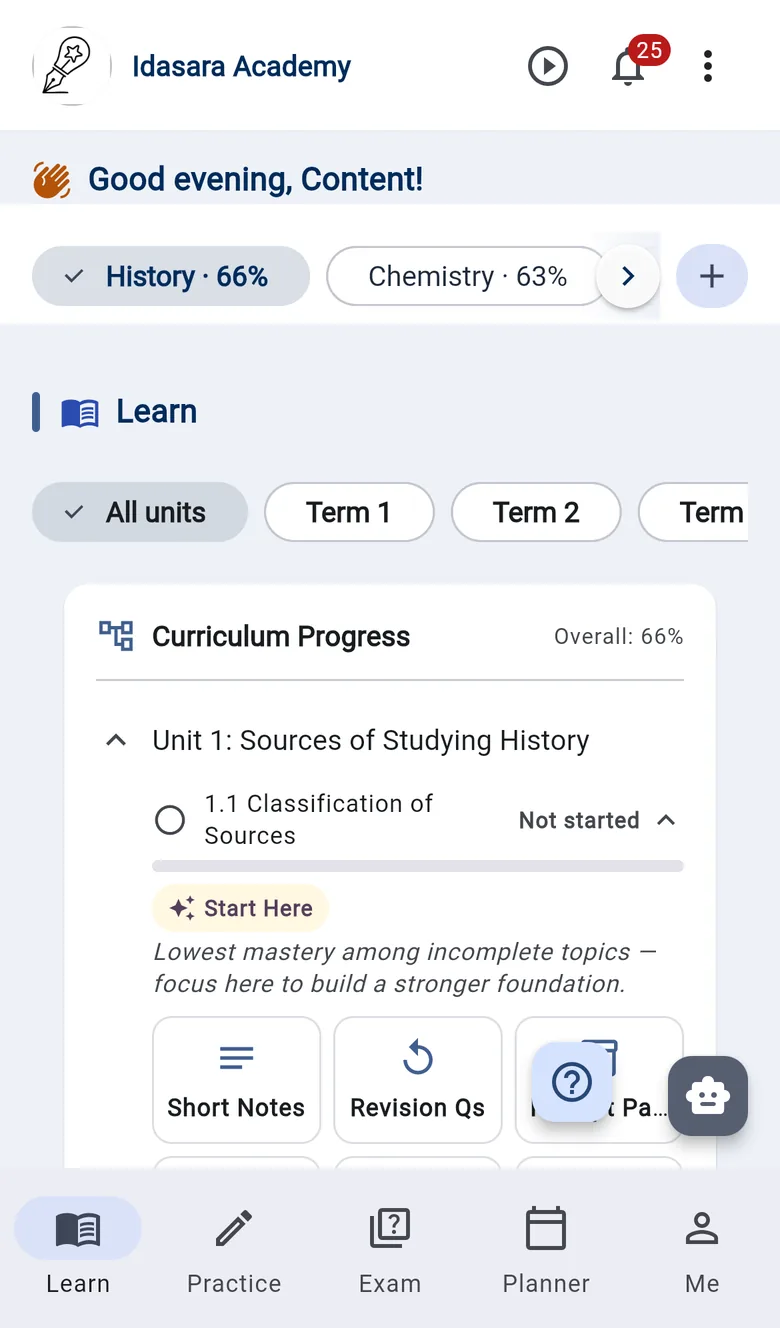
The free tier was built to be Layer 6 of exactly this stack: the state's free materials, organised — syllabus mapped by term, daily plan aimed, mistakes remembered — in your language, offline-capable, at zero rupees. The stack gives you everything; the engine makes it run — deliberately available to the family that can pay nothing.
Start Free — Create Your Account →
FAQ
If it's all free, why does everyone pay so much? Three honest reasons: convenience (paid things arrive organised — which is what Layer 6 now does free), pacing and pressure (the drumbeat the self-study chapter rebuilds), and culture — spending as proof of caring. The last one deserves the family conversation this chapter ends with: caring is better proven by protected time and the short real-purchases list.
Are free/pirated PDF guide-books part of the stack? The official layers above are legally, deliberately free — that's different from pirated commercial guides, which this book doesn't need anyway: the textbook chapter showed why third-party guides are the weakest material at any price. The stack isn't a poverty version of the paid pile; it's the primary sources the paid pile imitates.
Our library is small and old. Still worth it? A quiet room with a table is Layer 5's main service — the collection is a bonus. And small libraries respond to specific requests (past-paper collections, syllabus copies) far more than families expect: librarians are among the stack's most underused humans. Ask.
What about free seminars and mass classes before exams? Judge by the conversion test like everything else: a seminar that hands you technique and schemes can be worth a day; a motivational mass event usually converts to nothing but a lost Saturday. The stack's rule of thumb — materials and feedback beat performances — sorts them quickly.
Further reading
How to run the stack: Studying on Little Data (the supply-run) · No Tuition in My Area (the three services rebuilt) · Building Your Past-Paper Library (arriving — Layer 4's full craft).
Sources
- Educational Publications Department — edupub.gov.lk (free official textbooks)
- Ministry of Education — e-thaksalawa (free trilingual lessons)
- National Institute of Education — nie.ac.lk (syllabi & resource materials)
- Department of Examinations — doenets.lk (the examinations' official home)