Building Your Past-Paper Library: The Term-One Asset
The short answer: Use past papers as a system, not a pile: collect the most recent ten-plus years per subject with their marking schemes (doenets.lk, your school, seniors), staple each paper to its scheme, log every sitting in a ledger, and keep the three newest years unseen for the final dress rehearsals.
A chapter of the free book Learn to Learn
Published 2026-08-31 · updated 2026-08-31
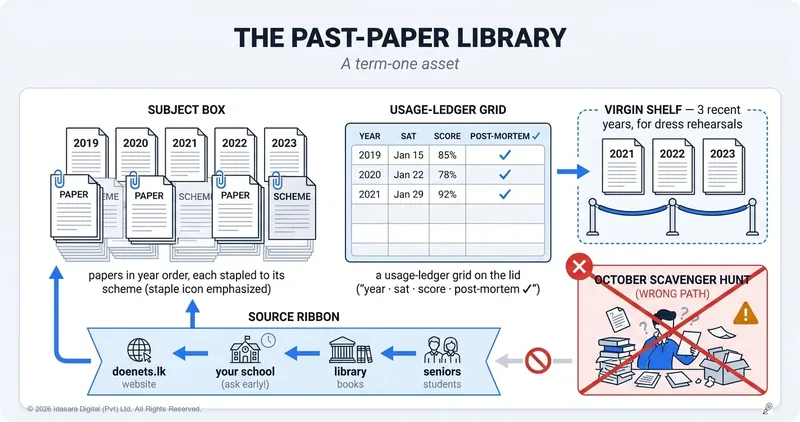
The volume chapter set the numbers — ten full papers for O/L, twenty for A/L, schemes and all — and every year students nod, then arrive in exam season scavenging papers one at a time from photocopy shops and group chats. This chapter of Learn to Learn is the logistics arm: where papers and schemes actually come from, how the library gets built in one early push, and the organization that turns a paper pile into a training system.
Watch the difference an asset makes. Exam-season student A spends precious October evenings hunting — which paper next, where's its scheme, whose photocopy is legible — the hunt itself eating the sittings it was meant to supply. Student B opens a box built back in term one: papers by year, schemes clipped to each, a ledger of what's been sat and what it scored. Same syllabus, same intentions; one of them runs the volume chapter's machine while the other assembles it under fire.
The library is a term-one asset — built once, early, in a deliberate push — because its value compounds all year (sectional drills draw on it from the first term-end; the archetype map builds across it; exam season runs on it) and because papers get scarcer and dearer exactly when demand peaks. Build it while nobody else wants it.
Where do past papers and schemes actually come from?
- The official channels first: the Department of Examinations (doenets.lk) is the examinations' official home — the anchor for authenticity; the state's education portals carry past-paper collections among their materials. Official papers with official schemes are the gold the volume chapter demanded: real setters' style, real scheme dialect.
- Your school — the most underused source in the country: staff rooms and school libraries hold years of papers and schemes, and the teacher-ask ("could I copy the last ten years for my subjects?") succeeds far more often than students try it. Schools in exam years often print bundles; ask early, before the season's rush.
- Public libraries and published collections: libraries stock the compiled volumes; the bookshops' year-collections are among the few education purchases that pass the family-budget audit easily (papers convert by definition). Buy the compilation with schemes included — a paper without its scheme is half an asset (the marking chapters showed why the scheme is where the learning lives).
- Seniors and past pupils: last year's candidates hold exactly your target library, one year fresher — and mostly never touch it again. The ask costs nothing; sweeten it with the mentor chapter's courtesy.
- Group chats and photocopy shops, with eyes open: fine as gap-fillers, but verify against official sources — mislabeled years, missing pages, and "model papers" masquerading as real ones are common, and the volume chapter's map only builds on genuine setters' work.
How much: the volume numbers plus margin — the most recent ten-plus years per subject where they exist, schemes attached, plus the school's own recent term papers (the closest preview of your markers' habits). A/L students: start the push in first year; the two-year arc gives the early builder a compounding advantage.
How should you organize the papers?
A paper pile is not a library. The system, one afternoon's work:
- One folder (or box divider) per subject, papers in year order, each paper stapled to its scheme — the pairing is the whole point; separated schemes are how libraries die.
- The usage ledger inside each folder's cover: a simple grid — year · date sat · conditions (full/sectional) · score · post-mortem done? This converts the library into a training record: the volume chapter's score-stabilisation becomes visible, re-sit candidates (the papers worth a cold second attempt) become findable, and exam season's "what next?" answers itself.
- The virgin shelf: keep the three most recent years unsat until the final months — full-dress rehearsals need papers your eyes haven't met (the rehearsal chapters' realism rule). Mark them clearly; guard them from casual browsing.
- Physical beats digital for the sitting itself (the exam is paper; sit paper — the pen-first chapters' logic), but a scanned backup of the whole library costs one supply-run session — one planned download outing — and insures against the borrowed-and-never-returned tragedy every student knows.
And the sharing economics: a library is a natural group asset — the study-group chapter's serious circle can split the building push (each member sources different years, everyone copies), and the marking-swap sessions run straight off the shared ledger. The one rule: originals stay with their owner; copies circulate. Libraries lent whole are libraries lost.
Do this month (ideally: this term)
- Run the build push: one school-ask, one library visit, one senior-ask, one official-channel supply-run session. Target the ten-year spine per subject, schemes attached.
- Spend the organizing afternoon: folders, staples, ledgers, the virgin shelf marked.
- Enter the library into your training calendar: sectional drills from the current term's end (the ladder's Rung 2), the sat-papers ledger feeding the mistake bank — your running list of errors — from day one.
At a glance
- The paper+scheme library is a term-one asset: built early in one push, compounding all year — never scavenged under fire in October.
- Sources, ranked: official channels (doenets.lk; state portals) → your school (the great untapped store — ask early) → libraries & published collections (with schemes) → seniors → group-chat copies, verified.
- Organization is the difference: paper stapled to scheme · the usage ledger (date, conditions, score, post-mortem) · the virgin shelf (three recent years guarded for dress rehearsals).
- Ten-plus years per subject, plus your school's own recent papers. A/L: start in first year.
- Build it as a group if you have one — split the sourcing, share the copies, keep the originals.
One step further with Idasara Academy
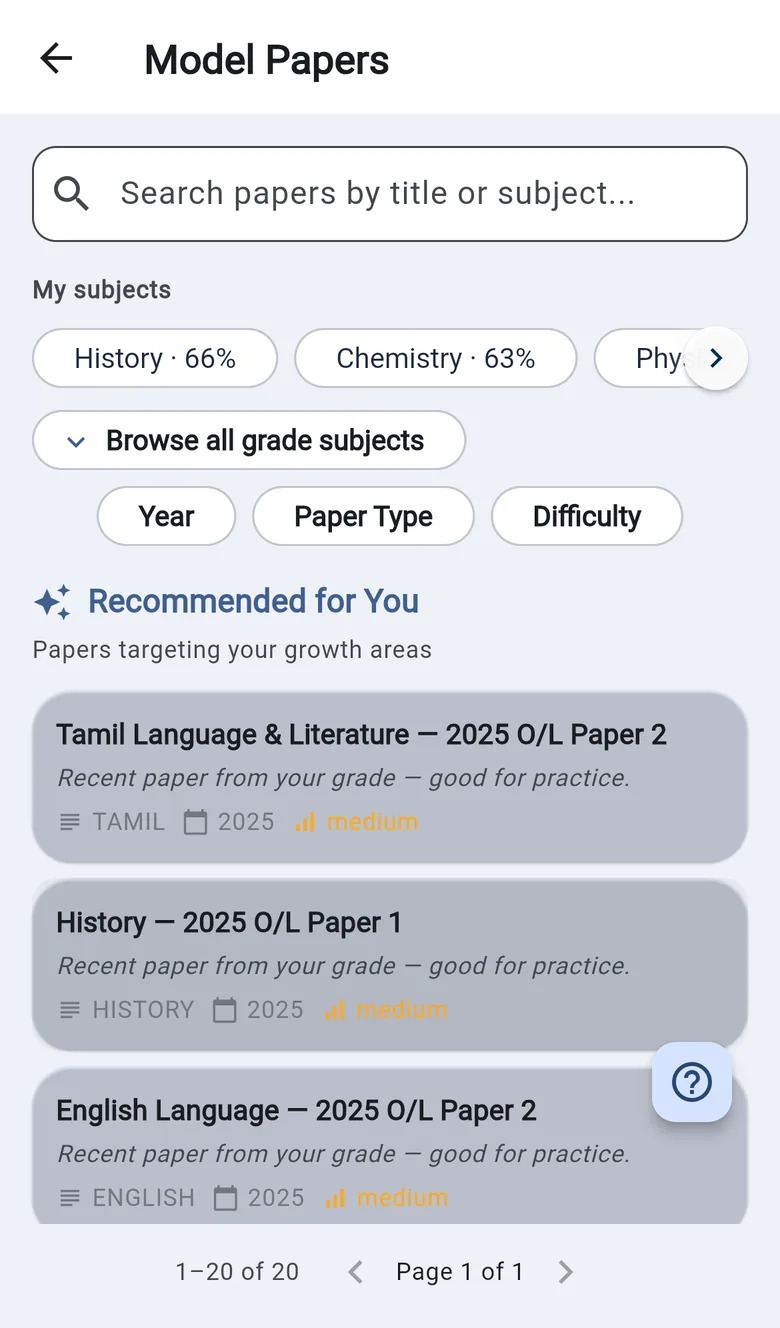
The exam plan carries the library's digital twin: real past papers sat inside the timed Exam Hall (conditions enforced, the resumable clock), with the ledger and the mistake-harvest automated — and Exam Paper Marking (paid tiers) closing the loop on written scripts — the usage grid this chapter draws by hand, kept by the system. Where the physical library shines is the paper-sitting realism; where the digital one shines is the bookkeeping and the marking queue. The strongest exam seasons run both: sit on paper, administer in the system.
Start Free — Create Your Account →
FAQ
How many years back is too old — do ancient papers mislead? Syllabus revisions date papers, so anchor on the current syllabus's era (your teachers know the revision years) and treat older papers as archetype practice with a scheme-dialect caveat. The recent decade is the spine; antiquity is optional seasoning.
Are tuition-class model papers worth shelf space? As supplements, per the volume chapter's ruling: good ones drill archetypes, but the library's spine must be official papers — model papers imitate the setters' style; the exam is the setters' style. Shelve them separately so the ledger stays clean.
I can't afford the printed collections and the photocopying adds up. (rural readers) The free stack covers most of it: official channels via the supply-run, the school and library asks (both free), the seniors' route, and the group-split for what must be copied. The library is among the cheapest high-value assets in this book — its cost is mostly initiative, which is why so few build it.
Papers for the new/revised syllabus barely exist yet. What then? The scarcity is real in revision years: lean harder on the school's term papers and the official specimen/model papers issued with the revision (the setters' own preview), and mine the old syllabus's overlapping topics with a teacher's guidance on what still applies. Scarce papers raise the value of ruthless post-mortems on each one — fewer sittings, deeper mining.
Further reading
The machine this asset feeds: Why 10 or 20 Past Papers (the numbers and layers) · Nothing Counts Until It's Marked (the schemes' role) · The Exam Day Playbook (the virgin shelf's purpose). The free sources: The Free Education Stack.
Sources
- Department of Examinations — doenets.lk (the official anchor)
- Ministry of Education — e-thaksalawa (state materials)
- The Idasara Method: Part 3 — The Grade Progression Ladder & Paper Marking (what the library is for)