The Exam Day Playbook: From the Night Before to the Final Ten Minutes
The short answer: Run exam day as a rehearsed script, not an improvisation. Close the books by dinner and sleep fully the night before; skip the corridor cramming; spend the first five minutes surveying the paper and budgeting minutes by marks; start with a strong question, and reserve the final ten minutes for gaps and a precision sweep.
A chapter of the free book Learn to Learn
Published 2026-08-31 · updated 2026-08-31
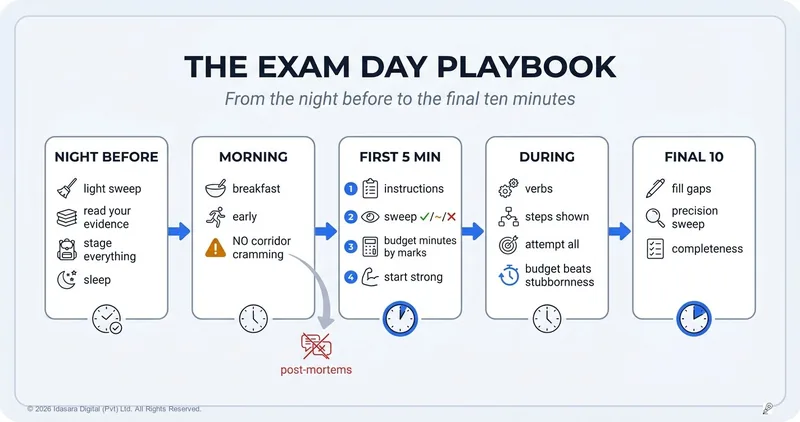
A year of preparation is delivered in one scripted day — and the day itself has a craft nobody teaches: what the last evening is for, how to spend the first five minutes of the paper, how to budget minutes like marks, and what to do when things wobble. This chapter of Learn to Learn is the playbook. Read it weeks early; run it as rehearsed routine, not day-of improvisation.
Here is an uncomfortable pattern every teacher knows: two students with identical preparation can walk out of the same exam with meaningfully different marks — because one of them ran the day well and the other improvised it.
The improviser crammed until 1 a.m., skipped breakfast, panic-revised in the corridor, answered questions in printed order (including the horror question first, "to get it over with"), lost twenty minutes to it, and finished with two questions unread. Nothing about their knowledge caused any of that. The day did.
The good news: exam day is the most scriptable day of your year. Almost everything about it can be decided, prepared, and rehearsed in advance — which is exactly how professionals in every high-stakes field handle their biggest days. Here is the script.
What should you do the night before the exam?
The last evening has exactly three jobs, and heavy studying is not one of them — you know from the cramming chapter that late massed input barely sticks, and from the nerves chapter that the lost sleep amplifies the alarm while un-saving the material.
- One light retrieval sweep, early evening. Blank-page or flash-card pass over the subject's skeleton — formulas, definitions, your red-ink hotspots. Ninety minutes, finish by dinner. You are dusting the surface, not building anything.
- Read your evidence, not your fears. Ten minutes with the tracker — your syllabus coverage record — the closed mistake pages, your marked-paper scores. This is the night's real revision: the documented answer to "am I ready?" — read it instead of interrogating your feelings.
- Stage the morning completely. Admission card, ID, pens (the proven ones, plural), pencils, instruments, water, clothes — laid out. Route and travel time known, with margin. Every decision made tonight is alarm-fuel deleted from tomorrow.
Then sleep, at the normal time, for the full 8–10 hours the health guidance prescribes. Sleep is the final revision session — it's when the year consolidates.
The morning: protect the machine
Eat a normal breakfast — the brain runs on it, and a three-hour paper is long. Leave with time to spare; arriving rushed spends composure you'll want later. And one rule that pays every single exam: no corridor cramming, and no quizzing with friends at the gate. The panicked group re-testing each other outside the hall manufactures exactly two products — last-minute doubt and borrowed anxiety. A student of this book has nothing to gain there; your knowledge was built months deep. Stand apart, breathe slowly, run your reset once. Boring is the goal.
The first five minutes: survey before you spend
When the paper turns over, the strongest move is to not start writing. Spend the opening minutes as a surveyor:
- Read the instructions actually printed — how many questions, which are compulsory, which sections offer choice. Papers change format occasionally; the student answering last year's rubric is a known tragedy.
- Sweep every question once, fast — the legitimate skim you learned in the reading chapter. Mark each: ✓ (strong), ~ (workable), ✗ (hard). Your paper map.
- Budget minutes by marks. The paper's oldest arithmetic: minutes available ÷ marks offered ≈ minutes per mark. A 10-mark question earns roughly twice the time of a 5-marker — and no more. Write actual clock times next to sections ("Part II by 10:40"). Rehearsed in your practice papers, this takes ninety seconds.
- Start with a strong question — not the hardest. The first answer sets your rhythm and settles the alarm with early evidence. The horror question goes last, when everything bankable is banked — where its damage is capped.
During: the disciplines you've already trained
Everything mid-paper is a chapter you've read, now performed together: circle the verb before answering (the two-second habit); show every step — method marks are bought by visible working; attempt everything — a half-answer holds marks a blank never will; write clear-at-speed, spending care on keywords, digits, units, labels; and obey the time budget — when a question's minutes are spent, leave a gap line, move on, return if time remains. The single most expensive day-of behaviour is refusing to abandon a stuck question; the budget exists to outrank your stubbornness.
If the mind blanks: run the 30-second reset from the nerves chapter — pen down, slow exhale, easiest remaining question, momentum. It's rehearsed; trust the rehearsal.
The final ten minutes: the cheapest marks on the paper
Reserve them deliberately. In order of yield: fill every gap (an attempt at anything abandoned — method marks wait there); run the precision sweep from your mistake-bank checklist — the errors you personally repeat — units on final answers, signs, misread digits, question numbers correctly labelled; and confirm every question you chose is actually answered. Students routinely find real marks in these ten minutes — sometimes the difference at a grade boundary — and they are the easiest marks of your entire year.
After: walk away from the post-mortem
The corridor autopsy — comparing answers, discovering (accurately or not) what you "got wrong" — changes nothing behind you and taxes the paper ahead. The result is sealed; your business is the next subject. Eat, rest, run tomorrow's light sweep, sleep. Between papers, the playbook simply repeats — and if a paper went badly, remember what the grading actually does: every paper stands alone, and the season is long. One hard morning is one hard morning.
Do this — in the weeks before, not the night before
- Run your remaining practice papers as full dress rehearsals of this playbook: the survey pass, the written time budget, strong-question-first, the reserved final ten. The playbook only protects you if it's muscle memory.
- Write your personal precision checklist (your mistake bank knows your species) on one card — it's what the final ten minutes runs on.
- Plan the night-before evening now, once, for every paper in your timetable: sweep → evidence → staging → sleep. Decisions made in calm weeks beat decisions improvised on a raw exam morning.
At a glance
- Night before: light retrieval sweep by dinner · read your evidence, not your fears · stage everything · full sleep (it's the real final revision).
- Morning: normal breakfast, early arrival, no corridor cramming — boring is the goal.
- First five minutes: read the real instructions · sweep and mark ✓/~/✗ · budget minutes by marks with clock times · start strong, save the horror for last.
- During: verbs circled · steps shown · everything attempted · budget outranks stubbornness · blank = rehearsed reset.
- Final ten: fill gaps → precision sweep (units, signs, digits) → completeness check. The year's cheapest marks.
- After: no post-mortems. Next paper.
One step further with Idasara Academy
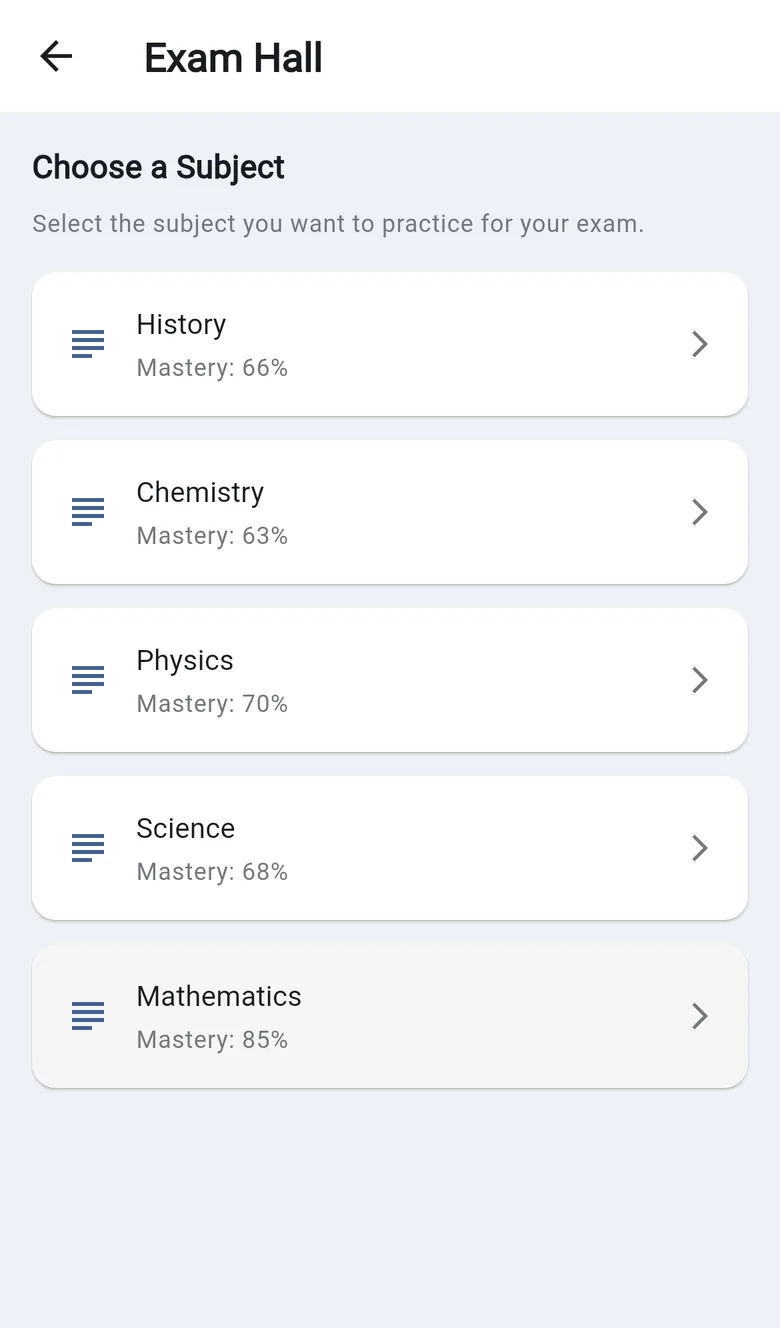
A playbook is only real once rehearsed, and rehearsal is what the exam plan's timed Exam Hall is for: full past papers under the real clock, where the survey pass, the budget, and the final-ten routine become muscle memory months early. The Readiness Score is the night-before evidence read, and your Mistake Bank's error species are the precision checklist, pre-written by your own year. On the day, you're not improvising — you're running lap two hundred of a familiar circuit.
Start Free — Create Your Account →
FAQ
Everyone says start with Question 1. Is answering out of order really allowed? Unless the paper's instructions say otherwise, you choose your order — just label question numbers clearly so the marker follows. Strong-first is standard exam craft: rhythm and banked marks early, the hardest question quarantined at the end.
What if I genuinely can't finish papers in time even with a budget? Then the diagnosis lives upstream, in training: writing speed (the fast-yet-clear chapter), reading pace (fast active reading), or over-long answers (write what the scheme pays — the mark-scheme chapter). Time trouble on the day is almost always a trainable skill-gap discovered too late; find it in your next practice paper instead.
Should I review the whole paper if I finish early? Run the final-ten routine first (gaps, precision, completeness) — that's the high-yield review. Wholesale answer-changing after that is riskier: change an answer only when you can name the error you made, not on a nervous re-feeling. Documented first instincts are right more often than exam-hall second guesses.
Any special playbook for MCQ papers (Part I)? Same skeleton, two adjustments: the time budget is per-question and stricter (mark-and-move on any question past its minute), and never leave blanks where there's no penalty for wrong answers — eliminate what you can, choose, move. Your last pass fills every remaining bubble.
Further reading
The examination contract — reading, composition, and time under exam conditions — is written up in the Idasara Method: Part 3 — The Grade Progression Ladder & Paper Marking.
Sources
- NHS — Help your child beat exam stress (sleep, routine, the night before)
- Cambridge International — Command words (what to check before answering)
- Smith, A. et al. (2016). Retrieval practice protects memory against acute stress — ScienceDaily summary
- The Idasara Method: Part 3 — The Grade Progression Ladder & Paper Marking