Write Fast, Yet Clear: Training the Hand That Sits the Exam
The short answer: Writing speed is trained like running pace: daily handwritten volume (your own notes and exercises) plus one timed answer a week at exam pace. Then save more time with economy — plan a skeleton first and write only what the marking scheme pays for.
A chapter of the free book Learn to Learn
Published 2026-08-31 · updated 2026-08-31
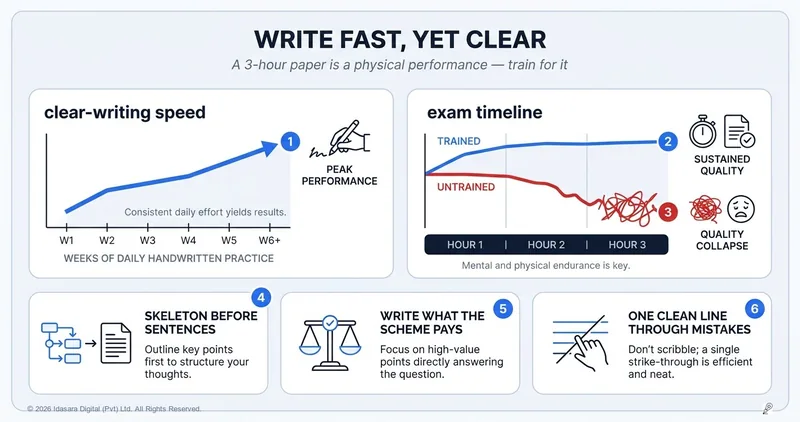
A national exam paper asks for roughly three hours of continuous handwriting — a physical performance most students never train for. This chapter of Learn to Learn treats exam writing as the athletic skill it is: how speed and clarity are built together, how to budget words under time, and why your daily notes are secretly your training ground.
In the last forty minutes of a three-hour paper, walk down any exam hall row and look at the hands.
Fingers cramping around pens. Wrists being shaken loose between sentences. Handwriting that started the morning neat, now sliding into a scrawl — not because the students stopped caring, but because their hands are exhausted. Some know the final answer and physically cannot get it onto the page in time.
Here is the question this chapter turns on: those students revised content for months. How many minutes did they spend training the one instrument every mark must pass through?
The exam is a physical event
We think of exams as mental tests, and forget what the body is doing: producing several thousand handwritten words, legibly, at speed, without meaningful rest. That is a motor performance — and motor performances obey training law, not wishing law. An untrained hand at exam pace behaves exactly like untrained legs at race pace: fine for ten minutes, degrading by the hour's end, failing in the final stretch — which in an exam is precisely where the last, most contested marks live.
The previous chapter established why clarity matters: the examiner can only pay for what they can read. This chapter is about the collision — because on exam day, clarity meets speed, and whichever one you never trained gives way. Slow-and-neat runs out of paper time. Fast-and-illegible runs out of readable answers. The skill the exam pays is the pair: fast and clear, at once — and the good news is that the pair is one trainable thing, not two competing ones.
How do you train fast and clear together?
Volume, daily, by hand. There is no substitute and no shortcut. The student following this book is already in training without noticing: short notes by hand, exercises on paper, question logs (the questions you save for class), practice answers — that is thousands of words a week through the writing hand, building the strength, endurance, and automatic letterforms that survive pace. This is one more reason the type-everything student and the photocopied-notes student arrive at the hall untrained — their content preparation and their physical preparation were the same missed hours.
Pace work, weekly. Fitness from volume; speed from deliberate pace. Once a week, write one full answer at exam pace — clock running, honest time allocation — then judge it on both scales: content, and could-a-stranger-read-it. Your sustainable clear-writing speed rises exactly the way running pace does: by regularly writing at the edge of it, not by hoping.
Economy, always. The fastest sentence is the one you don't need to write. Two habits buy more time than any handwriting drill:
- Skeleton before sentences. Thirty seconds planning an answer's three points saves the five minutes of circling, repeating, and crossing out that unplanned answers spend finding their shape. Panic writes long; clarity writes short.
- Marks-per-word thinking. Schemes pay for specific things — the keyword, the reason, the step, the label. A tight answer that hits four scheme points outscores a beautiful page that hits two. Writing less, on target, is simultaneously a speed technique, a clarity technique, and a marks technique.
Comfort, checked once. Small physical causes quietly cap writing speed: a pen gripped like a weapon (a strangled pen drains a hand in minutes, not hours — the pen should rest in the hand), a pen that drags or blots, a slouched posture that loads the wrist. Find the pen you genuinely write fastest with, buy several, and make every timed practice use that pen. Trivial? The marginal gain is real, and it's the cheapest one in this book.
What does "fast yet clear" look like on the page?
Not beautiful — decidable, at pace, to a tired stranger. Concretely: every letter and number unambiguous; a whisker of space between words; mistakes killed with one clean line (crossing-out storms cost time and legibility); working flowing down the page rather than crowding sideways into corners; and the high-value items — keywords, digits, units, labels — given the extra half-second of care, because that's where the marks are attached. Speed spent there is never wasted; ornamental neatness elsewhere is.
Do this tonight
- Measure your baseline. Copy a paragraph for exactly two minutes at your natural clear pace. Count the words. That number — most students have never met it — is your trained variable now; remeasure monthly and watch it move.
- One timed answer. Pick a past-paper question worth ~8 marks, allocate its honest exam time, and write it under the clock — skeleton first, scheme points in mind, your chosen pen.
- Judge it as two performances: content against the marking scheme, and legibility as a stranger. Circle every word a tired examiner would pause on. That circle count, falling week by week, is your training log.
At a glance
- A national paper ≈ three hours of continuous handwriting — a motor performance that obeys training law.
- Slow-and-neat and fast-and-illegible both lose; the exam pays fast and clear together, one trainable skill.
- Training = daily handwritten volume (your notes are the gym) + weekly timed answers at exam pace.
- Economy beats hurry: skeleton before sentences; marks-per-word thinking; care spent on keywords, digits, units, labels.
- Check the physical basics once: relaxed grip, a proven pen (own several), sane posture. Measure your two-minute word count monthly.
One step further with Idasara Academy
The honest judge of "fast yet clear" is whether a marker can pay your answer at full rate. Upload your timed handwritten answers to Idasara Academy's Exam Paper Marking (paid tiers) — it reads your actual handwriting and marks against the official scheme, so both performances get audited at once: where the content fell short, and where the writing itself dropped marks. A/L students get the same engine on full 25-mark essays. Train with the instrument that will be measured: your hand, at pace, on paper, checked.
Start Free — Create Your Account →
FAQ
My hand hurts halfway through papers. What actually fixes it? Almost always the combination of death grip plus no endurance base. Loosen the grip consciously during daily writing (the pen rests in the hand), and let handwritten volume build over weeks — pain that persists past that is worth a doctor's look, not a supplement's promise.
Should I learn a special fast handwriting style? No new alphabet needed. Keep your natural style, drop ornaments (loops, flourishes — anything that costs strokes without aiding decidability), and let pace practice compress it naturally. Style changes cost months; stroke economy costs nothing.
Is it better to write less so it stays neat? Frame it differently: write only what the scheme pays for, as clearly as pace allows. That usually IS less than panic would write — but chosen by target, not by fatigue. Deliberate brevity wins marks; exhausted brevity abandons them.
How long before exam day should this training start? Endurance builds over months, which is why it hides inside daily note-taking all year. Starting from zero, six to eight weeks of daily handwritten study plus weekly timed answers produces visible change; exam week itself is too late for the hand, just like race week is too late for the legs.
Further reading
Writing stamina is built in the method's first layer and spent in its third — the full write-ups are in the Idasara Method: Part 1 — The Human Foundation & Active Recall and Part 3 — The Grade Progression Ladder & Paper Marking.
Sources
- Mueller, P. & Oppenheimer, D. (2014). The Pen Is Mightier Than the Keyboard — summarised by the Association for Psychological Science: Take Notes by Hand for Better Long-Term Comprehension
- The Idasara Method: Part 1 — The Human Foundation & Active Recall
- The Idasara Method: Part 3 — The Grade Progression Ladder & Paper Marking