Method Marks vs Accuracy Marks: How Examiners Actually Pay You
The short answer: Examiners pay item by item against a marking scheme: method marks for each working step visible on the page, accuracy marks for the final value and its unit, keyword marks for exact syllabus terms. That's why a correct answer with skipped steps can score 2/5 and a wrong answer with full working can score 3/5 — the scheme pays for the journey it can see.
A chapter of the free book Learn to Learn
Published 2026-08-31 · updated 2026-08-31
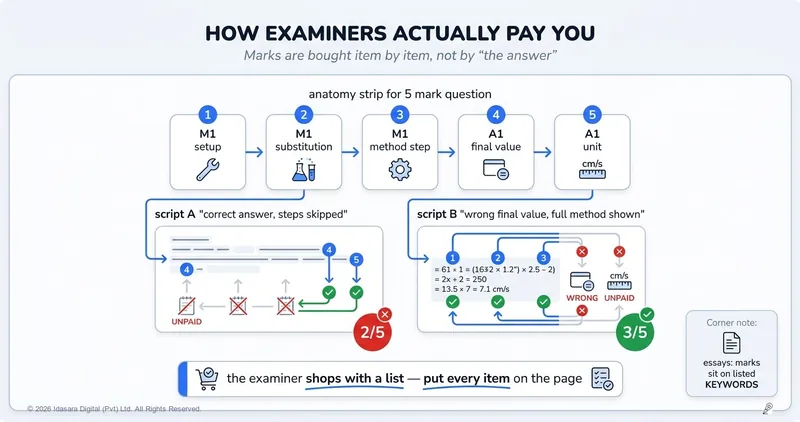
Exam marks aren't awarded for "the answer" — they're awarded item by item, against a scheme that pays separately for method steps, final accuracy, and required keywords. This chapter of Learn to Learn opens the examiner's payment system, explains the two mysteries it solves (2/5 for a correct answer; 3/5 for a wrong one), and shows how to write answers that collect everything the scheme is holding for you.
Two mysteries, from two students holding returned scripts.
The first: "My final answer is CORRECT — and I got 2 out of 5. How?"
The second, stranger still: "My final answer is wrong — and I got 3 out of 5. Why?"
Most students shrug at these as marker moods. They are nothing of the kind. Both are the marking system working exactly as designed — and a student who understands the design writes differently, immediately, in ways that are worth marks on every single question for the rest of their exam life.
Why did a correct answer get 2/5 — and a wrong one 3/5?
Here is the mental shift. You imagine the examiner asking: "Did this student get it right?" The examiner is actually holding a marking scheme — a printed payment contract — that asks something far more granular: "Which of these specific, listed items is present in this script?"
For a five-mark calculation, the contract might read: one mark for the correct setup (M1); one for the substitution (M1); one for the manipulation step (M1); one for the correct final value (A1); one for the value's unit (A1). Five separate purchases. The examiner is not judging your answer — they are shopping in it, list in hand, paying for each item they can find.
Now both mysteries dissolve:
Mystery one — correct answer, 2/5. The student wrote the setup, skipped two "obvious" middle steps (they did them in their head, or on a calculator), and presented the right value with its unit. The shopper found the setup, the value, the unit — and could not find the two method items, because they aren't on the page. The examiner cannot pay for what they cannot see — the handwriting chapter's law, now applied to logic itself. Steps done invisibly are steps done for free.
Mystery two — wrong answer, 3/5. The student showed complete method — setup, substitution, manipulation, all correct — then slipped a sign in the final arithmetic. The shopper paid all three method marks, withheld the accuracy marks, and moved on. Three-fifths of the payment, for an answer that is "wrong." Schemes even carry a standard kindness here — error carried forward: a later part built correctly on an earlier slip is paid on its own method, so one early mistake doesn't cascade into zeros.
Absorb what these two results say together: the scheme pays more for a visible journey than for a bare destination. That is not a quirk. It's the design — because method is what the exam is actually certifying.
How do essay answers get marked?
Structured and essay answers run on the same economics with different items. The scheme for a six-mark "explain" question lists the specific points — often specific syllabus keywords — that carry the marks: name the process, use the precise term, state the because-relationship, label the mechanism.
This resolves the essay student's own version of mystery one: a page of genuine understanding, written in casual paraphrase, collecting 3 of 6 — because the shopper found three listed items and three eloquent near-misses. You've met the root cause twice: the textbook chapter (schemes are written beside the official book's terminology) and the short-notes audit (exact wording, boxed and red-inked). This is where those habits pay cash. The student who writes "the plant makes food using light" and the student who writes "photosynthesis" may understand identically; the scheme can only pay one of them.
The command-verb chapter completes the picture: the verb tells you which species of items the scheme holds (reasons? comparisons? steps?), and the keywords are the items themselves.
Writing for the shopper
Once you see the shopper, the writing rules write themselves:
- Show every step — especially the easy ones. The steps you skip as obvious are frequently the ones with an M-mark attached. One line each; cheap insurance. Calculator work still gets its expression written first.
- Never abandon a question you can start. Method marks make partial attempts genuinely valuable: the setup you're sure of is worth a mark even if you can't finish. Blank answers are the only ones that pay zero with certainty.
- Land the accuracy items deliberately: final value stated clearly, unit attached, sensible precision, and answer flagged (a box or double underline helps the shopper find it). The ten-second precision sweep from the mistake-bank chapter — your ledger of collected errors — lives here.
- Spend syllabus keywords, not paraphrases, in definitions and explanations — and make diagrams labelled diagrams, since labels are frequently listed items.
- Study with schemes open. The deepest habit of all: after every past-paper attempt, read the scheme not just to mark yourself but to learn how your subject pays — where its M-marks cluster, which keywords recur, what its "explain" answers are built from. Ten papers studied this way (the volume chapter's map, now with prices) make you a student who writes answers the way the scheme reads them.
Do this tonight
- Take one marked past-paper question with its scheme — a calculation if your subject has them, an "explain" question otherwise.
- Play the shopper on your own answer: tick each scheme item you can find on the page. Watch where payment failed: absent steps? missing keywords? unit dropped?
- Rewrite the answer to collect everything — every step visible, keywords spent, accuracy items landed. Compare the two versions. That difference, multiplied across a whole paper, is commonly a grade boundary.
At a glance
- Examiners shop, not judge: the scheme lists items — method marks (M), accuracy marks (A), keywords — and pays for each one found on the page.
- Correct-answer-low-marks = invisible steps; wrong-answer-good-marks = visible method (+ error carried forward). The journey outpays the destination.
- Essay economics: marks sit on specific syllabus keywords and listed points — paraphrase is understanding the scheme can't pay.
- Write for the shopper: every step shown · no zero-attempts · units and clear final answers · keywords spent · diagrams labelled.
- Study with schemes: learn where your subject's marks cluster. That knowledge compounds on every question you ever answer.
One step further with Idasara Academy
This entire chapter is automated in Idasara Academy's Exam Paper Marking (paid tiers): upload your handwritten script and the feedback comes back in the scheme's own currency — method marks and accuracy marks itemised per question, keyword checks for structured answers — so you see precisely which items paid and which the shopper couldn't find. When a deduction confuses you, the AI Study Coach shows the exact working lines the scheme required, and the exam-technique guides drill the presentation habits this chapter taught. Ten marked papers later, you don't just know your subject — you know its prices.
Start Free — Create Your Account →
FAQ
Doesn't writing every step slow me down too much? Steps are one short line each, and you know the counter-cost now: each skipped line risks a listed mark. The real time-eaters are unplanned answers and re-work — the skeleton habit from the writing chapters. Method lines are the best-paid seconds in the exam.
Is "error carried forward" something I can rely on? Published schemes commonly work this way for multi-part questions, but treat it as a safety net, not a plan — it rescues method marks, never the accuracy ones. The precision checklist exists so you rarely need the net.
My subject is essay-based — do M and A marks apply to me? The labels differ; the economics don't. Your schemes list points, keywords, and structure requirements per level — same shopper, different shelf. The habit transfers whole: study your subject's schemes until you know what its six-mark answers are built from.
If schemes are this mechanical, where does real understanding come in? Understanding is what lets you produce the items — the method you show must be right, the keyword must be used correctly, and unfamiliar questions can't be navigated by memorised fragments. The scheme doesn't replace understanding; it's the format understanding must be delivered in to be paid. This book trains both ends deliberately.
Further reading
Mark-by-mark breakdowns — method marks, accuracy marks, keyword rubrics, and the marking engine that applies them — are written up in the Idasara Method: Part 3 — The Grade Progression Ladder & Paper Marking.
Sources
- Cambridge International Education — Command words and what they ask of candidates (how boards specify what answers must contain)
- Educational Publications Department — edupub.gov.lk (the terminology schemes are written beside)
- The Idasara Method: Part 3 — The Grade Progression Ladder & Paper Marking