Exam Nerves: What They Are, and What Actually Calms Them
The short answer: Normal exam nerves calm down when you give the body's alarm evidence: study by self-testing (knowledge built that way is proven to hold under stress), make the paper familiar through timed practice, guard sleep, and rehearse a 30-second reset for the blank moment. If anxiety is severe, persistent, and interfering with daily life, that is beyond any study technique — tell a parent, a teacher, or a doctor today.
A chapter of the free book Learn to Learn
Published 2026-08-31 · updated 2026-08-31
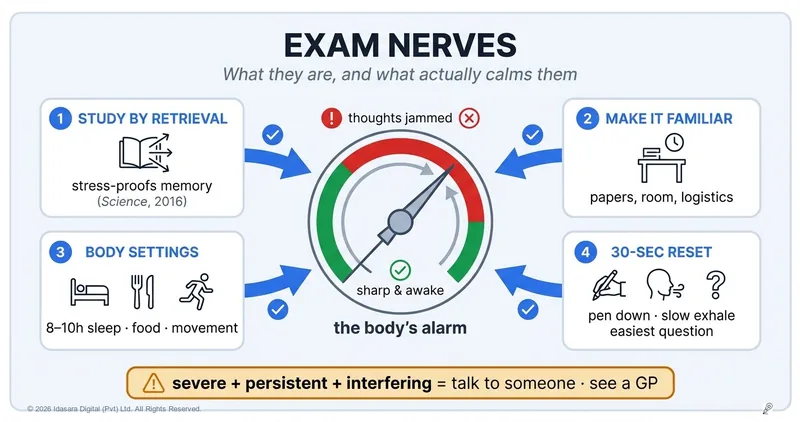
Exam stress is not a character flaw and not a sign you're unprepared — it's your body's alarm system doing its job at an unhelpful volume. This chapter of Learn to Learn explains what nerves actually are, the one study habit proven to protect memory under pressure, what to do when your mind blanks mid-paper — and when stress has crossed the line where a book should hand over to real help.
Every exam hall in the country holds the same silent scene.
A student who studied — genuinely studied — sits down, reads the first question, and feels it: the racing heart, the cold hands, the mind that was full an hour ago now offering nothing but fog. "Too much stress just gets you panicked," one student told the UK's exam regulator, "and you can't do anything." Another described the season simply: "it's everywhere. Everyone's stressing."
If that's you — or the child at your dinner table — this chapter has three honest jobs: to explain what nerves actually are, to show you what genuinely turns them down (some of it will surprise you), and to say plainly what this book can't fix, and who can.
What are exam nerves, actually?
Exam stress is your body's threat alarm — the same ancient system that once handled physical danger — firing about a paper. It floods you with energy, sharpens you for action, and narrows your attention. In small doses this is useful: mild nerves on exam morning mean your system is awake and taking the thing seriously.
The problem is volume. Past a certain intensity, the alarm starts competing with thinking — working memory (the mental desk you solve problems on) gets crowded by the alarm itself, and retrieval jams. That's the blank mind: not knowledge gone, but knowledge temporarily unreachable behind the noise. Two facts follow, and both matter:
The blank is temporary. The material is still there — students prove it minutes after every exam, when answers flood back in the corridor. So the game is not "know more"; it's "keep the road to what you know open under noise."
And the alarm answers to evidence, not to pep talks. You cannot argue yourself calm with "I'll be fine." Your alarm is checking a simpler question: have we done this before, and did we survive it? Which is exactly why the calming tools that work are all, in one way or another, ways of answering yes.
What actually turns the volume down?
1. Study by testing yourself — tested knowledge holds up under stress. This finding should change how you think about nerves. Scientists stressed students on purpose (surprise speeches, maths in front of judges), then tested what they had learned. The re-readers remembered less under stress. The students who had learned by self-testing lost nothing — stress could not touch it. The study was published in Science, and the message for you is simple: every blank-page test — recall onto an empty page — quiz, and past paper in this book is doing two jobs. It builds the knowledge — and it makes the knowledge stress-proof. The student who "goes blank under pressure" usually studied by reading. The self-tested student's knowledge holds.
2. Make the exam familiar. Alarms fire at the unknown — and the students in the exam-stress study said exactly that: "we need to know what we're going to come up against." So remove the unknowns, one by one. Full past papers under real conditions make the format, the timing, and the tiredness old news — by paper eight, three hours with a question booklet is something your body has survived many times, and the alarm knows it. See the exam centre before the day if you can. Lay out the admission card, pens, and clothes the night before. Every unknown you remove is fuel taken away from the alarm.
3. Look after the body the alarm lives in. The health guidance is blunt: teenagers need 8–10 hours of sleep, and "cramming all night before an exam is usually a bad idea." A tired body makes a louder alarm — and the all-nighter loses the material anyway (the cramming chapter showed why). Eat normally. Move every day — exercise is one of the most reliable stress-releases there is. These are not extras. They are the alarm's basic settings.
4. Have a reset move for the blank moment. Decide it now, not in the hall: pen down — both feet on the floor — one slow breath out, longer than the breath in — then read the easiest remaining question and start it. Thirty seconds. The slow breath out physically calms the alarm. The easy question gets your memory moving again on a road that isn't blocked. And once something is flowing, the blanked material usually comes back on its own. Practise the reset in your timed papers at home, so on the day it's a habit, not an experiment.
5. And shrink what the exam is allowed to mean. Some of the alarm's volume comes from a sentence running underneath: this one day decides everything. It doesn't. You've read the ladder chapter — results are built from a year of visible evidence, and by exam week you have that evidence: the tracker — your syllabus coverage record — the marked papers, the closed mistake list. Read it the night before instead of cramming; it is the honest answer to the alarm's question. And beyond that — hold the wider truth this book ends on: the exam matters, and there are many routes forward from every result. Both things are true. Students perform best when both are allowed to be.
Do this — starting tonight, not exam week
- Shift one hour of tonight's studying from input to retrieval — blank-page, quiz, past questions. You're now building stress-proof knowledge; that's the deepest nerve treatment there is.
- Write your 30-second reset on a card and rehearse it in your next timed practice.
- If exams are close: list your remaining unknowns (room? route? paper format weak spots?) and delete one per day. Guard sleep like it's on the timetable — it is.
When is it more than nerves? Read this part carefully
Everything above treats normal exam stress. Sometimes it's more than that. The health guidance draws the line clearly: if anxiety or low mood is severe, persists, and interferes with everyday life — sleep broken for weeks, appetite gone, tears or dread most days, no longer enjoying anything, or any thoughts of self-harm — that is not a study-methods problem, and no book chapter is the answer. Tell someone today: a parent, a teacher you trust, a doctor. Getting help early is a strength, not a mark against you. Parents: the same guidance asks you to listen without adding pressure — and to act on the persistent signs, not wait for results.
At a glance
- Nerves are your body's alarm — useful at low volume, thought-jamming at high volume. The blank mind is knowledge unreachable, not gone.
- The alarm answers to evidence: self-tested knowledge is proven (Science, 2016) to hold up under stress — re-read knowledge isn't.
- Remove the unknowns: paper volume makes the format familiar; the night-before layout deletes the cheap fears.
- Body settings matter: 8–10 hours of sleep, food, daily movement. The all-nighter feeds the alarm and un-saves the material.
- Rehearse a 30-second mid-paper reset: pen down · slow exhale · easiest question · momentum.
- Severe, persistent, life-interfering anxiety is beyond this book: tell someone, see a doctor — early, and without shame.
One step further with Idasara Academy
The stress-proofing habit is practice testing, and that's the app's free front door: micro-quizzes after every topic build retrieval-armoured knowledge from day one, and the exam plan's past papers in the timed Exam Hall manufacture the familiarity that starves the alarm. By exam week, the Readiness Score is the evidence you read the night before — the calm of a student who doesn't have to hope.
Start Free — Create Your Account →
FAQ
I studied hard but I still blanked in my last exam. Doesn't that disprove the "be prepared" advice? Look at how you studied. If it was mostly re-reading, the retrieval study above explains your blank exactly — input-built memory is what stress knocks over. Rebuild the same material through retrieval and the next paper is a different experience. If you already study by retrieval and still blank badly, rehearse the reset — and read the "more than nerves" section honestly.
Is it bad that I feel nothing — no nerves at all? Calm on a foundation of evidence is the goal state, so if the tracker and papers are healthy, enjoy it. Calm as avoidance — no nerves because no engagement — shows up in the instruments (empty tracker, no marked papers), and the fix is the system, not the feelings.
My parents' worry stresses me more than the exam. What can I do? Show them the evidence instead of reassurances — the tracker, a marked paper, the shrinking mistake list. Worry feeds on darkness; instruments give your family something real to look at. (The parents' chapters of this book say this to them directly — leaving it open somewhere visible has worked before.)
Do relaxation apps and breathing exercises work? Slow-exhale breathing has real physiology behind it — that's why it anchors the reset. Use whatever helps you practise it. Just keep the order of operations honest: breathing manages the alarm; retrieval-built preparation is what removes its reasons. An exam faced with calm breathing and empty preparation still goes badly — this book exists for the preparation half.
Further reading
Why evidence beats hope in exam week — and the system that builds the evidence — is the whole method: Part 3 — The Grade Progression Ladder & Paper Marking.
Sources
- Smith, A. et al. (2016). Retrieval practice protects memory against acute stress, Science — summary at ScienceDaily
- NHS — Help your child beat exam stress (signs, sleep, and when to seek help)
- Ofqual — What is it like to experience exam stress? A student perspective
- The Idasara Method: Part 3 — The Grade Progression Ladder & Paper Marking