Cramming vs Consistency: Can the Last Month Save the Year?
The short answer: No — the last month cannot save the year. Cramming builds the fastest-fading kind of memory, no amount of it trains the stamina and timing a three-hour paper demands, and the all-nighter cuts the very sleep in which the day's studying is kept; the final weeks only multiply what the year already built.
A chapter of the free book Learn to Learn
Published 2026-08-31 · updated 2026-08-31
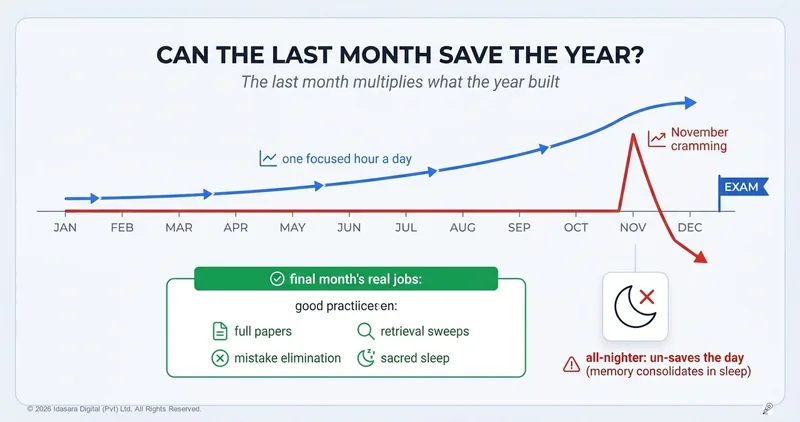
Every exam season, students attempt the great rescue — weeks of marathon days and shrinking sleep, trying to compress a year into a month — and every year the results teach the same lesson. This chapter of Learn to Learn prices cramming honestly: what it can and cannot buy, why the all-nighter is self-sabotage dressed as dedication, and what the final weeks are actually for.
It's four weeks before the exam, and the transformation is underway in thousands of homes.
The student who studied lightly all year is now studying ferociously — fourteen-hour days, meals at the desk, sleep cut to five hours, the phone finally, tragically, in a drawer. Parents watch with a mix of worry and relief: at last, they're serious. And the student feels it too — the intensity feels like redemption, as if enough suffering in exam month could pay back the wasted months.
This book owes that student the truth: the effort is real, the courage is real — and the returns are terrible, for reasons that have nothing to do with willpower and everything to do with how the machinery you've met in this book actually works.
Why doesn't cramming work?
Memory is built in layers, and layers need nights. The forgetting-curve chapter showed that knowledge becomes durable through spaced returns — retrieve, rest, retrieve again across days and weeks. Cramming pours everything in at once, and builds exactly the kind of memory that curve destroys fastest: a heap of fragile familiarity, draining away within days — sometimes during the exam period itself, as the subjects crammed first fade before their papers arrive. The learning-science verdict on massed versus spaced practice is one of the oldest and most replicated results in the field, and it isn't close.
Skills can't be crammed at all. Even if facts could be force-loaded, look at what the ladder actually demands: writing stamina for three-hour papers (a trained muscle, months in the making), format-fluency and time-calibration (built by ten marked papers, not readable in a weekend), method-mark discipline, fast active reading. The exam is substantially a performance, and performances answer only to rehearsal. Nobody crams a marathon.
And the sleep cut reverses the whole project. Here is cramming's cruellest joke: sleep is not time stolen from consolidating memories — sleep is when memory consolidates. The brain's basic housekeeping — clearing metabolic waste, strengthening the pathways used in learning and memory — runs during sleep, which is why the health literature calls sleep as essential to the brain as food. The all-nighter therefore robs the very student performing it: it spends the hours in which today's studying would have been kept, to shovel in more material that now won't be. The 2 a.m. student is pouring water into a jug while drilling a hole in its base — and will sit the paper, hours later, with the reaction time and judgement of someone impaired. The single highest-yield act on exam eve is not one more chapter. It is eight hours of sleep, protecting everything already banked.
What is the final month actually for?
None of this means the last weeks don't matter — they matter enormously, for the right jobs. You've already met them: they are the top rung of the grade ladder (the full-papers-and-mistake-hunting phase), run properly:
- Full papers under strict conditions — the volume that maps archetypes and calibrates your clock.
- Working the mistake bank to zero (your log of collected errors) — elimination sessions, the highest-yield hours a prepared student owns.
- Targeted coverage repair — the oldest gaps, bought at their last affordable price.
- Spaced retrieval sweeps of the whole syllabus — blank-page sessions per topic, cheap and devastatingly effective because the material has layers to refresh.
- Sleep, held sacred — because every one of the above is an investment that consolidates overnight or not at all.
Notice what makes these powerful: every one assumes a year of deposits — papers assume coverage, elimination assumes a bank, retrieval assumes something to retrieve. That is the honest answer to "can the last month save the year?": the last month multiplies whatever the year built. It multiplies a full year magnificently — and it multiplies zero.
Which returns us, at the book's closing stretch, to its very first chapter. The cramming student and the exhausted-but-stuck student are the same student at different dates: enormous fuel, no engine. The alternative was never more suffering in November — it was the modest, scientific daily habit this whole book has assembled: the loop (read, write from memory, check) on each lesson, the weekly tracker (your syllabus coverage list), the daily plan's short list, the papers in season. An hour a day, well-aimed, all year, beats a hundred desperate exam-month hours — not because effort doesn't matter, but because timing is part of the method. Consistency isn't the boring alternative to the heroic rescue. It's what makes rescues unnecessary.
Do this tonight
If your exam is far away: the highest-value move in this chapter is to make it irrelevant — start the daily habit now. Tonight's version: one loop on one lesson, ten minutes of yesterday's retrieval, tomorrow's short list written. That's the whole rescue, taken in instalments of one evening.
If your exam is weeks away: re-aim the intensity — the effort is an asset; only the allocation is wrong. Replace marathon re-reading with the five right jobs above, in that order. Fix a hard lights-out and treat it as part of the study plan, because it is. And drop the all-nighter from the plan entirely — exam eve is for a light retrieval sweep, the logistics, and sleep.
At a glance
- Cramming builds the fastest-fading kind of memory (massed exposure vs the spaced layering that lasts) — sometimes fading before the papers arrive.
- The exam is substantially a performance — stamina, format-fluency, time-calibration — and performances can't be crammed, only rehearsed.
- The all-nighter robs its own student: sleep is when memory consolidates; cutting it un-saves the day's studying and impairs exam-day judgement.
- The final month's real jobs: full papers · mistake-bank elimination · oldest-gap repair · blank-page retrieval sweeps · sacred sleep.
- The last month multiplies what the year built — a full year magnificently, zero by zero. Consistency makes rescues unnecessary.
One step further with Idasara Academy
Consistency's real enemy is not laziness — it's the nightly decision-making that willpower must win all year. Idasara Academy removes exactly that, free to start: Today's Plan hands you each day's short list, and streaks and badges make the habit visible and satisfying — the same daily-return loop games use, spent on your future instead. In exam season the engine pivots to the top-rung work — papers (the exam plan), elimination, retrieval — automatically. The app can't do the year for you; our position hasn't changed since the honesty chapter. It exists so the year happens one easy decision at a time, and exam season finds you multiplying instead of rescuing.
Start Free — Create Your Account →
FAQ
Cramming worked for my small school tests. Why not for O/L or A/L? A unit test samples two weeks of material and forgives fragility — a three-day memory can survive it. National exams sample two years, in performance format, across weeks of papers. The trick that beats a puddle doesn't cross an ocean.
Is there any place for a long day in the final weeks? Long, yes — structured, with the deep-block architecture and real breaks, on the five right jobs. What has no place is the day paid for with sleep: any plan that only works by cutting nights is un-saving itself as it goes.
I'm mid-year and already behind. Is it cramming to work extra hard now? No — that's repayment, and mid-year is a wonderful time for it: the debt chapters gave you the structure (oldest-first, beside current work, full-quality). Cramming isn't defined by effort; it's defined by massed, last-minute, sleep-funded effort. Intensity inside the method is just a strong year.
As a parent, how do I support exam season without feeding the panic? (for parents) Guard the two things the science says matter most: the routine (meals, a sane lights-out, the daily rhythm) and the calm. A household that treats sleep as part of studying — because it is — does more for the marks than any amount of pressure. The next chapters of this book speak to you directly.
Further reading
The method's closing argument — academic excellence as the natural outcome of a scientific daily habit, never last-minute cramming — is written up in the Idasara Method: Part 4 — Time Management & Flipped Learning.
Sources
- The Learning Scientists: Learn How to Study Using… Spaced Practice (why cramming costs more time for less learning, and displaces sleep)
- NIH / NINDS — Brain Basics: Understanding Sleep (sleep's role in memory pathways)
- Murre, J. & Dros, J. (2015). Replication and Analysis of Ebbinghaus' Forgetting Curve, PLOS ONE
- The Idasara Method: Part 4 — Time Management & Flipped Learning