Why "A Few Past Papers" Isn't Enough — and 10 (or 20) Is the Real Number
The short answer: Ten full past papers per O/L subject, twenty for A/L — each in one sitting, under full exam time, and every script marked. Two or three papers only teach you what a paper feels like; it takes volume to learn the recurring question types, calibrate your clock, and harvest the mistakes you still need to fix.
A chapter of the free book Learn to Learn
Published 2026-08-31 · updated 2026-08-31
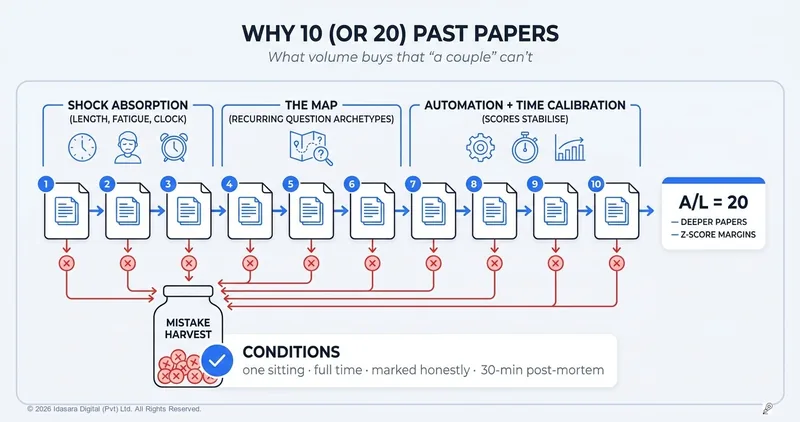
Most students do two or three past papers and consider themselves prepared; the method's A-pass threshold is ten full papers for O/L, twenty for A/L, under strict conditions. This chapter of Learn to Learn explains what volume buys that a few papers can't, how to run a paper so it actually counts, and how the numbers fit into a real calendar.
Ask a student in November how their past-paper practice is going, and the commonest answer is a comfortable one: "I've done a couple — they went okay."
A couple. For a performance that will be sampled from two years of syllabus, under three hours of pressure, in a format with its own dialect and rhythms — two rehearsals.
Nobody would accept that arithmetic anywhere else. No coach sends a runner to a marathon off two long runs; no examiner passes a pilot on two simulator hours. The method's numbers — ten full papers for an O/L subject, twenty for A/L — strike students as extreme only because the "couple of papers" norm is so deeply installed. So let's do what this book does: open the machine and show why the number is what it is.
What does each layer of volume buy?
The returns on paper volume arrive in layers, and each layer needs more papers than the last:
Papers 1–2 buy shock absorption. The first full papers mostly teach you what a full paper feels like — the length, the fatigue, the clock panic. Valuable, but this is calibration, not training. A student who stops here has learned the shape of the storm and none of the sailing.
Papers 3–5 buy the map. Exam papers are built from recurring question archetypes — the same species of question returning in new clothes year after year: this subject's standard graph question, its classic two-part derivation, its predictable essay structures. No single paper reveals the pattern; across four or five, the archetypes step out of the fog. Suddenly you're no longer meeting strangers — you're recognising families. This recognition is a large share of what separates the A-student in the hall: less of their three hours is spent deciphering, more is spent executing.
Papers 5–10 buy automation and time-calibration. With archetypes recognised, repetition makes your responses to them semi-automatic — the setup steps, the mark-scheme shape of the answer, the time each question type deserves. Your internal clock calibrates: you feel when a six-mark question has consumed nine marks of time. This is the layer where scores stabilise: early papers swing wildly; by paper eight or nine, your mark becomes predictable — and a predictable mark is the first mark you can deliberately raise.
And every paper, at every layer, harvests errors. Each marked script feeds your mistake list — the elimination discipline the ladder chapter paired with volume. This is why the papers must be marked, not merely attempted: an unmarked paper delivers perhaps a third of its value. Ten marked papers is both a training programme and a complete diagnostic survey of you.
Why twenty for A/L? Depth and stakes. A/L questions are longer, multi-stage, and the Z-score competition is between students who all work hard — the analytical depth of three-hour Combined Maths or Chemistry papers simply has more archetypes, more time-traps, and more error species to harvest. The map takes more papers to draw, and the margin for unfamiliarity is thinner.
The conditions clause — where most volume gets wasted
The threshold says full papers under strict conditions, and the clause is load-bearing. A paper done "loosely" — with pauses, phone glances, a peek at notes, generous extra minutes, marked by feeling — trains almost none of the layers above, because every layer depends on exam-realism: fatigue is only trained by unbroken full-length sittings; time-calibration only by an honest clock; format-fluency only by exam-legal circumstances.
Running a paper properly:
- One sitting, full time, exam-legal. Timer set, desk cleared, phone gone, no pauses. The conditions are the training.
- The full production: handwritten, verbs circled, working shown — everything this book has trained, performed together.
- Marked honestly, promptly — against the official scheme or externally, per the marking chapter's law. Same day or next; feedback decays.
- Post-mortem, thirty minutes: where did marks leak — knowledge, method, keywords, time, legibility? Every leak categorised and fed to the mistake list. The post-mortem is where a paper's real tuition gets paid out.
One properly-run paper outvalues three loose ones. If your calendar forces a choice, choose fewer papers run right.
How do 10 or 20 papers fit a real calendar?
Ten or twenty papers sounds mountainous until it meets a calendar honestly.
A paper plus its marking and post-mortem is roughly a five-hour unit. In the final three months before an exam — Rung 3 season, the grade ladder's final phase, coverage complete — two units a week per priority subject is demanding but entirely sustainable inside the time-layer's structure (deep-work blocks, subject rotation, protected sleep). Two a week for ten weeks is twenty units: the A/L threshold, met, with margin for O/L's ten. (The full-volume thresholds are for your priority subjects — the Z-floor, the gates; lighter subjects live on sectional drills and a smaller full-paper diet.) Start earlier — sectional drills through the term-ends, first full papers as coverage closes — and the final months carry even less.
The mountain, in other words, is a schedule. What actually stops students is never the arithmetic — it's starting late (coverage debt eating Rung 3's weeks — you know that chapter) and the quiet dread of being honestly measured (you know that chapter too: want the bad news early, while it's cheap).
Do this tonight
- Count your honest current volume per subject: papers done under strict conditions and marked. Loose attempts don't count — that's not harshness, just accurate bookkeeping.
- Do the calendar arithmetic for your exam date: weeks remaining × sustainable units per week. Write the plan — which papers, which weeks.
- Schedule unit one for this weekend: paper chosen, three hours blocked, scheme ready for the marking. The threshold is crossed one properly-run paper at a time — and the first one starts the map.
At a glance
- The A-threshold: 10 full papers (O/L) / 20 (A/L) — under strict conditions, every one marked.
- Volume pays in layers: papers 1–2 shock absorption → 3–5 the archetype map → 5–10+ automation and time-calibration — plus error harvest throughout.
- A/L's twenty reflects deeper papers, more archetypes, and Z-score competition margins.
- Conditions are load-bearing: one sitting, full time, exam-legal, honest prompt marking, thirty-minute post-mortem. One proper paper > three loose ones.
- The calendar arithmetic works: ~2 five-hour units a week in the final months meets the threshold with margin — if coverage debt hasn't stolen the weeks.
One step further with Idasara Academy
Volume's two frictions have always been getting the papers and getting them marked. The exam plan solves both: a library of real past papers sat inside a timed, resumable Exam Hall (the clock and conditions enforced for you), and Exam Paper Marking (paid tiers) turning every handwritten script into examiner-grade feedback the same evening — with the mistake list building itself in the Mistake Bank as you go. The papers stay your work; the feedback loop runs at your pace instead of a marker's queue.
Start Free — Create Your Account →
FAQ
Where do I get that many past papers? Official past papers span decades and are widely available through schools, published collections, and official sources — with marking schemes. Building your paper+scheme library early in the year (the marking chapter urged this) is what makes Rung 3 season frictionless.
Should I repeat papers I've already done? Selectively, yes — a paper re-attempted cold after a month is a fine check that its harvested errors actually died. But fresh papers carry more new archetypes; repeat for verification, not for comfort (a re-done paper's score flatters, and you know which chapter explains why).
What about model papers and tuition-class papers — do they count? As supplements, especially for drilling specific archetypes. But the threshold is best met with official papers: they alone carry the real setters' style, difficulty distribution, and scheme dialect — the exact things volume exists to map.
Doing papers exposes me to topics I haven't covered yet. Wasteful? It's diagnostic — but you already know the diagnosis: coverage debt, and papers are an expensive way to keep re-measuring it. That's why the ladder sequences full-paper volume after substantial coverage. Bridge the gap first; then let papers do their real job.
Further reading
The A-pass volume protocol and the marking engine that makes it practical are written up in the Idasara Method: Part 3 — The Grade Progression Ladder & Paper Marking.
Sources
- Dunlosky, J. et al. (2013). Improving Students' Learning With Effective Learning Techniques — overview at the Association for Psychological Science (practice testing at volume)
- UCLA Bjork Learning and Forgetting Lab — research overview on spaced, varied practice
- The Idasara Method: Part 3 — The Grade Progression Ladder & Paper Marking