An Answer Is Worth Nothing Until Something Marks It Honestly
The short answer: Mark every attempt against the official marking scheme — step by step, keyword by keyword — or get the script externally marked, while it's still fresh. Glancing at the answer key is not checking: the exam pays for the working, and only scheme-grade marking sees the working.
A chapter of the free book Learn to Learn
Published 2026-08-31 · updated 2026-08-31
Students produce thousands of practice answers a year — and most are never checked against the standard the exam will use, leaving every flaw free to repeat itself until results day. This chapter of Learn to Learn is about closing the loop: why unmarked practice is half-practice, what "honest marking" actually means, and how to get examiner-grade feedback all year instead of once, at the end, when it can't help you.
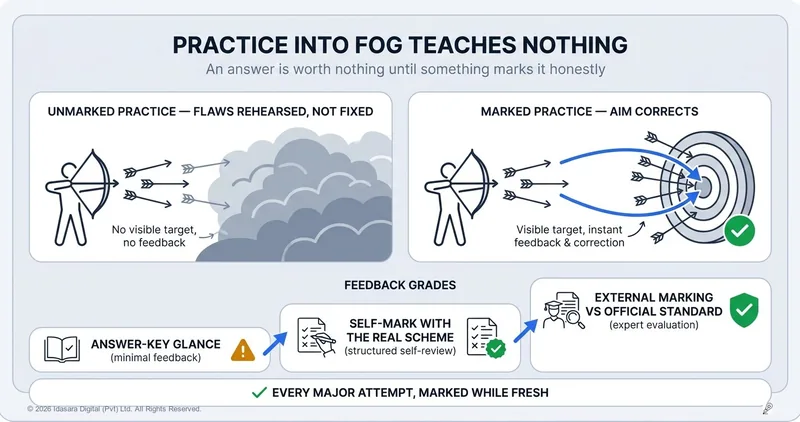
Imagine training for months to be an archer — with one strange condition: every arrow you shoot disappears into fog. You never see where it lands.
You'd still be doing something. Your arms would strengthen; your draw would smooth out. But your aim? Your aim would stay exactly wherever it started — because aim is corrected by seeing the miss, and you never see one. Six months of diligent, blind practice, and the first landing you ever witness is at the tournament.
Now count how much of your studying is archery into fog. The past paper written and never properly marked. The essay finished and filed. The exercises done, answers glanced at — "close enough." The working that got the right final number by a method no marking scheme would pay. Thousands of arrows a year. Fog, most of them.
Why must the loop close?
This book has drilled the first half of the learning engine into you: produce — from memory, on paper, under time. But production is only half a loop. The other half is honest feedback: your output, compared against the real standard, with the differences made visible. Learning science is blunt about this pairing — practice improves performance when its results are known and corrected; the testing that tops the effectiveness tables includes checking the test. Production without feedback strengthens the habit of producing — including every flaw in it.
And the flaws are exactly what you can't feel from inside. By now you know the roll-call: the confidently-wrong step (feels identical to a right one), the missing scheme keyword (you understood, so it felt complete), the method the examiner won't pay, the drifting handwriting, the answer to the verb that wasn't asked. Every one invisible to the writer, obvious to a marker — and each repetition without marking stamps it deeper. Unmarked practice doesn't just fail to fix flaws. It rehearses them.
What does "honest" mean?
Not all checking closes the loop. Three grades of feedback, in ascending order of worth:
Self-glancing — comparing your final answer against the answer key. Better than fog, but barely: it verifies destinations, not journeys. Wrong-method-right-answer passes; missing keywords pass; everything the exam actually marks passes unexamined.
Self-marking against the scheme — a genuinely powerful habit most students never form. Real past papers publish real marking schemes; sit with yours after an attempt and mark your own script the way the scheme dictates: method marks — the marks paid for working — step by step, keyword by keyword, no mercy for "that's what I meant." This is hard to do honestly — you are a biased marker of your own work, always in the generous direction — but even imperfect scheme-marking teaches you how the paper pays, which quietly transforms how you answer. (You've done its miniature already: the red-ink audit — checking your notes against the book — at answer scale.)
External honest marking — the gold grade: your handwritten script, assessed by something that isn't you, against the official standard, with per-question feedback. A teacher with the scheme. A paper-class marker. Or — the option that changed the economics of this entirely — a marking tool that reads your handwriting and applies the official rubric on demand. External marking catches what self-marking's bias protects, and its verdicts are the only ones that predict the hall.
The rule that follows, and it deserves to be a law of your study life: every major attempt gets marked at the highest grade available, while it's fresh. A past paper deserves external marking. Weekly practice deserves the scheme. Nothing deserves fog.
Feedback is a gift with a deadline
One more reframe, because the emotional side is where this habit actually dies.
Students avoid marking for a human reason: marks are verdicts, and verdicts sting. The unmarked paper stays comfortable — unopened, possibly fine. Opening it risks bad news.
But walk the logic: the flaws in that script exist whether or not you look. The only question is the discovery date — and you know this book's pricing by now. A flaw found in week five costs one evening's repair and never returns. The same flaw found on results day has been compounding all year and is now permanent history. Honest marking isn't the risk; it's the insurance. The 3-mark deduction on question 4(b), seen in May, is among the most valuable objects your studying can produce — it's next week's syllabus, personally addressed. (What to do with that deduction — the systematic collection and elimination of your errors — is the entire subject of the mistake-bank chapter.)
The students who improve fastest share one trait that looks like courage and is really just arithmetic: they want the bad news early, because early bad news is cheap.
Do this tonight
- Find your most recent substantial unmarked work — a past-paper attempt, a full exercise set, an essay. The fog pile's top item.
- Mark it honestly at the best grade you can reach tonight: the official scheme if you have it, ruthlessly applied — method marks, keywords, the verb — or submit it for external marking if you have the means.
- Write down the three most expensive things the marking found. Those three lines are your next study session, chosen by evidence instead of mood — and the whole point of the loop.
At a glance
- Practice without honest feedback is archery into fog: effort strengthens, aim never corrects — and flaws get rehearsed, not fixed.
- Your most expensive flaws are invisible from inside: wrong-method-right-answer, missing scheme keywords, unanswered verbs, drifting legibility.
- Three grades of checking: answer-key glancing < self-marking against the real scheme < external marking against the official standard.
- The law: every major attempt gets marked at the highest grade available, while fresh.
- Marks found early are cheap; the same marks found on results day are permanent. Want the bad news early.
One step further with Idasara Academy
The gold grade of feedback used to be scarce — one teacher, forty students, one of you. Idasara Academy's Exam Paper Marking (paid tiers) makes it routine: photograph your handwritten script and it's read — working, equations, diagrams — and marked against the official rubric: method marks, accuracy marks, keyword checks, per-question feedback. When a deduction puzzles you, the AI Study Coach is one tap from the result: "show me the working lines the scheme required for full marks here." And every marked attempt logs its errors into your Mistake Bank automatically — the loop closed, the lesson banked, the same evening you wrote the answer.
Start Free — Create Your Account →
FAQ
Marking my own work honestly feels impossible — I always give myself the benefit of the doubt. Everyone does; that's why the scheme is your shield. Don't ask "did I basically get it?" — ask only what the scheme asks: is this exact step present? this keyword? this unit? Mercilessness by checklist beats willpower. And for work that matters, prefer external marking precisely because it lacks your bias.
Where do I get real marking schemes? Official past papers are published with schemes, and teachers and paper classes work from them. Building a small library of paper+scheme pairs for your subjects is one of the highest-value collections a student can own — the ladder chapters ahead assume it.
Doesn't constant marking make studying feel like constant judgement? Reframe who the judge is: marking during the year is diagnosis — private, cheap, repairable. The only marking that's truly judgement is the exam's, and every honest mark before it makes that one smaller news. Students who mark constantly report less exam fear, not more — the paper has no surprises left.
My answers are usually right — do I still need this? "Usually right" by whose measure? If it's the answer key's, you specifically need scheme-grade marking, because destination-checking is exactly where method flaws and keyword gaps hide. The better you think you are, the more the fog is hiding.
Further reading
Closing the feedback loop — and how script marking works against official rubrics — is written up in the Idasara Method: Part 3 — The Grade Progression Ladder & Paper Marking.
Sources
- Dunlosky, J. et al. (2013). Improving Students' Learning With Effective Learning Techniques — overview at the Association for Psychological Science
- The Learning Scientists: Learn How to Study Using… Retrieval Practice (retrieval + checking as the complete technique)
- The Idasara Method: Part 3 — The Grade Progression Ladder & Paper Marking