Your Mistakes Are Your Syllabus: The Mistake Bank
The short answer: Record every lost mark while the marking is fresh — the topic, what went wrong, and what kind of wrong (knowledge, method, precision, or format) — then work the list weekly until each error stops recurring. Your collected mistakes are the most precise study plan you will ever own: they point at exactly where you leak marks.
A chapter of the free book Learn to Learn
Published 2026-08-31 · updated 2026-08-31
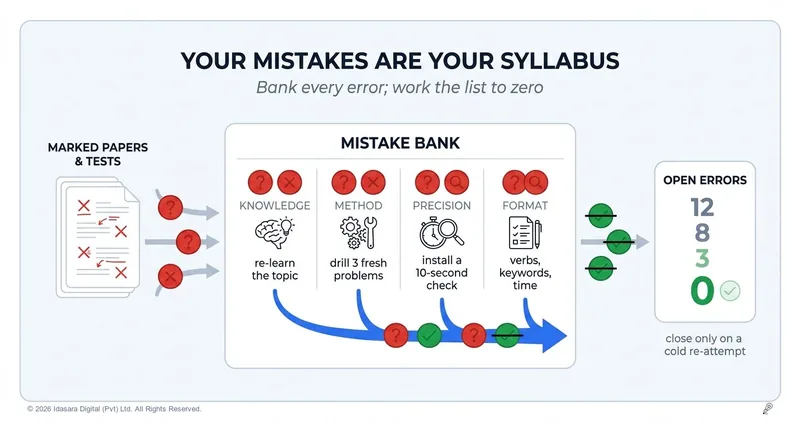
Every error you make is a precise, personalised instruction about what to study next — and most students throw thousands of them away every year. This chapter of Learn to Learn shows how to bank your mistakes instead: collect them, sort them by kind, and work them until they stop recurring. It is the single highest-yield study system in this book.
Two students get their marked test papers back. Both scored 61. Watch what happens next, because the next ten minutes predict the next ten months.
The first student reads the mark, feels the sting, flips through the red circles with a wince — careless… didn't know that… stupid mistake — and puts the paper in a folder. The folder is where their mistakes go to be forgotten. Next month's paper will feature, with eerie precision, the same red circles.
The second student takes out a notebook and, for ten unglamorous minutes, records each lost mark: what the question was, what went wrong, and — this is the key — what kind of wrong it was. Then the paper goes in the folder, but the mistakes don't. They've been banked. And banked mistakes, as we're about to see, pay interest in the student's favour.
The most valuable data you own
Here is the reframe this chapter exists for. An error, seen coldly, is a piece of diagnostic information of a quality nothing else can match: it tells you exactly where your knowledge fails, under real conditions, at a specific question, on a specific day. Not where you feel weak — the illusion-of-competence chapters buried that instrument — but where you demonstrably, behaviourally leaked marks.
A term's worth of collected errors is therefore something extraordinary: a syllabus of you. The official syllabus lists what everyone must learn; your error record lists what you specifically haven't yet — with addresses. And study time aimed at that list has a property no other studying has: every hour lands on a proven leak. This is precisely why the ladder made mistake-elimination half of the A-protocol; the A-student's "study your weaknesses" is only possible for students who know their weaknesses, and errors are the only honest census.
Which makes the standard student behaviour — wince and file — an act of quiet self-sabotage: throwing away, daily, the exact data that would make studying efficient, then wondering why revision feels like guesswork.
How do you bank a mistake?
A mistake bank runs on two habits.
Collect everything. Every lost mark from every marked source — tests, past papers, checked exercises, marked scripts — gets an entry while the marking is fresh: the topic, the question (or its reference), and what actually went wrong in one honest sentence. Ten minutes per marked paper. No exceptions for "silly" mistakes — especially not for those, as you're about to see.
Classify by species. Here is where the bank becomes intelligence. Errors are not one thing, and each species has a different cure:
- Knowledge gaps — you didn't know it. Cure: the loop — textbook, short note, exercises, on that topic. The only species most students treat, because it's the only one that feels like a "real" study task.
- Method errors — you knew the content but applied the wrong procedure, or the right one wrongly. Cure: worked repetition — re-derive the correct method, then drill three fresh problems of the same archetype.
- Precision errors — the infamous "careless mistakes": sign slips, unit drops, misread digits. Cure: not "be more careful" — that's a wish, not a method. The cure is identifying your personal recurring slip (everyone's are patterned — the bank reveals yours) and installing a specific check: a ten-second units-and-signs sweep at each answer, digits verified at transcription. Precision errors are the cheapest marks in your entire ledger; they need a checklist, not more knowledge.
- Format errors — right knowledge, wrong delivery: the unanswered verb, the missing scheme keyword, working the marker couldn't follow, time run out. Cure: the exam-craft chapters — verbs, marking dialect, time-calibration — drilled at the specific failure.
Classify a term of errors and a revelation usually follows: the distribution is lopsided. Students who assumed they "don't know enough" discover half their leak is method and precision — curable in weeks. The bank doesn't just list your weaknesses; it prices them, and the price list reorders your study plan all by itself.
Working the bank to zero
Banked data pays only when worked. The operating rhythm:
A weekly banking session — thirty minutes, fits naturally beside your tracker ritual: enter the week's new errors, then work the oldest open ones by species: re-study the gap, drill the method, install the precision check, rehearse the format fix.
Close only on proof. An error closes when you've re-answered its question cold — days later, from scratch, correctly — not when you've read the correction and nodded (you know that trap's name by now). Recurring species close when three fresh problems of the archetype pass clean.
Watch the balance, not just the entries. The bank's health is its open count per topic. A topic accumulating faster than it closes is flashing red — route this week's study there. Topics driven to zero and staying there are genuinely, provably secure — a confidence no amount of re-reading can supply. And in Rung 3 season — the grade ladder's final phase — "drive the bank to zero" is the work: each past paper deposits, each elimination session withdraws, and the balance trending to zero is the most honest exam-readiness signal that exists.
Do this tonight
- Start the bank: a dedicated notebook section, columns for date · topic · what went wrong · species · closed-when.
- Seed it from your most recent marked work — that test in the folder, tonight's checked exercises. Ten minutes, every lost mark, honestly speciated.
- Read the species distribution of even this first page. Then work one entry to closure this week — cold re-attempt and all — and feel the difference between hoping a weakness is gone and proving it.
At a glance
- Errors are the highest-quality diagnostic data you own: proven leaks, with addresses. A term of them is a syllabus of you.
- Bank every lost mark while marking is fresh: topic · what went wrong · species.
- Four species, four different cures: knowledge (the loop) · method (worked repetition) · precision (installed checks, not "be careful") · format (exam-craft drills).
- Work the bank weekly, oldest first; close only on cold re-attempt proof; watch the open balance per topic.
- Rung 3 in one line: papers deposit, elimination withdraws, and the balance driven to zero is the A.
One step further with Idasara Academy
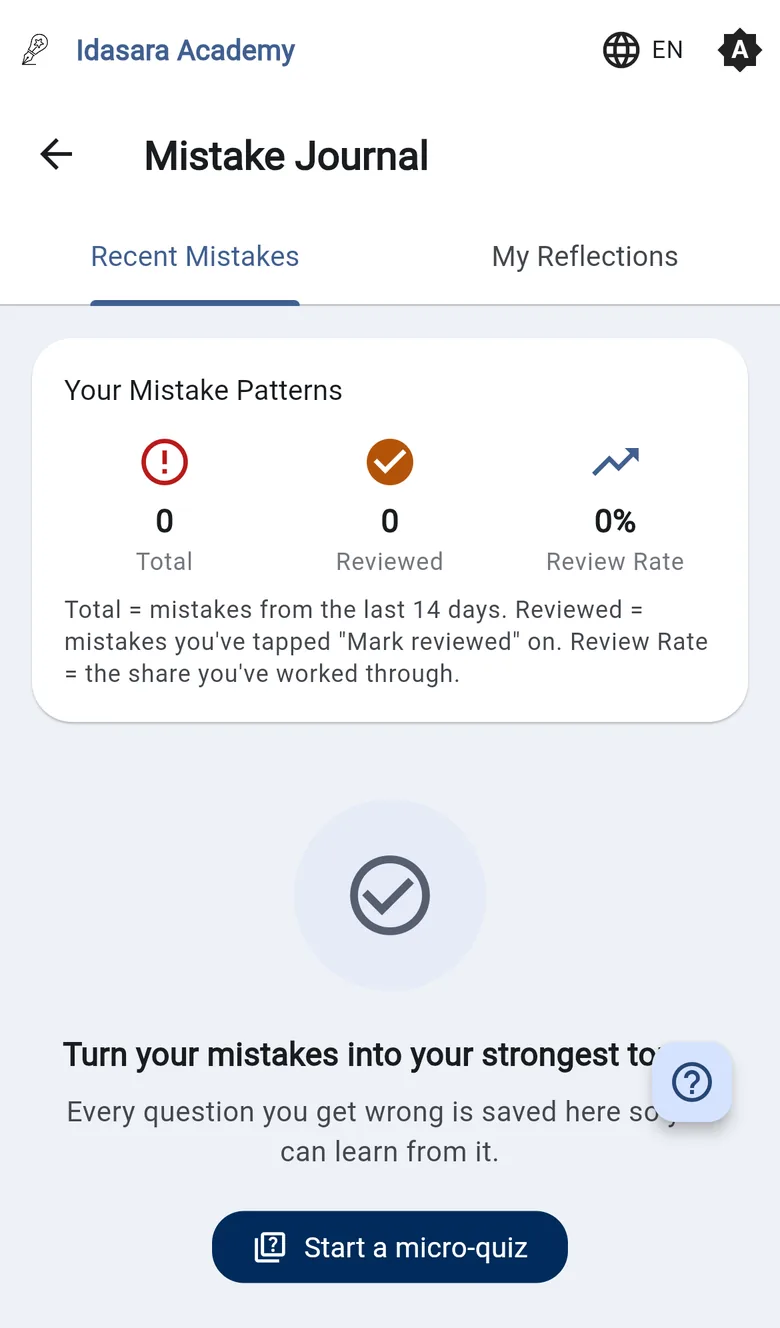
Collection and scheduling are the bank's drudgery, and they're exactly what Idasara Academy automates — and you can start free: the Mistake Bank begins filling from your first free micro-quiz, every wrong answer mapped to its topic, each topic's health tracked from red toward green as you close errors. Today's Plan — free — routes practice at your open entries; on the paid tiers, marked handwritten scripts feed the bank too, and a Socratic session with the AI Study Coach closes them. The wince-and-file pathway is simply removed: nothing you get wrong is ever thrown away again.
Start Free — Create Your Account →
FAQ
Isn't keeping a book of my failures demoralising? Students report the opposite once the frame flips: the bank converts a vague fog of "I'm weak" into a finite, shrinking list — and lists shrink visibly, which fog never does. The demoralising thing was the folder: same mistakes, resurfacing forever, unexplained.
"Careless mistakes" aren't real weaknesses though — I knew the answer. The exam pays zero for known-but-leaked. Precision errors are patterned (the bank will show you yours within weeks), patterned means predictable, and predictable means preventable — by checklist. Treating them as noise is donating the cheapest marks on the paper, every paper.
How is this different from just reviewing my marked papers? Reviewing is reading; banking is accounting. Review sees each paper once, in isolation, then files it. The bank accumulates across papers — which is the only way recurring species become visible, and recurrence is the whole signal.
When do I get to delete things from the bank? Closed entries stay, struck through — a strike-through ledger is a scoreboard (the question-log chapter taught you this pleasure). Before the exam, the closed pages are also something else: written proof of exactly how much of "you" has been repaired. Read them the night before, instead of cramming. It's better for you.
Further reading
The mistake bank's telemetry — topic keys, health indices, and Socratic remediation — is written up in the Idasara Method: Part 3 — The Grade Progression Ladder & Paper Marking.
Sources
- Dunlosky, J. et al. (2013). Improving Students' Learning With Effective Learning Techniques — overview at the Association for Psychological Science
- The Learning Scientists: Learn How to Study Using… Retrieval Practice (feedback and re-testing to closure)
- The Idasara Method: Part 3 — The Grade Progression Ladder & Paper Marking