Studying on Little Data and Weak Signal: The Offline-First Student
The short answer: Almost all of the studying happens offline, on paper — the method was built that way — so the connection becomes a weekly supply run: one planned session at good signal fetches the coming week's materials, papers, and answers. Prefer text over video, download once and keep forever, and a modest weekly data budget covers a full study week.
A chapter of the free book Learn to Learn
Published 2026-08-31 · updated 2026-08-31
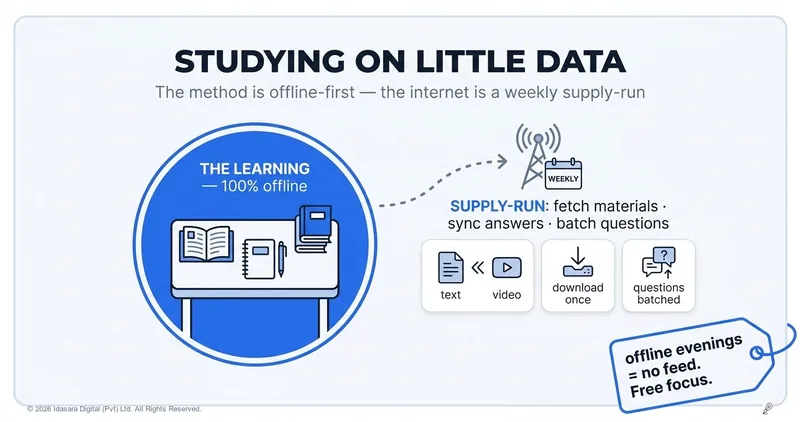
The internet has convinced students that studying is something that happens online — which makes every rupee of data and every bar of signal feel like a wall between them and an education. This chapter of Learn to Learn breaks that spell: the method is offline-first by design, the connection is a weekly supply-run rather than a nightly need, and the low-data student who plans their megabytes often out-studies the unlimited-data student drowning in them.
Here is a sentence to read twice if your home has weak signal, expensive data, or both:
Almost everything in this book happens offline.
Go back through the chapters and check: the textbook read to the end of the section — paper. The short note from memory — paper. The red-ink audit — paper against paper. The exercises, the past papers, the mistake notebook, the blank-page tests, the derivation deck, the figure walk, the Pomodoro block with the phone away — paper, paper, paper. The learning engine this book spent fifty chapters building was designed around a mind, a pen, and a textbook, and not one of its load-bearing parts asks for a connection at the moment of learning.
That's not an accident, and it's not a consolation prize. The method was built that way — which means the question was never "how do I study with little data?" It's the far more manageable one: "what are the few things a connection genuinely buys me, and how do I buy them cheaply?"
What does studying actually need the internet for?
Strip studying to what truly needs the internet, and the list is short:
- Fetching materials — a lesson explanation, past papers, syllabus outlines, this book's chapters.
- Checking and feedback — quizzes synced, marked answers, questions asked and answered.
- Planning updates — what's next, what's due.
Notice what all three have in common: none of them needs to happen at study time. They are supply runs — and supply runs can be batched, scheduled, and done wherever the signal lives.
The supply-run system
Batch the fetch, weekly. One planned session — at school, the town junction, a relative's WiFi, wherever signal is real — downloads the week ahead: the materials for coming topics, the paper you'll sit Saturday, the answers to your logged questions. The syllabus contract makes this possible: because you know what's coming (the term map is the point), you can fetch for the future instead of stumbling online nightly. A student with a plan needs the internet once a week; only a student without one needs it every night.
Study from the store, daily. Between runs, the week runs on what's stored: the paper core plus the downloaded materials. And notice one honest advantage hiding here: an offline evening has no feed, no notifications, no rabbit holes — the focus that data-rich students fight for with app-blockers and willpower. This doesn't make the constraint a blessing; it makes it a constraint you're managing well — and many strong rural results are built on exactly that.
Spend megabytes like rupees — and know the rough prices. Data is a budget, so run it like the money chapter runs money, with real numbers in your head: a chapter of text costs well under 1 MB; a photographed answer page costs a few MB; an hour of video can eat several hundred MB — hundreds of text chapters' worth. So: prefer written explanations always; treat video as a rare luxury for topics that truly need motion; download once, keep forever (never re-stream); batch your questions in the log and spend them in one session. Before installing any app, check its listed download size in the store and make it a planned purchase, not a surprise. And the family conversation belongs here too: a student's weekly study-data — often a few hundred MB, a modest top-up — is one of the highest-return purchases a stretched household can make. Small, named, and protected beats large and vague.
Let the tools respect the constraint. Built-for-here software works offline-first: content cached for offline study, progress syncing when signal returns, low-bandwidth modes for weak connections. That's a design standard you should demand of any study tool — an app that dies without signal was built for somebody else's country.
The signal-poor exam year
Two seasonal notes. Exam season needs less connection, not more — by then the work is papers, retrieval sweeps, and the mistake list: the most offline phase of the whole year. Don't let panic convince the family that exam season needs big data spending; it needs the store you built all year. And school is a signal asset: its connection, its computer room, its printed past-paper stocks — the supply-run's natural depot. Teachers respond well to the student who arrives with a written fetch-list; it reads as exactly what it is — method.
Do this week
- Write your fetch-list for one week ahead (the term map tells you what's coming): materials, one paper, your logged questions.
- Run one supply-run at your best signal point; store everything for offline use.
- Then study the week from the store — and notice, honestly, whether the offline evenings focused better than connected ones ever did. That noticing turns a constraint into a system you'd keep even if the data were free.
At a glance
- The method is offline-first by design: every load-bearing practice in this book — notes, tests, papers, audits — happens on paper, connection-free.
- The internet's real study jobs are three: fetch, feedback, planning — all batchable into a weekly supply-run at wherever signal lives.
- The syllabus contract is what makes batching possible: plans fetch for the future; planlessness begs the network nightly.
- Spend data like money, with prices known: text < 1 MB a chapter · a photographed page = a few MB · an hour of video = hundreds of MB. Text over video, download-once, questions batched; check an app's store-listed size before installing.
- One honest advantage inside the constraint: offline evenings have no feed — real focus, free.
One step further with Idasara Academy
The app was built for exactly this country: data-lite mode — free — adapts to weak connections, lessons and materials work offline once fetched, and progress syncs when the signal returns, so the weekly supply-run is literally the designed usage pattern. One session at the junction fills the week; the learning happens where it always did — at your desk, on paper, with the engine running.
Start Free — Create Your Account →
FAQ
Everyone says modern studying needs YouTube lessons. Am I falling behind without them? Video is one delivery format — and this book's whole delivery-vs-conversion argument applies: the textbook plus a written explanation carries the same content at a hundredth the megabytes, and conversion (your paper hours) is where marks come from anyway. Spend video's budget only where motion genuinely teaches (a dissection, a mechanism animation) — as a treat, not a diet.
My only signal is at school, and school days are full. When do I run supply? Interval time plus a written fetch-list makes a fifteen-minute run possible — that's the list's whole point: no browsing, just collecting. Many students pair it with the week's teacher-questions (the night-before-class ritual's starred survivors), making one session serve both. And off-peak speeds are real — a late-night fetch is fine; late-night studying isn't (you know what sleep is worth).
What about Ask-AI-style help — doesn't that need constant connection? It needs connection at ask-time — so batch it: the question log accumulates all week (that's its design), and the supply-run spends the whole log in one sitting, answers written back beside each question in ink for the offline week ahead. The log was always an offline-first technology.
Further reading
The free materials this system runs on: The Free Education Stack (next in Hard Mode). The planning machinery that makes batching possible: The Syllabus Is a Contract.
Sources
- Ministry of Education — e-thaksalawa (downloadable official materials, trilingual)
- Educational Publications Department — edupub.gov.lk (textbooks, download-once)
- The Idasara Method: Part 1 — The Human Foundation & Active Recall (the paper core)