The Syllabus Is a Contract — Sign It Before the Exam Signs It For You
The short answer: The paper is built from the entire national syllabus, so every topic you never cover caps your maximum grade by plain arithmetic — before you write a word. Treat the NIE topic list as a contract you personally sign, and enforce it with a ten-minute weekly tracker: count only honestly finished topics, compare against the calendar rather than your class, and repair every gap in the week you find it.
A chapter of the free book Learn to Learn
Published 2026-08-31 · updated 2026-08-31
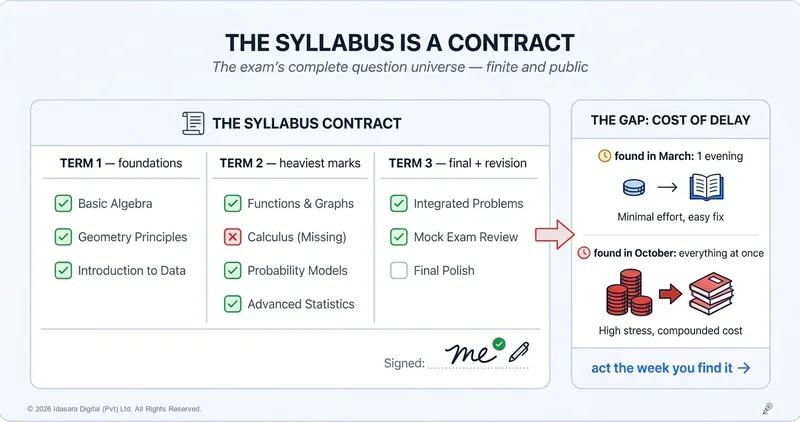
The exam paper is built from the entire national syllabus, mathematically spread across all three terms — so uncovered topics silently cap your maximum possible grade before you write a word. This chapter of Learn to Learn turns the syllabus from a vague cloud into a signed contract with a weekly tracker, so no gap survives to exam season unseen.
There is a particular kind of exam-season fear, and every student past Grade 10 knows its taste.
It isn't the fear of a hard question. It's the creeping arithmetic that starts around August: the exam is in four months… we're still in the middle of the syllabus… wasn't there a whole section in Term 2 we never really did? The fear is vague — and that's exactly what makes it powerful. You can't fight a cloud.
This chapter replaces the cloud with a document. Because here is what the "syllabus" actually is, seen clearly: a public, finite list of everything the exam is allowed to ask — published by the National Institute of Education, structured across your three terms. Not a suggestion. Not your school's plan. The exam-setter's complete universe. And a finite list, unlike a cloud, can be tracked, audited, and finished.
What does an uncovered topic actually cost?
First, understand what an uncovered topic actually costs — because it's worse than "some lost marks."
Examination boards distribute questions across the whole syllabus — Term 1 material, Term 2, Term 3, all of it, year after year — and where a paper offers a choice of questions, coverage is what buys you the choice. So walk into the hall having genuinely covered 70% of the list, and simple arithmetic takes over: roughly 30% of the paper's marks sit on territory you never visited. Your maximum possible mark — with a perfect performance on everything you know — is capped near 70. An A is gone before the first question is read, not through any failure in the hall, but through arithmetic settled weeks earlier at your desk.
That's the brutal part. Here's the liberating part: the cap is entirely visible in advance. Every future exam question comes from a list you can hold in your hand today. Almost no other high-stakes event in life offers that. Most students never use it — because they experience the syllabus as whatever school happens to be doing, rather than as a document they personally audit. The fix is a change of posture, in two moves.
Move one: sign the contract
At the start of the year — or today, wherever in the year you are — open your syllabus's topic list, structured by term, and read it the way you'd read a contract you're about to sign. Because you are. The terms:
- Term 1 is foundations. These topics are what Term 2 assumes. Debt here is the most expensive in the whole year — every later topic silently charges interest on it. (It's expensive enough that the next chapter is devoted to it.)
- Term 2 is the heavy marks. In most subjects, the deepest, most-examined material. A student on schedule here pulls decisively ahead of one who's catching up.
- Term 3 is the last new material, then consolidation. A student still learning Term 1 content in Term 3 is competing against past papers, revision, and every other subject at once — the definition of arriving late.
Signing means one honest act: accepting that this list is your responsibility — not your school's, not your tuition teacher's. They are your suppliers; some deliver late (more on that in a coming chapter). The contract, and the results slip, carry only your name.
Move two: run the weekly tracker
A signed contract without enforcement is decoration. Enforcement is a ten-minute weekly ritual — Sunday works — with three rules that do all the work:
Count only what's genuinely finished. "Finished" does not mean the class covered it, or you've heard of it, or the notes exist somewhere. It means you have run your full loop on it: read the official text, written your short note from memory, audited it in red, done the exercises, had them checked. Anything less is in progress — and the tracker's honesty is its entire value. The illusion-of-competence chapter taught you how "familiar" impersonates "done"; the tracker is where that impersonation gets refused, weekly.
Compare against the calendar, never against your class. The natural benchmark — "am I keeping up with school?" — is a trap, because your school may itself be behind, and the exam doesn't grade on a curve of your school's pace. The syllabus's term structure is the schedule. Week by week: is my finished-list where the calendar says it should be?
Act on any gap in the week you find it. This rule is why the ritual is weekly, and it's pure economics. A single unfinished Term 2 topic discovered in March costs one evening — read, note, exercises, done. The same topic discovered in October costs that evening plus everything it must displace: past-paper time, revision, other subjects' hours. Same gap, wildly different price, and the only variable is the discovery date. The whole purpose of the tracker is to buy every gap at its March price.
Do this tonight
- Get your syllabus topic list for each subject, structured by term — from the official outline or your term-mapped study materials. This list is the contract; put it where you study.
- Run your first audit on one subject: mark each topic finished (full loop, honestly), in progress, or untouched. Expect surprises — most students find their "covered" percentage sits well below their felt percentage. Better tonight than in October.
- Diary the ritual: ten minutes, every Sunday, same list. And take this week's oldest gap — one topic — and buy it at this week's price.
At a glance
- The syllabus is the exam's complete, public question universe — finite, listed, term-structured. Coverage gaps cap your maximum grade by arithmetic, before the hall.
- Sign the contract: the list is your responsibility; school and tuition are suppliers, not guarantors.
- Term 1 = foundations (costliest debt) · Term 2 = heaviest marks · Term 3 = last material + consolidation.
- Weekly tracker: count only honestly-finished (full loop) · benchmark the calendar, not your class · buy every gap in the week you find it — March price, not October price.
- Ten minutes a week converts exam-season dread into a shrinking checklist.
One step further with Idasara Academy
The contract needs the list, and the list is built in — free: Idasara Academy's curriculum browser maps every subject's official syllabus across Term 1, Term 2, and Term 3 for your grade (O/L students even get the compulsory core enrolled automatically on day one). Your weekly audit becomes: open the term view, see finished versus remaining at a glance, and let Today's Plan route this week's work at whatever gap is oldest. The cloud, permanently replaced by a list.
Start Free — Create Your Account →
FAQ
How is this different from the timetable in the time-management chapter? Different altitude, same machine: the tracker decides what's owed (which topics, how far behind); the daily plan decides when it's paid (today's blocks and energy). The tracker without the plan is a list of debts; the plan without the tracker polishes hours while gaps grow.
My subject's syllabus feels enormous. Doesn't listing it just prove it's impossible? The opposite, reliably. Un-listed, the syllabus is infinite dread; listed, it's a number — often 30-odd topics per subject per year, which at a steady weekly rate is visibly, provably finishable. Dread doesn't survive division.
What counts as "the official list" — my textbook's contents page? The published syllabus outline for your grade is the authority (the NIE publishes the syllabi; your school applies them), and the official textbook's structure tracks it closely — which is one more reason the textbook chapter told you to anchor there. A term-mapped topic outline built from those is exactly the right instrument.
I audited and I'm badly behind. Panic? No — price-shop. Order your gaps oldest-first (Term 1 debt before Term 3 polish), buy one per evening alongside current work, and remember the arithmetic works both ways: every topic genuinely finished raises your cap. Behind-with-a-list beats on-track-with-a-cloud.
Further reading
Coverage timelines, the syllabus contract, and the term tracker are Layer 2 of the method — written up in the Idasara Method: Part 2 — The Plan.
Sources
- National Institute of Education, Sri Lanka — nie.ac.lk (official syllabi)
- Educational Publications Department — edupub.gov.lk (official textbooks tracking the syllabus)
- The Idasara Method: Part 2 — The Plan