No Tuition in My Area: The Self-Study Year, Fully Built
The short answer: A tuition class sells three services — delivery, feedback, and pacing — and every one can be rebuilt where you live: the textbook and your school's teachers for delivery, self-marked past papers for feedback, a weekly tracked plan plus a witness for pace. A well-run self-study year reaches the same exam, and it is a real advantage, not a consolation.
A chapter of the free book Learn to Learn
Published 2026-08-31 · updated 2026-08-31
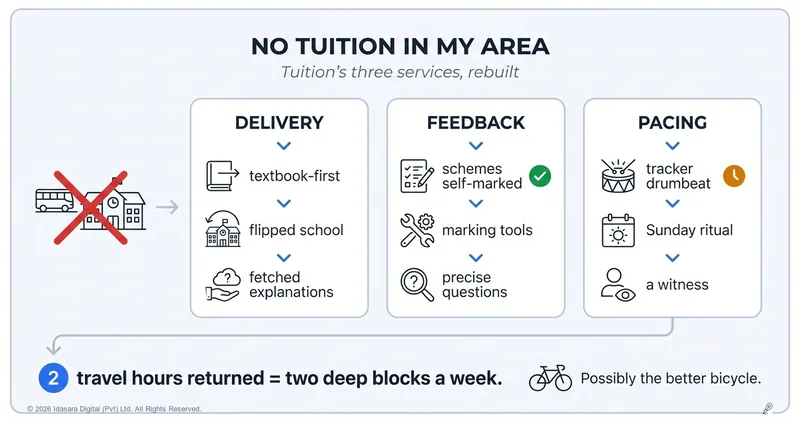
In the towns, tuition is a burden families complain about; in much of the country, it's a loss families feel — the "good classes" are two buses away, and the student left out assumes they're finished. This chapter of Learn to Learn rebuilds what tuition actually provides — teaching, feedback, and pace — from parts you can reach, and makes an honest claim the tuition towns won't like: the well-run self-study year is not a poor copy of the class year. It can be the better one.
Start with the question underneath the grief, asked honestly: what does a tuition class actually give a student?
Strip the culture away and the answer is three services: delivery (the material, explained again), feedback (papers marked, questions answered), and pacing (a schedule that keeps you moving, and a room of rivals that keeps you honest). That's the whole product. Nothing in it is magic; nothing in it lives only in a crowded hall two bus-rides away. Each service can be rebuilt — and this book already built the parts. What follows is the assembly.
How do you rebuild delivery?
Tuition's delivery was always the second telling of material your school and textbook tell first — that's why the Me Time chapter's warehouse image works. The self-study student rebuilds it stronger:
- The textbook, read properly, is the master delivery — the exam is built from it (the oldest chapter in this book), and the reading discipline (finish the section; log the confusion) replaces the tutor's re-explanation with something better: your own located questions.
- School, flipped, becomes your live teacher — the night-before ritual makes your one available classroom worth double, and your school teachers (who granted study rooms in the last chapter) answer starred questions gladly when they arrive precise. The tuition-less student should be the heaviest user of their school's teachers, not the lightest.
- Written explanations and curriculum-grounded AI carry the re-explanation role — batched through the supply-run — the weekly signal-day fetch — if data is tight, always ranked below the textbook (the standing rule).
How do you rebuild feedback?
The service families most fear losing — the marked paper, the answered doubt — and the one technology has most completely rebuilt:
- The self-marking discipline: real past papers with real schemes, marked by you, ruthlessly, per the marking chapter — the skill tuition students often never build because someone always marked for them.
- The marking tools: photographed handwritten answers checked against official rubrics from the Advanced tier up (and inside every account's 42 free days) — feedback in the exam's own language, no class queue needed (this is the single place the app most directly replaces a paid class).
- The mistake bank as your private tutor: the tuition master's real skill was knowing your weaknesses; the bank knows them better, with receipts.
- The question log spent on every available human: school teachers, the one educated neighbour, the priest who taught maths once — precise questions get answered in any village; vague ones die everywhere.
How do you rebuild pacing — the real danger?
Here is the honest hard part. Tuition's deepest service was never the teaching; it was the drumbeat — the weekly schedule that moved you and the visible rivals that shamed you forward. Self-study years fail here or nowhere: not from missing explanations, but from drift — weeks sliding by with no one noticing.
The replacements, all machinery you own, now promoted from helpful to load-bearing: the syllabus contract tracked weekly (your drumbeat — the calendar-versus-me check is what the class schedule used to do); the Sunday ritual, never skipped (the self-study student's weekly check on their own school); streaks and visible progress (motivation's engineering, since no rival sits beside you); and a declared witness — a parent reading the wall-tracker, a friend on the same path exchanging Sunday check-ins, a mentor by message. Pacing survives on visibility to someone; build it deliberately, because the class isn't building it for you.
The honest advantages
Now the claim from the opening, kept: run this assembly and you hold advantages the tuition student pays never to have. The travel hours come back — two bus-rides twice a week is a deep-work block returned to your week, every week. Every hour is conversion — the tuition student's week is delivery-heavy by design; yours is Me Time — the student's own conversion hours — by default, and this book has spent its whole length proving which one manufactures marks. And the self-management itself compounds: the student who ran their own year owns the exact engine the lifelong-learning chapter says the next decades pay for — while the class-carried student meets self-management for the first time at university, alone.
Is tuition therefore useless? No — a genuinely great teacher is worth buses (the audit rules from the parents' chapters decide which classes are that). But the family two bus-rides from everything should hear this chapter's verdict plainly: you are not locked out of the race — and a well-run self-study year is a real advantage, not a consolation.
Do this month
- Write the three-service audit for your situation: how will you deliver (textbook + flipped school + supply-run), get feedback (schemes + tools + question log), and keep pace (tracker + Sunday + witness)? One page — this is your class, founded.
- Recruit the witness and set the Sunday ritual's fixed time.
- Bank the travel-hours you're not spending: name the two weekly blocks they fund and protect them like fees paid.
At a glance
- Tuition = three services: delivery, feedback, pacing — each rebuildable from parts this book already gave you.
- Delivery: textbook-first + the flipped school day + batched written/AI explanations. Feedback: scheme self-marking + marking tools + the bank + precise questions to every available human.
- Pacing is where self-study years live or die: tracker-as-drumbeat, the unskippable Sunday ritual, visible progress, and a declared witness.
- The advantages are real: travel hours returned, conversion-rich weeks, and the self-management the future pays for.
- Not locked out of the race — the well-run self-study year is an advantage, not a consolation.
One step further with Idasara Academy
For the tuition-less student the app is the class that travels — delivery, feedback, and pacing rebuilt in your pocket, free to start, offline-capable, in your language. Less than the bus fare to the classes you can't reach.
Start Free — Create Your Account →
FAQ
Everyone who does well in our school goes to town classes. Doesn't that prove I need them? Look closer at what it proves: the families who can afford town classes can afford everything else too — the books, the quiet room, the time. The classes get the credit for what the whole package did. Meanwhile every district's results include self-built students — you just don't hear about them, because nobody profits from their story. This chapter is that story, written down step by step.
I have no one at all for the witness role. Then borrow structure harder: the app's streaks and parent-view (even shown to a non-studying parent — the traffic light needs no education to read), a same-path friend found through school or the working-teen community, or the mentor chapter's method for finding one adult. The witness needs eyes, not expertise.
What about subjects my school teaches badly or not at all? That's the school-behind chapter's drift, at maximum — and its bridge (textbook + full loop + term map) is your main road, not your detour. For truly teacher-less subjects, the question log's output goes to the supply-run's AI session and to any reachable subject-human, and your paper volume becomes the primary teacher earlier than usual.
Group classes online — worth the data? Judge them as delivery (the conversion test decides): a live class that's mostly watching costs precious megabytes for the weakest service. Recorded/written material fetched once usually beats streamed classes for the low-data student — spend the connection on feedback instead; it's the service that actually needs two-way.
Further reading
The parts this chapter assembles: The Syllabus Is a Contract · Nothing Counts Until It's Marked · Me Time · Studying on Little Data.
Sources
- Wikipedia — Private tuition in Sri Lanka (the culture's scale — and its geography)
- Ministry of Education — e-thaksalawa (state delivery, everywhere)
- The Idasara Method: Part 2 — The Plan (flipped school; syllabus pacing)