Money Skills for Students: The Same Engine, Pointed at Rupees
The short answer: Run your money like your studies: write down every rupee in and out for one month, set one named, priced savings goal with a small automatic slice of every inflow, then sort the month's spending into needs, chosen pleasures, and leaks — and send the leaks to the goal.
A chapter of the free book Learn to Learn
Published 2026-08-31 · updated 2026-08-31
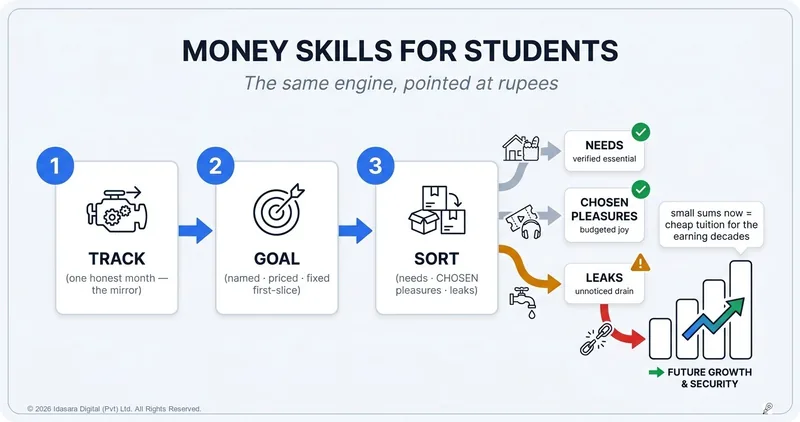
School teaches compound interest as a formula and never as a life skill — so students graduate able to calculate what they've never practised: tracking, budgeting, saving toward something. This chapter of Learn to Learn makes the transfer the school skips: the study engine you've built — instruments, honest tracking, small daily habits, goals with evidence — is a money engine wearing different clothes, and adolescence with pocket money is the cheapest tuition in finance you'll ever get.
Here is a strange asymmetry in how you've been raised. For studying, this book handed you instruments and honesty: track what's real, not what's hoped; small daily habits over heroic vows; goals broken into evidence. For money — the other resource your whole life will run on — the culture hands most students nothing: pocket money arrives and evaporates, earnings (for the working teen) blur into the household, and the first real financial education happens at twenty-five, expensively.
But look at what you already own. The tracker's honesty, the streak's consistency, the visible-progress loop, the audit's species-sorting — every load-bearing part of the study engine transfers to money unchanged. This chapter is that transfer, in three installations — small ones, because the sums are small; that's exactly why now is the practice season.
Installation 1 — The tracking habit: see the money like you see the syllabus
The study engine's first law was instruments over feelings, and money's version is identical: for one month, write down what actually happens — pocket money in, every spend out, one line each. No budgeting yet, no judgement (day-one conclusions are as banned here as in the bounce protocol) — just the mirror. The month's revelation is nearly universal: the money went somewhere real (the daily biscuits, the data top-ups, the small nothings) and seeing it is the entire foundation — the same shock the screen-time counter delivered, in rupees. A student who tracks for one honest month knows more practical finance than most adults, because most adults never installed the mirror.
Installation 2 — The named goal: saving as a ladder, not a virtue
"Save your money" is the money-world's "study harder" — a virtue with no machinery. The working version borrows the ladder: one named goal, priced, with a timeline the arithmetic makes visible — the calculator, next year's course fee, the cricket kit — and a fixed small slice of every inflow routed to it first (the habit chapters' anchor logic: the slice is automatic, so willpower never votes). Then the progress made visible — the chart, the growing number — because the motivation chapter's law holds perfectly here: visible progress toward a named thing sustains what abstract virtue never did. The working teen's version scales up (the earn-and-learn chapter routed savings to the next qualification stage); the pocket-money version practises on smaller stakes — same machine, training weights.
Installation 3 — The audit eye: spending sorted by species
The species-sorting of the mistake bank — your sorted record of study errors — pointed at the ledger: after the tracking month, sort the spending — needs (the bus, the data budget), chosen pleasures (deliberate, enjoyed — the leisure the phone chapter said to schedule on purpose), and leaks (the spending that happened to you: ambient, unremembered, unenjoyed). The sort's discipline is honesty about the middle category — this chapter is not an austerity sermon; chosen pleasures are the point of money — while the third category funds the goal without any sacrifice that feels like one. Leaks-to-ladder is the whole redistribution, and it's usually enough.
And two graduation notes, for when the sums grow: the family conversation (a student running instruments earns a voice in the budget chapter's household audit — many families discover the tracked teenager is the house's best accountant), and the earning threshold (first jobs, the working-teen life: the private earnings-tracking and goal machinery scales with you, and the money-meaning conversations from the abroad-parenting chapter apply from the earner's side). The deeper point, worth saying once: financial dignity is learned exactly like academic capability — by instruments and small wins, never by lectures. The engine is the same engine. You've been training it all along.
Do this month
- Install the mirror: one month's honest one-line tracking, no judgement, starting with today's rupees.
- Name the goal: one thing, priced, timeline computed, the fixed slice chosen and automated by habit-anchor (the slice moves the day money arrives).
- After the month: the species sort, and the leaks routed to the ladder. Then show a parent the chart — the family conversations that follow are the graduation.
At a glance
- The study engine is a money engine: instruments over feelings · small automatic habits · named goals with visible progress · species-sorted audits.
- Track first, judge later: one honest month of one-line records — the mirror is the foundation, and its shock is the tuition.
- Saving = a ladder, not a virtue: one named priced goal, a fixed first-slice of every inflow, progress visible. Willpower never votes.
- Sort by species: needs · chosen pleasures (kept, deliberately) · leaks (the ambient spending that funds the goal painlessly).
- Small sums now are the cheap practice season for the earning decades — financial dignity is built by instruments, not lectures.
One step further with Idasara Academy
The money engine ships alongside the study one, free: the personal-finance budget tool runs the mirror and the species view, saving goals hold the named ladder with its visible chart, and the working teen's earnings tracking is private by design (encrypted — your work-money is your business, shareable with family only if you choose). The life-skills track's coach builds on it when you're ready. Same account, both engines — which was always the thesis: learning to learn includes learning to run your own life.
Start Free — Create Your Account →
FAQ
My pocket money is tiny — what's the point of tracking crumbs? The habit is the asset, not the amount: the mirror installed at small stakes runs automatically at large ones, and the person who tracked crumbs at fifteen audits salaries at twenty-five without effort. Meanwhile even crumbs hold leaks — most tiny-allowance students find a goal-slice they never missed.
My earnings go to the family — there's nothing to 'manage.' Tracking still serves you doubly: the record dignifies the contribution (visible evidence of what you carry — the working-and-caring chapter's point), and even a token personal slice, agreed openly, keeps the goal-machinery alive for the day the ratios change. The instruments are yours even when the money mostly isn't.
Should students invest — everyone online says start early? The sequence matters more than the excitement: mirror → goal → buffer, then the learning about anything riskier — with the predator checklist from the budget chapter in hand, because "young investor" is a favourite hunting ground (guaranteed returns are the guaranteed-A of finance). The early start that actually compounds is the habit stack, and it's already begun.
As a parent, should I pay for marks or chores? (for parents) Whatever the family decides about chores, keep money off the marks — paying for grades imports the outcome-pressure this book spent its parents' chapters dismantling, and rents motivation the exam hall will repossess. Fund the instruments instead: the tracked allowance, the matched savings slice — money lessons that don't tax the learning ones.
Further reading
The engine's home chapters: Motivation That Survives Monday (visible progress) · Earn While You Learn (the scaling-up) · The Family Education Budget (the household's version). The life-skill frame: Learning to Learn.
Sources
- The Idasara Method: Part 4 — Time Management & Flipped Learning (habit anchors; visible progress)
- Mahapola — mahapola.lk (where the saving ladder can lead)
- Idasara Academy — Trust & data safety (earnings privacy, by design)