Learning to Learn: The One Skill That Outlasts Every Exam
The short answer: Learning to learn means owning a portable engine — read and compress any material from memory, turn confusion into precise questions, train performances under real conditions, eliminate your errors systematically. School content fades within a decade; the engine built while mastering it keeps working for sixty years, on every new job, tool, and field.
A chapter of the free book Learn to Learn
Published 2026-08-31 · updated 2026-08-31
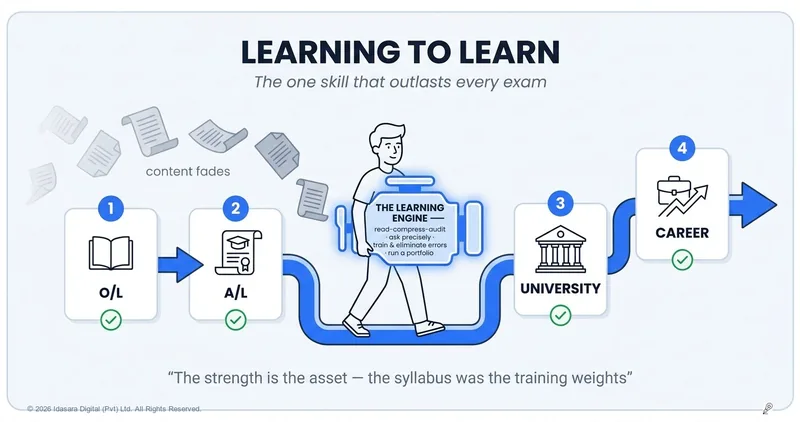
Every subject you're studying will fade, be superseded, or become a footnote in your working life — but the machinery you used to learn it can serve you for sixty years. This capstone chapter of Learn to Learn names what this book has actually been teaching: not exam preparation, but a portable learning engine — and shows why it may be the most valuable thing school years can produce.
Here is a strange question to ask near the end of a book about exams: what, from your school years, will you still be using at fifty?
Be honest with the inventory. The organic chemistry mechanisms? Only if you're one career in a hundred. The history dates, the geography of rivers, the trigonometric identities? Traces, at best. Study after study of adult life converges on an awkward truth every adult privately confirms: the content of school has a short half-life. Within a decade, most of it has gone the way of everything the forgetting curve promised.
So were the years wasted? Only for students who took away content alone. Because underneath the content, something else was available — and most students walk straight past it. You didn't. Look at what you're actually carrying out of this book.
The engine is the asset
Strip the Sri Lankan syllabus out of every chapter you've read, and look at what remains:
You can take any dense body of material and make it yours — read primary sources actively, compress them from memory in your own words, audit yourself in red, and know (not feel — know) what you've actually absorbed. You can locate your own confusion precisely and convert it into questions that get answered — by people, books, or machines. You can train a performance: identify what the test actually pays, rehearse under real conditions, harvest your errors by species, and eliminate them systematically to zero. You can run a portfolio through time: track coverage against a calendar, aim your best energy at your weakest front, keep everything alive, and hold a sustainable pace for a year without burning down.
Read that list again, slowly, and notice what it doesn't mention: physics, chemistry, or O/L anything. It is a general-purpose learning engine — and it happens to be a fairly complete description of how competent adults master anything: a new profession, a new technology, a new language, a driving licence, a medical diagnosis they suddenly need to understand. The syllabus was the training weights. The strength is the asset.
This is the book's namesake and its actual thesis: ඉගෙන ගන්න හැටි ඉගෙන ගන්න — learn how to learn. The exams were never the point. They were the occasion.
Why does this skill's price keep rising?
A generation ago, learning-to-learn was valuable. Three forces are now making it the defining skill of working life — and every one strengthens the case for what you've built:
Careers stopped being single-subject. The adult working lives ahead of you will cross tools, roles, and often whole fields, several times. Each crossing is a syllabus with no teacher assigned — the person who owns a learning engine crosses in months; the person who only ever learned under instruction waits for a course that may never come. Lifelong learning has moved from aspiration to job description; global education bodies now build whole frameworks around it.
Knowledge started expiring faster. In technical fields especially, what you master at twenty-five is partially obsolete at thirty-five. This sounds like bad news — it is bad news, for content. For the learner-of-things it's the opposite: a world of expiring knowledge is a world that pays a permanent premium to whoever re-learns fastest and most honestly (self-audit, mistake elimination — you know the machinery; you've run it).
And AI raised the stakes on exactly your half. You've read this book's AI chapters: as machines make answers cheap, the human premium moves to asking precisely, judging critically, and owning results — the literacy stack. But there's a meta-level above even that: AI makes new capabilities arrive constantly, and each arrival is one more thing to learn quickly and judge honestly. The engine that mastered your syllabus while training your AI judgement is the same engine that will absorb every wave that follows. You've been rehearsing the future's core loop all along.
How do you carry it forward?
A skill this valuable deserves deliberate packing. Three acts of ownership before your school years end:
Name what you do. Not vaguely ("I study hard") but mechanically: "I compress from memory and audit in red. I keep a question log. I train under test conditions and eliminate my errors to zero. I protect the floor, not just the ceiling." What you can name, you can redeploy — and you'll recognise, for the rest of your life, when a new challenge calls for which tool.
Notice that the engine is content-agnostic — by using it once elsewhere. Take something entirely outside the syllabus you want to learn — an instrument, a coding language, cricket statistics, cooking — and consciously run the machinery on it: primary sources, notes from memory, deliberate practice with feedback, an error log. The day the engine works on something you chose, it stops being "study skills" and becomes what it actually is: yours.
And keep the honesty. Of everything in this book, the most transferable component is the smallest: the blank-page test — the refusal to confuse familiar with known. Adults lose careers, money, and years to that one confusion, in domains far from any classroom. The habit of asking "can I produce this, or do I merely recognise it?" is a lifelong immune system. Guard it.
Do this tonight
- Write your engine down — one page, your own words: the five or six mechanisms you now run, named plainly. Keep the page; it's the real certificate these years produced, and unlike the other one, it appreciates.
- Choose your first outside-the-syllabus deployment — something you want to learn — and diarise it for the week after exams end. The engine should never sit idle long enough to be mistaken for exam equipment.
- And tonight, run the engine as usual on tomorrow's syllabus work — knowing, now, what you're actually practising.
At a glance
- School content has a short half-life; the learning engine built while mastering it can serve for sixty years — the strength, not the weights, is the asset.
- Your engine, named: make any material yours (read–compress–audit) · locate confusion and ask precisely · train performances (conditions, error harvest, elimination to zero) · run a portfolio through time.
- Three forces raise its price: multi-chapter careers · expiring knowledge · AI's constant arrival of new things to learn and judge.
- Pack it deliberately: name the mechanisms · deploy them once outside the syllabus · keep the blank-page honesty for life.
- ඉගෙන ගන්න හැටි ඉගෙන ගන්න — the exams were the occasion, never the point.
One step further with Idasara Academy
Idasara Academy was built as this philosophy made runnable: a system that doesn't just deliver content but makes the method — the loop, the honest feedback, the error elimination, the portfolio discipline — a daily habit, until it belongs to the student rather than the app. That's the quiet test of the whole design: the student who uses it well eventually carries the engine out of it. We consider that graduation, not loss.
FAQ
If the content fades anyway, why fight so hard for the A? Because the A and the engine are produced by the same actions — you can't build one without the other using this method, which is rather the point. And the A buys real doors (streams, universities, first chances) at the exact moment doors matter most. Fight for both; keep the one that lasts.
Isn't "learning to learn" just a slogan? It sounds unfalsifiable. As a slogan, yes. As a named list of mechanisms — retrieval, spacing, self-audit, error elimination, deliberate conditions — it's among the most falsifiable things in education: every component has decades of evidence, which is why this book cited its sources chapter by chapter. The slogan is empty only for people who never operationalised it. You have.
What happens to students who get the grades without the engine — pure tuition-drilling, spoon-fed to the exam? The grade opens the first door identically. The difference surfaces at the second door — university's unstructured load, the first job's undefined problems — where instruction stops and the engine is the only thing that walks through with you. It's the difference this book exists to prevent.
Which chapter should I re-read a year from now? This one — and then whichever mechanism your new challenge calls for. The book was designed as a shelf, not a sequence: the day you're learning something hard again, the relevant chapter will read differently, because you'll be back inside the problem it solves.
Further reading
The method's framing of 21st-century learning — and the roadmap from exam mastery to lifelong capability — is written up in the Idasara Method: the manifesto and Part 1 and Part 4's conclusion.
Sources
- UNESCO — Artificial intelligence in education: a human-centred approach (lifelong competencies beyond any tool)
- Dunlosky, J. et al. (2013). Improving Students' Learning With Effective Learning Techniques — overview at the Association for Psychological Science (the evidence base the engine is built from)
- Murre, J. & Dros, J. (2015). Replication and Analysis of Ebbinghaus' Forgetting Curve, PLOS ONE (why content fades; method remains)
- The Idasara Method: Part 1 — The Human Foundation & Active Recall