Motivation That Survives Monday: It's an Output, Not a Fuel
The short answer: Motivation is what studying produces, not what it runs on — so stop waiting for the feeling and make starting cheap instead: a twenty-minute session anchored to the same time daily, progress kept visible on a chart, and a streak that slowly makes "I study daily" a fact. Action first; motivation is the exhaust, not the fuel.
A chapter of the free book Learn to Learn
Published 2026-08-31 · updated 2026-08-31
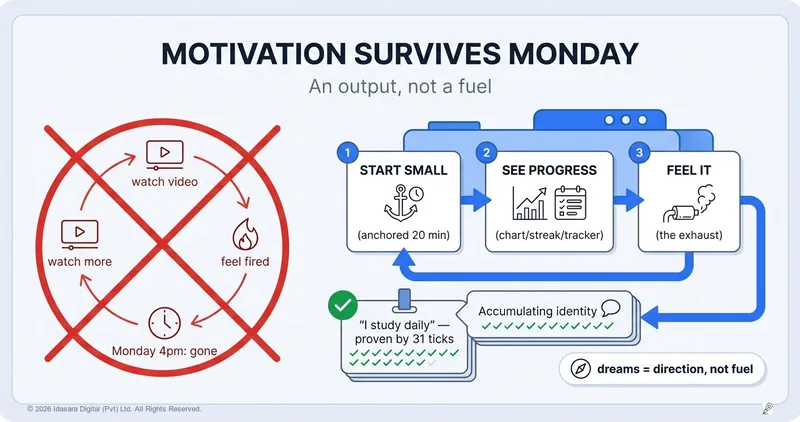
"How do I stay motivated?" is the most-asked study question on the internet, and almost every answer sells the same broken product: feelings first — videos, quotes, visualising success — then action, supposedly, follows. This chapter of Learn to Learn inverts it with the only model that survives an ordinary Monday: motivation is what action produces, not what it runs on — and the students who "always feel like studying" are running three pieces of machinery you can install this week.
Sunday night, the student watches a motivational video. Chills. Notes taken on success. Tomorrow, everything.
Monday, 4 p.m.: the feeling is gone. Not weakened — gone, the way weather goes. And the student concludes what millions conclude: "I lack motivation. I need to find more." Then back to the videos, in the exact loop the motivation industry is built on.
Here's the model that breaks the loop, and it's the most practically important sentence in this Part: motivation is not the fuel for action — it's the exhaust of it. You do not feel-your-way into working; you work-your-way into feeling. Every student who "always seems motivated" is downstream of action that started without the feeling — started small, produced a visible win, and harvested the motivation that followed. The feeling the videos give you is real but unattached: chills with no machine to drive. The students you envy own the machine.
How do you stay motivated? The machine: three parts
Part 1 — Action first, sized so small the feeling isn't needed. You've met this everywhere in this book because it is the book: the launch chapter's twenty minutes, the pomodoro's one block, the never-zero floor — the rule that no day hits zero. The engineering point deserves its plain statement: starting is the only part motivation was ever needed for — the mid-task feeling largely takes care of itself once material is moving — so all the machinery aims there: the tiny opening quota, the anchored time, tomorrow's material laid out tonight, the plan that names the first task so deciding never blocks starting. A student who has made starting cheap has replaced motivation's biggest job with design.
Part 2 — Visible progress, harvested deliberately. The exhaust needs collecting. Progress you can see — the streak chart filling, the tracker's topics ticking, the mistake list shrinking, the marked papers' line rising — converts back into tomorrow's starting energy, and this loop (act → see → feel → act) is the actual perpetual-motion machine behind every "naturally motivated" student. The corollary explains most motivation collapses: invisible progress demotivates even when it's real. The student working hard with no instruments feels nothing moving and concludes it isn't — this book's dashboards were always motivation engineering wearing measurement's clothes.
Part 3 — Identity, built from evidence. The deepest layer: "I'm doing some studying" burns out; "I'm the kind of person who studies daily" self-sustains — but identity can't be installed by declaration (that's the vow again). It's built the comeback way: evidence accumulating until the sentence becomes undeniable. Thirty unbroken days makes the sentence true; the sentence then makes day thirty-one easier. Guard it with the never-zero rule — the streak's continuity is the identity's heartbeat — and feed it the witnessed wins the protocol chapters engineered.
What about the why — dreams, goals, the reasons?
They matter — as direction, not fuel. The career walked backwards, the door the grades open, the family's ceiling being raised: these choose what the machine works on and steady you at the real decision points. What they cannot do is start Tuesday's session — that's the machine's job — and expecting the dream to carry daily labor is exactly the design flaw this chapter opened with. Write the why on the wall by all means; then trust the twenty minutes, not the poster.
Two honest boundary-notes, because this book doesn't sell fluff even about not-selling-fluff. Low motivation is sometimes a symptom: of fear (the parents' chapters named it), of stacked debt making every session a defeat (the comeback protocol treats that — motivation returns when work starts working), or of the flat, weeks-long greyness that is more than laziness — the nerves chapter's when-it's-more-than section applies to mood too, and asking for help is the strong move. And rest isn't the enemy of the machine — it's a component: the burnout that motivation-culture calls weakness is usually a system that budgeted no recovery. Yours budgets it.
Do this week
- Install Part 1 tonight: the anchored twenty-minute start, material laid out, first task named. (If it's already installed from earlier chapters — notice that you've been running motivation machinery all along.)
- Install Part 2's harvest: one visible instrument — chart, tracker, streak — where your eyes land daily.
- Retire the fuel-hunting: when the urge to watch motivation arrives, run the five-minute floor instead — then watch which one produces Tuesday.
At a glance
- Motivation is exhaust, not fuel: action produces it; waiting for it before acting is the loop that fails every Monday.
- The machine: starting made cheap (tiny anchored quotas, decisions pre-made) → progress made visible (charts, trackers, marked papers — invisible progress demotivates even when real) → identity built from evidence (the unbroken streak makes the sentence true).
- Dreams and whys are direction, not daily fuel — the poster steadies decisions; the twenty minutes starts Tuesdays.
- Persistent flatness can be a symptom (fear, debt, low mood) — treat the cause; ask for help when it's more than laziness.
- Rest is a component of the machine, not a betrayal of it.
One step further with Idasara Academy
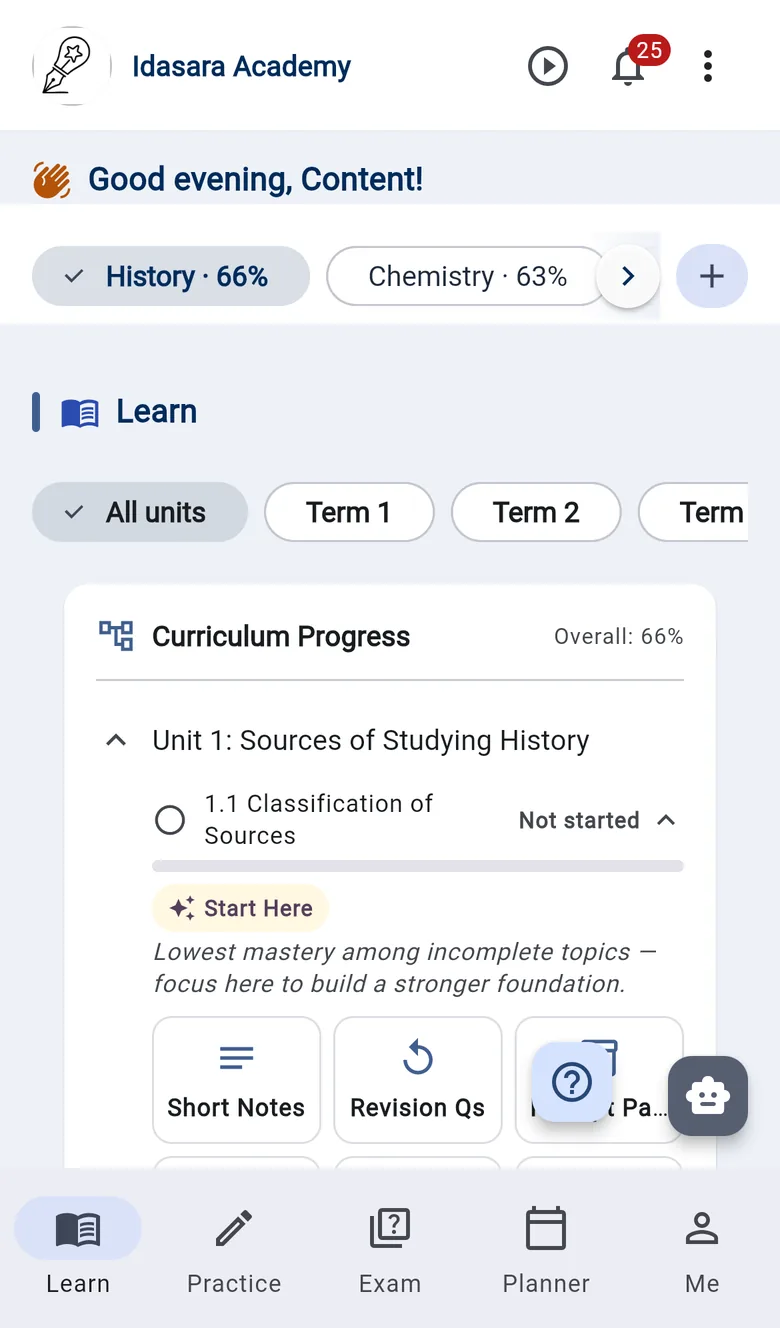
The three parts are the free tier's core loop by design: Today's Plan makes starting cheap (first task named, sized, waiting), streaks and the progress dashboards run the harvest (the exhaust collected daily, visibly), and the accumulating record — days, topics, closed mistakes — builds the identity's evidence file automatically. The app can't give you motivation. It runs the machine that makes it.
Start Free — Create Your Account →
FAQ
But some days I genuinely feel nothing — even starting feels impossible. That's what the emergency floor is for: five minutes, one card-batch, streak intact — designed for exactly the nothing-days. And notice what usually happens at minute four. If every day is a nothing-day for weeks, re-read the boundary-notes: that's a symptom deserving a cause-hunt, not more machinery.
Are motivational videos and quotes actually harmful? As dessert, harmless — occasionally even useful direction-setting. As the strategy, they're worse than nothing: each feelings-spike spent without action deepens the belief that studying awaits a feeling. The test: does consumption end in a started session? If yes, enjoy. If no, the five-minute floor is the better video.
My motivation dies specifically when I compare myself to top students. That's the comparison chapter's territory (it has its own machinery) — but the short version belongs here: their visible position is downstream of their machine, not their mood, and your race is against the syllabus. Compare machines, not positions — then steal the parts.
How do parents motivate a demotivated child? (for parents) By building machine-parts, not applying pressure: protect the anchor time, fund the visible instruments (a wall chart costs nothing), praise process on schedule, and — hardest — stop demanding the feeling ("show some enthusiasm!"). The parents' chapters carry the full playbook; the summary is: you can't install fuel, but you can co-build the engine.
Further reading
The machine's chapters: The First 30 Days (starting) · "I Never See You Studying" (visibility) · Starting From S and F (identity by evidence). The direction-setting: Pick the Career, Then Walk Backwards.
Sources
- The Learning Scientists — Spaced Practice (daily-small as the sustainable engine)
- What Parents Ask — the fear beneath "unmotivated"
- NHS — when low mood is more than laziness
- The Idasara Method: Part 4 — Time Management & Flipped Learning