"I Never See You Studying": The Blame Cycle That Breaks Students — and the Visibility That Ends It
The short answer: Real studying — retrieval, thinking, planned rest — looks like nothing from the doorway, so the parent guesses, and fear guesses low; blame then teaches a working child that honest effort doesn't count. The way out for both sides is shared evidence, not louder accusations: a wall tracker and marked papers, or the parent dashboard, read together each week.
A chapter of the free book Learn to Learn
Published 2026-08-31 · updated 2026-08-31
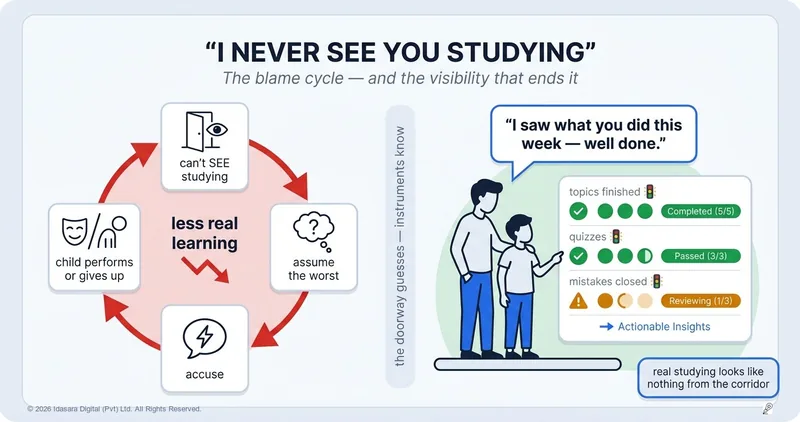
In thousands of homes, the same fight runs nightly: a parent who cannot see studying assumes none is happening, and a child who was studying stands accused of lying. This chapter of Learn to Learn is written to both sides of that fight — why studying is invisible by nature, how the blame cycle quietly destroys the very motivation it means to create, and how shared visibility turns the accusation into the most motivating sentence a parent can say.
Here is the fight, told fairly from both doorways.
The parent's side. You pass the room at 9 p.m. The door is half-closed. The child is… sitting. Or on the phone. Or staring at nothing. You paid for the classes, you rearranged the household around this exam — and you cannot see one visible minute of studying. The fear rises, and out comes the sentence: "I never see you studying! Do you think exams pass themselves?"
The child's side. You just finished a blank-page test on yesterday's chemistry — the chapter written from memory, the hardest kind of studying there is. Before that, twenty minutes of reading, then the question log — your confusions written down as questions. The phone in your hand was the study plan. And the person you most want to believe in you just called it all nothing. Something in your chest closes. Why bother, if this is what it looks like to them?
Both people in this fight are wrong about one thing and right about one thing — and the way out is not more trust, more shouting, or more spying. It is visibility. Let's take it apart properly.
Why is real studying invisible from the doorway?
The parent's blindness is not a character flaw. It is optics: real studying doesn't look like anything.
Think about what this book has taught its student reader to do: retrieve with the book closed. Sit thinking before writing. Read one section slowly instead of turning pages impressively. Rest deliberately between focus blocks — because the rest is part of the method. Now look at that through a doorway: a closed book, a motionless child, "doing nothing," a break that looks like laziness. Meanwhile the worst studying — copying notes for three hours, highlighting whole chapters — looks magnificent from the corridor: pen moving, pages glowing, visible industry. The doorway rewards exactly the methods this book spent fifty chapters dismantling, and punishes the ones that work.
The phone completes the confusion. In a home running this book's system, the phone is the study plan, the quiz, the marked script, the AI tutor — and it is also, in every parent's hard-won experience, the great thief of evenings. From the doorway, the two are indistinguishable. So the parent guesses. And fear always guesses low.
How does blame manufacture the thing it fears?
Now watch what the guess does, step by step — because this is the part neither side sees while standing inside it.
The accusation lands on a child who was working, and it teaches them a precise lesson: effort that isn't performed doesn't count. From there, two roads, both bad. Some children start performing studying — the open books arranged for the doorway, the visible sitting, hours staged for an audience of one. (Re-read the gauges section of the parents' chapter: pressure on the hours-gauge produces visible sitting, not learning — this is where that comes from.) Other children withdraw: if the verdict is already in, why keep paying for it? Real effort quietly declines — the parenting experts this book consulted are blunt that the root is usually fear of failure, and that blame amplifies exactly that fear. Either road leads the same place: less real learning, worse marks — and the worse marks confirm the parent's suspicion, which sharpens the accusations, which… around it goes. The blame cycle doesn't just fail to motivate. It manufactures the failure it predicted, and hands the child a psychological bill on top: children believe the verdicts their homes issue — the parents' chapter said it, and this is the chapter where it happens nightly.
One more honest sentence to the parent before the fix: sometimes your fear is right — some evenings genuinely are lost to the phone. That possibility is exactly why guessing is unacceptable in both directions. A false accusation corrodes a working child; a false trust abandons a struggling one. Neither blame nor blind faith survives contact with reality. Only evidence does.
The fix: shared visibility — surveillance's opposite
The cure is not watching harder. It is replacing the doorway's guesswork with instruments both sides can read — the same move this book made for the student's own self-deception, now applied to the household's.
The paper version costs nothing and works tonight: the syllabus tracker and the mistake list live somewhere visible — the wall, the fridge, the front of the file. The weekly conversation runs on the parents'-chapter questions (tracker on schedule? last marked paper? mistake list shrinking?) — asked calmly, answered with pages, not protests. The child's part of the bargain: keep the instruments honestly. The parent's part: retire the doorway verdicts completely. No more reading posture through half-open doors. The instruments speak now.
The app version does the same thing without the bookkeeping: the parent dashboard — free to open — shows what actually happened: topics genuinely finished, quizzes taken and their results, scripts marked, mistakes closed — and on the exam plan, each subject as a simple traffic light. Suddenly the 9 p.m. scene transforms. The parent doesn't see "a child sitting with a phone" — they see "chemistry went green this week; twelve mistakes closed; tonight's plan is done." And here is the inversion the whole chapter exists for: the parent who can finally see stops saying "I never see you studying" and starts saying the most motivating sentence in family life — "I saw what you did this week. Well done." Specific, evidence-based acknowledgment — process praise with the proof in hand. Children run on being seen accurately the way engines run on fuel; the dashboard's deepest feature is not tracking. It is making accurate seeing possible.
And when the instruments show the work genuinely isn't happening? Then no blame either — because now you can have the right conversation instead of the loud one: is it method? fear of failure? a foundation gap? the phone? The evidence names the problem, and this book's chapters (and the given-up-child FAQ in the parents' chapter) take it from there. Evidence doesn't just end false accusations. It makes true ones useful.
Do this — this week
Parent: Retire the doorway verdict out loud: "I realise I can't judge studying by looking at you — so I'll stop trying. Let's set up something we can both see instead." Then set it up — wall-tracker or dashboard — and within the week, deliver one specific, evidence-based "I saw what you did. Well done." Watch what it does.
Student: If you're the one being wrongly accused — don't just protest; instrument yourself. Show the tracker, the red-inked notes, the mistake list; offer the shared dashboard. Visibility is your defence, and offering it voluntarily says more than any argument. (And yes — send this chapter to your parents. It was written to be sent.)
At a glance
- Real studying is invisible from the doorway — retrieval, thinking, and planned rest look like nothing; copying and highlighting look impressive. The doorway rewards the wrong methods.
- The blame cycle: can't see → assume → accuse → child performs fake studying or withdraws → real learning falls → marks confirm the suspicion → louder accusations. Blame manufactures the failure it fears.
- Neither blame nor blind trust survives reality — only shared evidence does: wall-tracker + weekly questions, or the parent dashboard's traffic lights.
- The inversion: "I never see you studying" becomes "I saw what you did this week — well done." Accurate seeing is itself motivation.
- When evidence shows real trouble: no blame then either — diagnosis (method? fear? gap?) replaces the loud conversation with the right one.
One step further with Idasara Academy
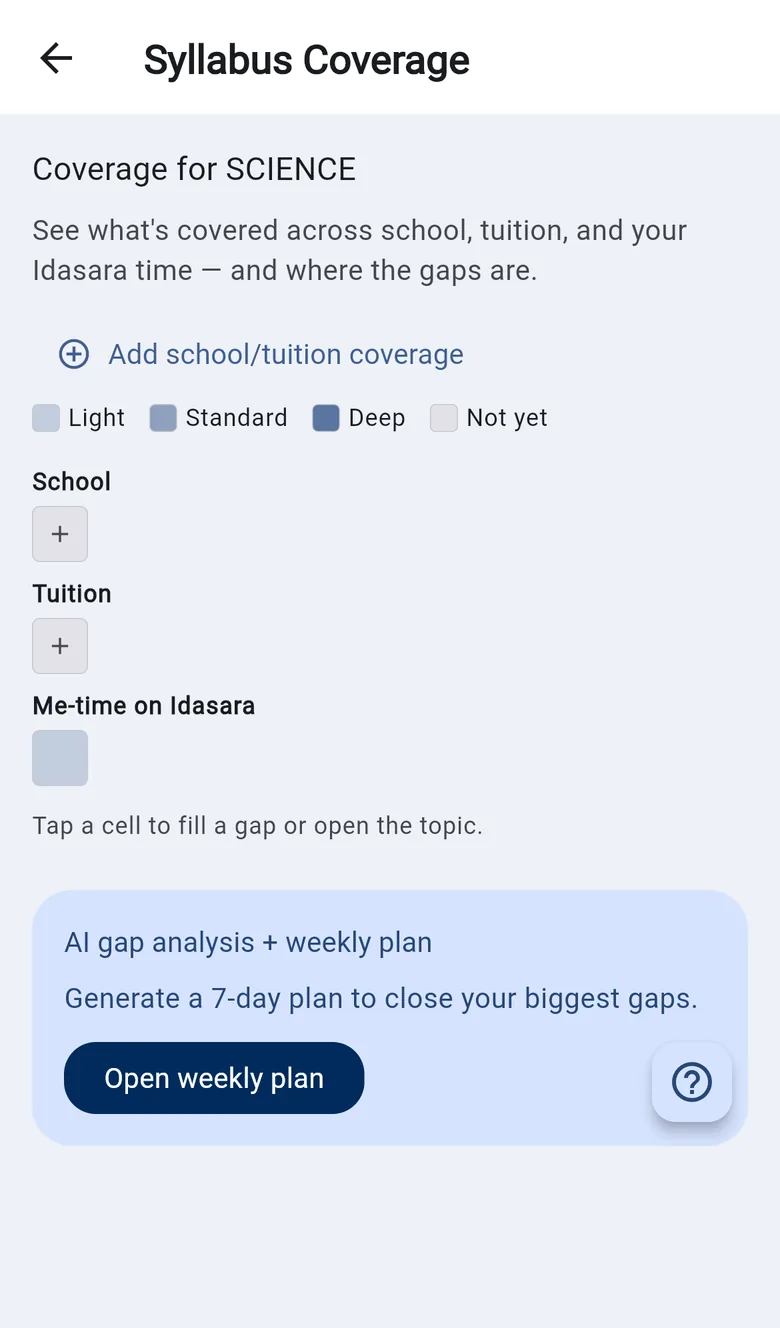
Visibility is the parent side of everything this system does: the parent dashboard — free to open — turns the invisible evening into topics finished, quizzes scored, and mistakes closed; the exam plan adds the per-subject traffic light, richer alerts, and an opt-in WhatsApp digest in your language. Shared-device homes get free PIN-separated profiles. One honest boundary, stated as always: the dashboard shows activity and results, not sincerity — pair it with the two-minute screen-off check from the AI chapter ("explain it to me"), and the picture is complete. Suspicion retired; the evening fight replaced by a screen two people read together.
Start Free — Create Your Account →
FAQ
Isn't a parent dashboard just surveillance with better manners? The difference is structural: surveillance is secret, one-directional, and verdict-seeking; shared instruments are known, co-owned, and diagnosis-seeking. The child sees the same screen, keeps the instruments, and benefits first from what they show. One watches a suspect. The other reads a scoreboard together.
Shouldn't I simply trust my child? Trust isn't the alternative to evidence — it's the product of it. "Trust me" demanded nightly convinces no one; a tracker kept honestly for a term builds trust nothing can shake. And trust without instruments abandons the child who is genuinely stuck and hiding it — the loving version of looking away.
We don't use the app. Does this chapter still work? Fully — the wall-tracker, the marked papers, and the weekly questions are the same machine in paper. The app removes the bookkeeping and adds the traffic light; the principle — evidence over doorway verdicts — costs nothing.
What if my child refuses to share any visibility? Start by asking why, gently — refusal usually guards either autonomy or a struggle they're ashamed of. Offer the trade explicitly: visibility in exchange for the end of accusations and nagging. Most students take that deal gratefully once they believe it; it's a better contract than the one they're living under. If shame is what surfaces, the parents' chapters — and patience — are the road.
The blame in our house comes from my husband — he's barely home, and his only contact with the studying is the verdict at the door. What do I do? This is one of the commonest shapes of the cycle: the parent who sees least judges hardest, precisely because they see least — fear always guesses low, and an absent eye has only fear to go on. Don't argue about the child; change what the judging parent sees. Put the wall-tracker where the doorway verdict happens. Hand over the marked paper, not the defence. If the dashboard runs, make its weekly digest arrive on his phone. Most verdict-givers soften within weeks of having actual evidence in front of them — the verdicts were never cruelty — they were guesses made in the dark. And where they don't soften, the child now has a public record that outvotes the doorway.
My daughter studies less visibly than my son ever did — but her day is also full of housework his never was. Then before judging her studying, count her hours honestly. In many households a girl's chores are simply invisible — absorbed, expected, unnamed — and the same parent who says "I never see you studying" also never quite sees the sweeping, the younger siblings minded, the kitchen shift. The working-student chapter's arithmetic applies inside the family: protected study time is a household decision, and it must be protected equally. If the evening has one free hour and hers is spent on duties, the fix isn't a lecture about effort — it's a redistribution the whole household agrees to, out loud.
Further reading
The instruments behind the shared screen — tracker, marked papers, mistake bank, readiness — are this book's Parts 5 and 6, and the parent's full playbook is How to Help Without Hovering. The method write-up: Part 3 — The Grade Progression Ladder & Paper Marking.
Sources
- What Parents Ask — Why is my child not studying for his exams? (fear of failure as the root; blame amplifies it)
- NHS — Help your child beat exam stress (listen without criticising; support over pressure)
- Dunlosky, J. et al. (2013) — overview at the Association for Psychological Science (why impressive-looking studying isn't the effective kind)
- The Idasara Method: Part 3 — The Grade Progression Ladder & Paper Marking