"Everyone Is Better Than Me": The Comparison Trap and the Race You're Actually In
The short answer: The exam that matters is graded against the syllabus and marking scheme, not against your classmates — the whole class could earn the A. The topper's lead is history plus method, never fixed essence: copy the method, and measure yourself against last month's you instead of against Nimal.
A chapter of the free book Learn to Learn
Published 2026-08-31 · updated 2026-08-31
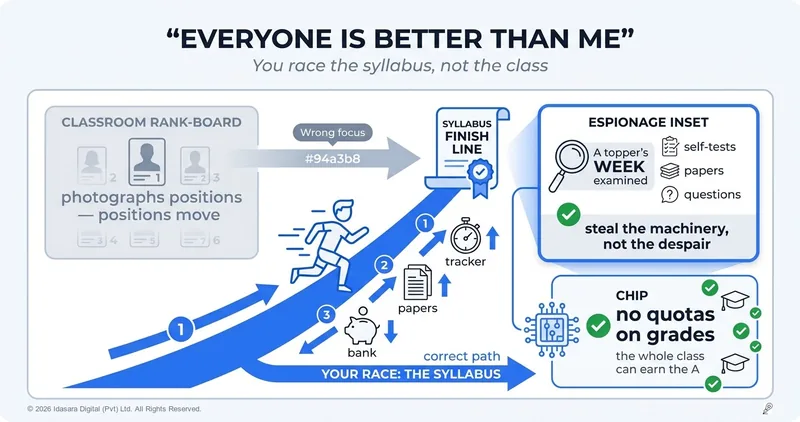
Every classroom manufactures it: the ranks, the read-aloud marks, the cousin's results at every family gathering — until a student's inner voice is just a scoreboard of other people's names. This chapter of Learn to Learn dismantles the trap: what ranks actually measure (less than you think), why the exam you'll sit doesn't work like your classroom, and how to redirect the comparing instinct — which won't switch off — toward the one comparison that compounds.
Here is the sentence that quietly runs thousands of studying lives: "What's the point? Nimal is just better."
It sounds like humility. It works like poison — because "they're better" gets silently read as fixed ("they have it; I don't" — the talent story this book has spent ninety chapters dismantling), and a fixed gap makes effort feel absurd. The comparison trap isn't the noticing — noticing is human and permanent. The trap is the conclusion.
So let's attack the conclusion, three ways: what the scoreboard actually measures, which race you're actually running, and where to point the comparing instinct instead.
What does the visible scoreboard actually measure?
The classroom's ranks and read-aloud marks feel like measurements of minds. Look closer at what they aggregate: years of different starting lines (the topper's home tutoring since Grade 3, the English spoken at their dinner table, the quiet room — Hard Mode documented what these are worth), different current methods (you've learned by now that "naturally bright" is usually machinery you couldn't see — the topper self-tests; the ranks can't show that), and a moment in time — a rank is a photograph of positions, and this whole book is the documented case that positions move (the comeback chapters are full of students the December rank couldn't have predicted from the March one).
None of this means the topper isn't genuinely ahead — they are, today. It means the gap is made of history and machinery, not essence — history you can't change, machinery you can copy. Which converts the only useful thing a rank ever tells you: not where you stand but whose methods to steal. Watch the topper's actual week (not their marks): the self-quizzing, the papers done, the questions asked. That's espionage worth doing. The despair never was.
Which race are you actually in?
Here is the arithmetic the classroom hides: the national exam is not graded against your classmates. Your grades are earned against the syllabus and the schemes — the ladder chapters' whole machinery — and there are no quotas in a subject grade: every student in your class could earn the A; every one could miss it. The student beside you is not your rival for marks; the marking scheme is your only counterpart. (The A/L's Z-score is relative — but to the national stream cohort of tens of thousands, against which your classroom's pecking order is statistical noise. The Z chapter's advice was never "beat Nimal"; it was "protect your floor.")
So the racing question changes shape: not "am I ahead of them?" but "am I ahead of where I was, against the syllabus's calendar?" — and that question has instruments: the tracker — your syllabus checklist — the marked papers, the shrinking mistake list. This is why this book kept building you personal dashboards: a student with their own instruments checks the class scoreboard the way you'd check the weather somewhere else — occasionally, and without it changing the day's plan.
Redirecting the instinct (it won't switch off)
Comparison is ancient equipment; it doesn't uninstall. It re-aims:
- Compare backwards — you vs you. Last month's paper vs this month's; the streak's length; the bank's balance — your logged-mistake count — then and now. This is the comparison that motivates by design, because you control every input (the motivation chapter's visible-progress machinery is exactly this).
- Compare process, not position. In a study group, or with a friend: papers-completed, questions-brought, streak-days — scoreboards where effort shows and compounding is visible to everyone. Process comparison lifts; position comparison sorts.
- Curate the feed — the digital version of the trap deserves one blunt paragraph: exam-season social media is a highlight reel of everyone else's best moments consumed at your worst ones (nobody posts their blank-page failures — the self-tests that went wrong). The feed chapter's defences apply; exam-season muting of the performative accounts is self-care, not weakness.
And for the household: the cousin-comparison at family gatherings — "Nimal got nine A's, ah?" — deserves retirement, and the parents' chapters armed your family with its replacement (process praise, the instruments, the relatives-armor line). Parents comparing children build exactly none of the machinery and all of the poison; the visibility chapter's tools give worried families something real to look at instead.
Do this week
- Run the espionage properly, once: pick the student you envy most and study their week, not their marks. Steal two pieces of machinery. Thank them, even — most toppers explain their systems gladly (and the teaching helps them too; the group chapter told you why).
- Install the backwards comparison: one page — this month's numbers (papers, streak, bank balance) beside last month's. Date it; repeat monthly.
- Mute the performative accounts for the season. Notice, after a week, what your baseline mood does.
At a glance
- The trap isn't noticing the gap — it's concluding it's fixed. Gaps are made of history (unchangeable) and machinery (copyable), not essence.
- Ranks photograph positions; positions move — this book is the documented proof. A rank's only useful output: whose methods to steal.
- The national exam grades you against the syllabus, not your classmates — no quotas on grades; the whole class can earn the A. (The Z is relative to tens of thousands, not to Nimal.)
- Re-aim the instinct: backwards (you vs you, on instruments) · process, not position (papers, streaks, questions) · curated feeds in season.
- Families: retire the cousin-comparison; the instruments replaced it.
One step further with Idasara Academy
The anti-rank dashboard is the product's design: your streaks, tracker and Mistake Bank — free, with the exam plan's Readiness Score on top — measure you against the syllabus and your own last month: the race you're actually in. The classroom's weather stays outside; your instruments face the only counterpart that grades you.
Start Free — Create Your Account →
FAQ
But my school openly ranks us and reads marks aloud. I can't opt out of the scoreboard. You can't opt out of hearing it; you can opt out of steering by it — that's what the instruments are for. Treat the announced rank as the espionage trigger (whose machinery moved this term?) and the backwards page as the real report card. Students who run both describe the announcements losing their sting within a term — weather, somewhere else.
What if the backwards comparison also shows no progress? Then it's done its honest job: your machinery needs changing, not your essence — and this book is a hundred chapters of what to change (the audit chapters find the leak; the comeback chapters rebuild the floor). No-progress on instruments is a diagnosis, and diagnoses have treatments. One boundary, said plainly: if the "everyone is better than me" feeling has become a heaviness that instruments can't touch — weeks of it, sleep and appetite going with it — that's not a comparison problem, and the answer is a person, not a chapter: a parent, a teacher you trust, a doctor. Telling someone early is a strength.
Isn't some competition healthy? Our whole batch runs on it. Rivalry that trades methods and celebrates process is the healthy strain — the group chapter's machinery formalises it. The test: does your rivalry make the loser study more or less? Healthy competition survives losing; the toxic strain converts every loss into the fixed-gap conclusion. Choose rivals who share systems, not ones who guard them.
As a parent, I compare because I'm scared — how do I stop? (for parents) Name the fear underneath (it's love, badly routed — the parents' chapters' opening truth), then give it instruments instead of cousins: the traffic light, the weekly evidence questions, the process praise. Fear with a dashboard becomes support; fear without one becomes Nimal's nine A's at dinner — and you've read what that builds.
Further reading
The machinery this chapter redirects toward: Motivation That Survives Monday (visible progress) · Grades Are a Ladder, Not a Lottery (the syllabus race) · The Z-Score (what's actually relative). The family's part: "I Never See You Studying".
Sources
- Dunlosky, J. et al. (2013) — overview at APS (visible-method differences behind "talent")
- NHS — comparison, pressure and the exam-season mind
- The Idasara Method: Part 3 — The Grade Progression Ladder & Paper Marking (graded against the scheme, not the class)