Grades Are a Ladder, Not a Lottery
The short answer: An A pass is manufactured by specific actions in a fixed order: read the official textbook for every topic, do the exercises and get them checked, practise under exam conditions, then work through full past papers — around ten for O/L — while systematically eliminating your repeated mistakes. Talent appears on none of these rungs; the route is public and open to any student.
A chapter of the free book Learn to Learn
Published 2026-08-31 · updated 2026-08-31
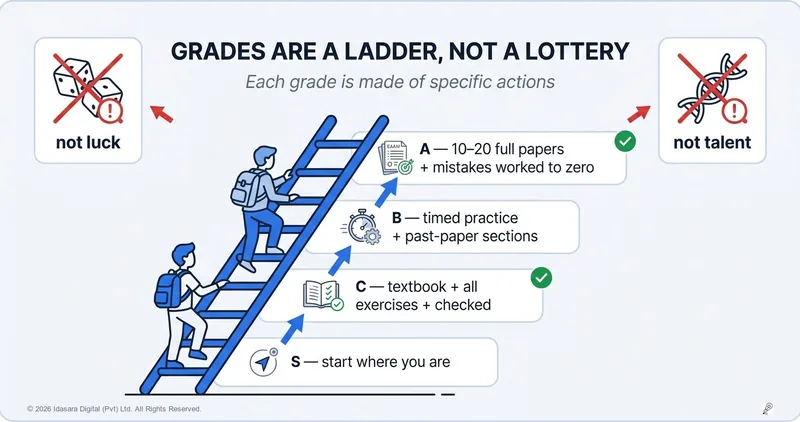
Exam grades look like verdicts on talent, but each grade band corresponds to a specific, known set of study actions — a ladder anyone can climb one rung at a time. This chapter of Learn to Learn shows what each rung is made of, and why the climb from an S to an A is a route, not a jackpot.
Results day. Two families open two slips of paper.
One slip says A. The neighbours nod knowingly: "That child was always gifted." The other slip says S — a simple pass. And the quiet explanation forms around that child like weather: "Well… not everyone is made for studies."
Both explanations point at the child. Both are wrong. Here is the question nobody at either doorstep asks: what, exactly, did each student's evenings look like for the past year?
Because grades are manufactured in those evenings — by specific actions, in a specific order. And once you see the manufacturing process, the mystery of the "gifted" child dissolves into something far more hopeful: a ladder, with visible rungs, that was always standing there for everyone.
What is each rung made of?
Let's describe the ladder plainly — not as motivation, but as mechanics. Ask what an exam paper is: questions built from the official syllabus, at baseline and stretch difficulty, marked against a scheme that rewards specific knowledge, method, and presentation. Then each grade band simply corresponds to how much of that machine you've matched:
The rung to a solid pass and onward to a C is made of three humble actions: read the official textbook for every topic, do the end-of-chapter exercises on paper, and get every attempt honestly checked. Nothing glamorous. But complete coverage plus baseline problem-solving is precisely what the majority of any paper's marks are offered for. A student who genuinely does these three things across the whole syllabus has not "hopefully passed" — they have built the paper's foundation marks, action by action.
The rung from C to B adds practice under exam conditions: revision questions against the clock, sections of real past papers, answers checked against real marking standards. Here the student stops merely knowing things and starts performing them — retrieving at speed, in exam format, on paper. Self-testing under realistic conditions is, not coincidentally, the most strongly evidence-backed study technique known.
The rung from B to A is the one the myths are made of, and it is the most mechanical of all: volume of full past papers — on the order of ten for O/L, twenty for A/L — under strict conditions, plus one discipline almost no struggling student practises: systematically eliminating your own repeated mistakes. Every marked paper produces a list of exactly where you lose marks. The A-student's secret is that this list, not the comfortable topics, is what they study. They hunt their weaknesses until the list is empty. That's it. That is the famous "gift."
Notice what appears nowhere on any rung: talent, luck, a special brain. And notice the ladder's most liberating property — you cannot skip rungs, but you also cannot be denied one you've built. The order is fixed; access to it is not.
Why does the lottery story survive?
If it's a ladder, why does everyone keep calling it a lottery — or genetics?
Because the climbing is invisible. The A-student's classmates see the result, not the two hundred evenings of textbook-exercises-marking-papers-mistakes that produced it. Effort compresses into an adjective: gifted. Meanwhile the S-student — who may have spent just as many exhausted hours re-reading and copying notes — concludes from their own genuine effort that effort must not be the answer. As this book's opening chapter argued: their fuel was real; the engine was wrong. The ladder isn't climbed by hours. It's climbed by those particular actions.
The lottery story survives because it excuses everyone. The ladder story is harsher — it says the route was always public — and infinitely kinder: it says the route is still public, and open, including to you, including this term.
Where are you on the ladder — really?
Try this honest self-placement. For your weakest subject, answer with evidence, not feelings:
- Have I read the official textbook for every topic covered so far — or are there chapters I've only met through tuition notes?
- Have I done (not read) the end-of-chapter exercises — and had them checked?
- Have I attempted real past-paper questions under time?
- Do I have a written list of my repeated mistakes — and is it shrinking?
Most students discover something surprising: they are standing lower on the ladder than their hours suggest, because their hours went into actions that aren't rungs. That discovery is not bad news. It means the next rung is visible, cheap, and yours.
Do this tonight
- Pick the subject whose grade you most want to change.
- Run the four questions above. Write the honest answers.
- Identify your current rung — the first question you answered "no" to.
- Do one hour of that rung's work — not the rung you wish you were on. If textbook coverage has gaps, read one missing chapter. If exercises are undone, do one set. The ladder only moves under your actual feet.
At a glance
- Each grade band is manufactured by specific actions: textbook + exercises + checking → solid pass/C; + timed practice → B; + full past papers (≈10 O/L / ≈20 A/L) + systematic mistake elimination → A.
- Talent appears on no rung. The "gifted" student is a student whose climbing you didn't see.
- Hours don't climb the ladder; rung-actions do — which is why exhausted students can stay stuck.
- You can't skip rungs, and you can't be denied one you've built. The route is public.
- Find your real rung with evidence (coverage? exercises? papers? mistake list?) — then work that rung.
One step further with Idasara Academy
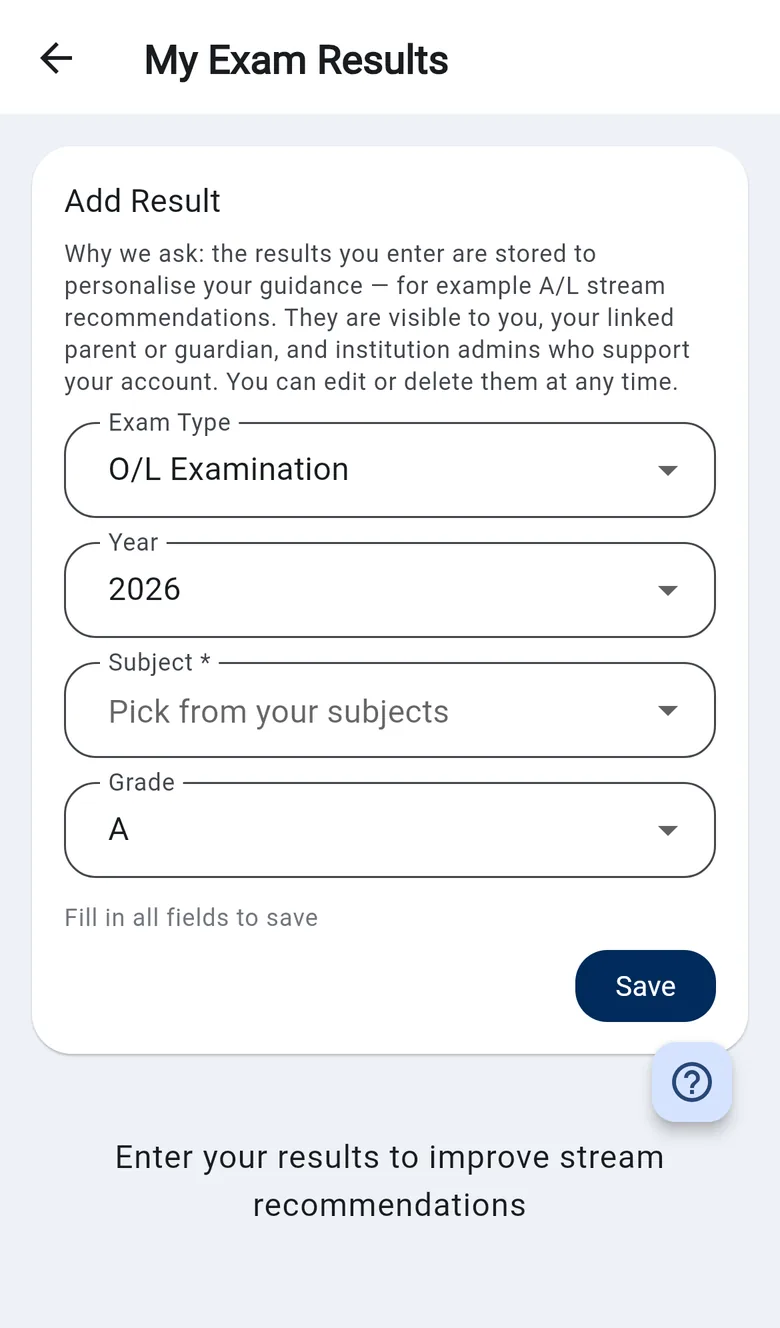
Self-placement is hard to do honestly — feelings keep grading themselves. Start free with the curriculum browser: your grade's full syllabus tree, term by term, where "have I really covered everything?" stops being a feeling. On the exam plan, the Readiness Score then does the whole placement with evidence — coverage, marked answers, and open mistakes aggregated into a live 0–100 measure per subject. The ladder, with a position marker on it.
Start Free — Create Your Account →
FAQ
Isn't some of it genuinely talent? Some students just grasp things faster. Speed of first understanding varies, yes — but national exams don't measure first-understanding speed. They measure accumulated, retrievable, well-presented knowledge, which the ladder's actions build for anyone. A slower start on the same rungs reaches the same height; it's the rungs that are non-negotiable, not the pace.
I'm in the final months before the exam. Is the ladder still climbable? The rungs compress but don't change: coverage gaps first (they cap your maximum), then past papers with ruthless mistake-hunting. What months of runway buys is comfort; the order of actions stays identical. Start where the ladder actually finds you.
My child works so hard but stays on an S. Should we accept their level? (for parents) Ask a different question first: which rungs do those hours contain? Hours of re-reading and tuition-attendance can be full of love and empty of rungs. Before accepting any verdict on the child, check whether the four rung-questions above have ever genuinely been "yes."
Does the ladder apply beyond O/L and A/L? Everywhere. University, professional exams, learning a trade — every assessed skill has its version of coverage → practice → volume → weakness-elimination. Learn to see rungs once, and you'll find them for the rest of your life.
Further reading
The full grade progression ladder — with the exact C, B, and A protocols and how marked papers feed the climb — is in the Idasara Method: Part 3 — The Grade Progression Ladder & Paper Marking.
Sources
- Dunlosky, J. et al. (2013). Improving Students' Learning With Effective Learning Techniques — overview at the Association for Psychological Science (practice testing top-rated)
- UCLA Bjork Learning and Forgetting Lab — research overview on testing and spacing
- The Idasara Method: Part 3 — The Grade Progression Ladder & Paper Marking